
Wall Street closed out a strong week with broad gains across all three major indices as market participants digested better-than-expected inflation data and prepared for the Federal Reserve’s upcoming interest rate decision. The S&P 500 (SPY) rose 1.94% for the week, the Nasdaq (QQQ) advanced 2.18%, and the Dow Jones Industrial Average (DIA) climbed 2.26%, positioning each index at record territory.
The week’s rally gained traction following a below-forecast inflation reading on Friday, which reinforced market expectations for additional rate cuts ahead. This softer-than-anticipated Consumer Price Index report eased concerns about sticky inflation and solidified the 98% probability the Federal Reserve is pricing into a 25-basis-point rate cut at its meeting scheduled for October 28-29.
The earnings season, now in full swing, delivered a mixed picture. Major financial institutions led initial reporting with JPMorgan Chase, Bank of America, and Wells Fargo all beating analyst expectations, with combined investment banking revenues surging higher. However, regional-bank weakness resurfaced as a cautionary tale for credit markets. Zions Bancorp disclosed about $50 million in charge-offs tied to alleged loan fraud, while Western Alliance Bancorp revealed a related lawsuit over bad loans, sparking renewed concerns about regional credit exposure and commercial-mortgage-linked borrowers.
Tech stocks extended their rebound through the week after a weak September, with gains driven by optimism in large-cap names. Apple led the sector after research reported that early sales of the iPhone 17 outpaced the previous generation in both the U.S. and China. Broader market strength also lifted consumer-discretionary names like Amazon, as U.S. equities posted their largest weekly gains since August, reflecting improving sentiment toward corporate earnings and consumer resilience despite ongoing economic uncertainties.
Looking ahead, the coming week stands as a critical inflection point for markets, with the Federal Reserve’s policy decision taking center stage. Equally important will be mega-cap earnings reports from the technology sector, including Apple, Microsoft, Amazon, Meta, and Alphabet, which collectively represent roughly one-quarter of the S&P 500. These reports will be scrutinized for management guidance on capital expenditures related to artificial intelligence investments and commentary surrounding consumer spending trends heading into the final months of the year.
With markets now positioned at record highs and valuations elevated, investors will be closely monitoring whether fundamental earnings growth can sustain recent momentum.
How This Impacts You
When interest rates were around 5% last year, having a high-yield savings account made a lot of sense because savings actually earned something meaningful. Now that rates are expected to decline, those returns will likely start to shrink. As things change, you might notice how shifts in interest rates can influence where your money grows most effectively.
Note: Economic data releases remain on hold because of the government shutdown and any that are postponed are not shown here.
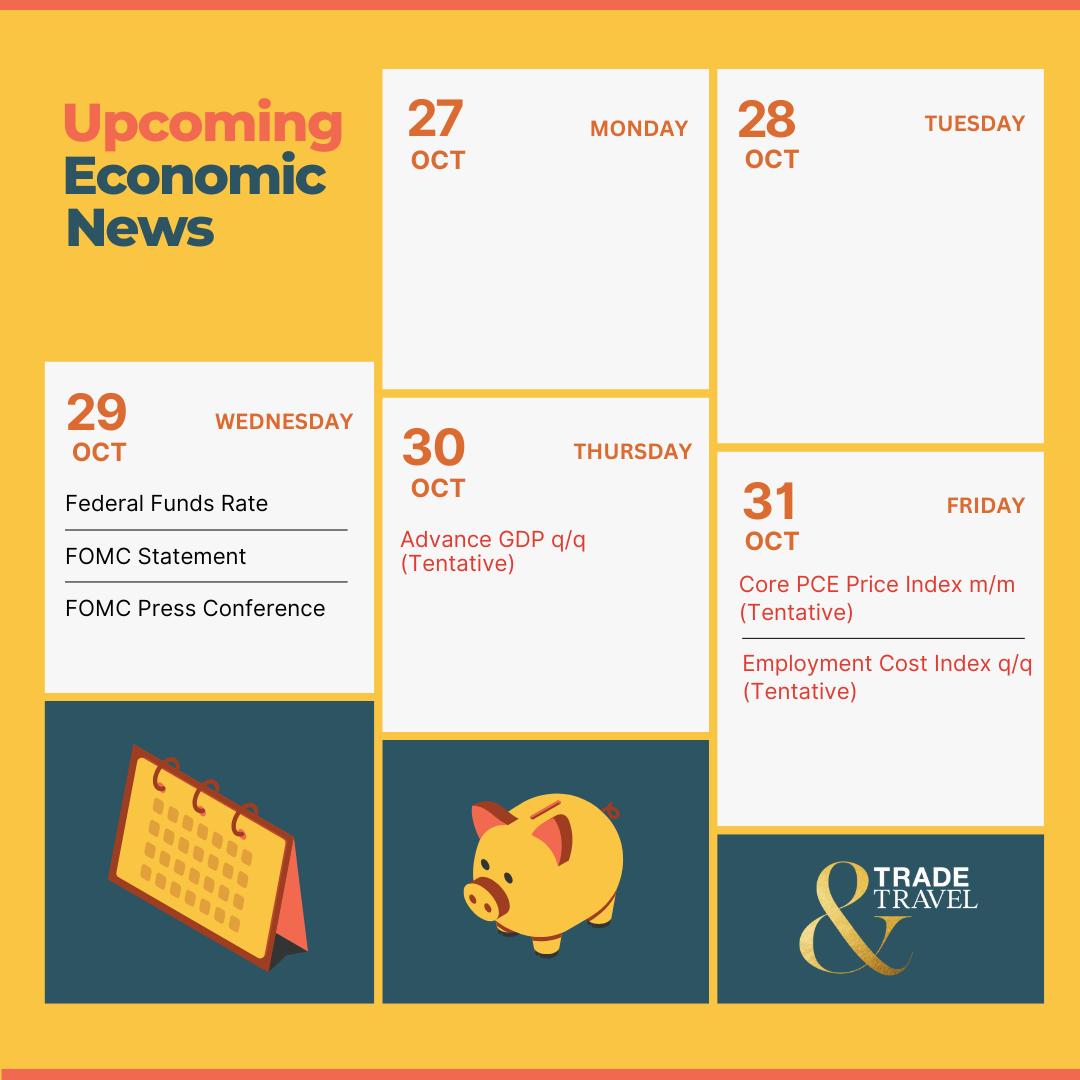
📅 Wednesday, Oct 29th
- FOMC Statement, Press Conference, and Federal Funds Rate:
The Federal Reserve is expected to cut interest rates by 25 basis points at its October 28-29 meeting, bringing the federal funds rate down to a target range of 3.75% to 4.00%. Market pricing data from CME Group shows a 98.3% probability of this quarter-point reduction, which would mark the second consecutive cut following September’s 25 basis point decrease that lowered rates to the current 4.00% to 4.25% range.
Market participants should watch for several key elements in Fed Chair Jerome Powell’s post-meeting press conference, including forward guidance on whether the committee will deliver the widely anticipated third cut in December, bringing rates to 3.50% to 3.75% by year-end.
Another critical focus will be how policymakers address the ongoing government shutdown’s impact on economic data availability, particularly the absence of September employment figures, which has obscured their view of labor market conditions that motivated the initial rate cut.
Additionally, markets will scrutinize any dissenting votes, especially from newly appointed Governor Stephen Miran, who voted for a larger 50 basis point cut in September and may dissent again, or from hawkish members concerned about inflation running at 3.0% for headline CPI and 3.1% for core CPI, both above the Fed’s 2.0% target.
Finally, traders should monitor for any announcement regarding the potential end of quantitative tightening (balance sheet reduction), which Powell hinted could conclude “in the coming months” as bank reserves decline and money market pressures emerge. This decision would help prevent liquidity constraints while maintaining ample reserves in the financial system and would represent a significant shift in monetary policy beyond just the interest rate path.
📅 Thursday, Oct 30th
- Advance GDP q/q (Tentative): The U.S. Advance GDP report for the Q3 is expected to show a moderation in economic growth to 3.0% on a quarter-over-quarter annualized basis, down from the robust 3.8% expansion recorded in Q2 2025.
This deceleration follows a particularly strong second quarter that benefited from a sharp reversal in trade patterns and inventory adjustments. Market participants should focus on four key components when analyzing the report. First, consumer spending, which accounts for roughly two-thirds of GDP, will be critical to watch as any slowdown in personal consumption expenditures (PCE) could signal weakening household confidence despite the solid 2.5% growth seen in Q2. Second, business investment and inventory changes warrant close attention, as the Q2 advance estimate showed private inventories dragging down growth, and further deceleration in inventory accumulation could subtract significantly from headline GDP growth even if absolute inventory levels remain positive.
Third, net exports (exports minus imports) will be a major factor, since the sharp import decline in Q2 artificially boosted growth, and any normalization of trade flows could reduce GDP contributions. Finally, traders should monitor the GDP price index and core PCE inflation readings within the report, as these will influence Federal Reserve policy expectations and market volatility, particularly given that inflation has been moderating from the 3.7% PCE price increase in Q1 to just 2.1% in Q2.
📅 Friday, Oct 31st
- Core PCE Price Index m/m (Tentative): The upcoming Core PCE Price Index month-over-month report shows forecast and previous readings both holding steady at 0.2%, signaling contained near-term inflation pressure in consumer prices excluding food and energy.
The Federal Reserve closely monitors this data as its preferred inflation gauge, and with the annual rate hovering around 2.9%, the core PCE remains elevated relative to the Fed’s 2% target. Market participants should focus on whether the monthly reading holds at 0.2% or surprises in either direction, as this metric directly influences expectations for future rate-cut decisions. A matched forecast to the previous month suggests market consensus expects stable underlying price pressures, which would likely be viewed favorably for potential continued monetary easing if overall economic conditions support it.
- Employment Cost Index q/q (Tentative): The Employment Cost Index for Q3 of 2025 is expected to show compensation costs increasing 0.9% quarter-over-quarter, matching both the previous quarter’s reading and market expectations, with the annual pace projected at 3.7% compared to 3.6% in Q2 2025.
According to the Bureau of Labor Statistics, the Employment Cost Index showed that wages and salaries increased 1.0% in Q2 of 2025, up from 0.8% in Q1. Benefit costs rose 0.7% in Q2, following a 1.2% increase in Q1. The total Employment Cost Index for civilian workers increased 0.9% over the quarter and 3.6% over the year ending June 2025.
The Federal Reserve monitors the ECI as one indicator of labor cost trends when assessing inflation and overall labor market conditions. The index provides a broad measure of changes in employer labor costs, helping economists evaluate whether compensation pressures are contributing to inflationary dynamics within the economy.
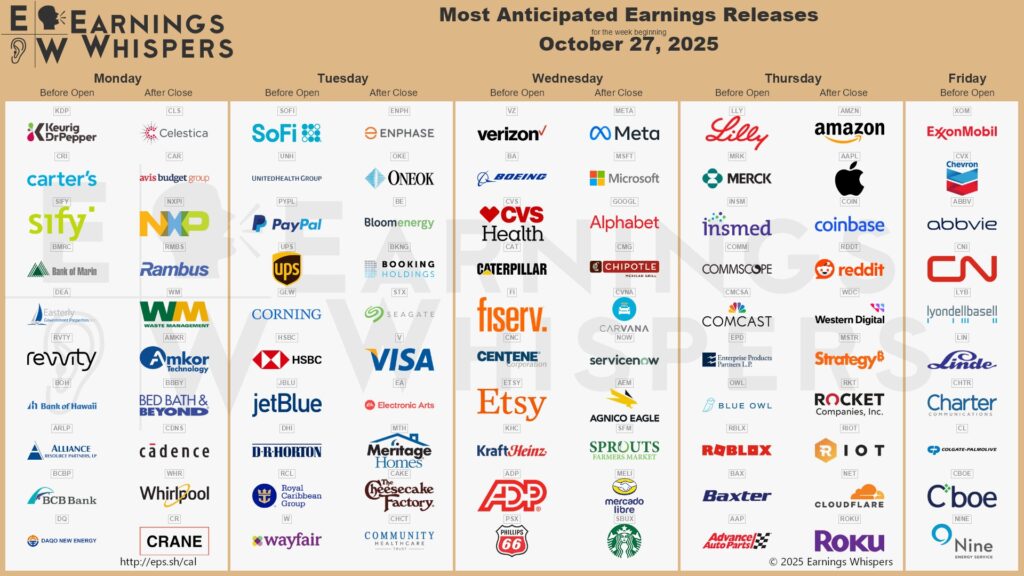
💼 This week launches the heart of earnings season, with major U.S. banks having already kicked things off and a broad cross-section of companies scheduled to report across sectors through the week.
📅 Wednesday, Oct 29th
- Microsoft Corp (MSFT): Microsoft is scheduled to report its first-quarter fiscal 2026 earnings. Analysts expect the software giant to post earnings per share (EPS) of $3.67, representing approximately 11.2% year-over-year growth, on revenue of $75.37 billion.
The Intelligent Cloud division is projected to generate $30.26 billion in revenue, a 25.6% increase from the prior-year quarter, with Azure cloud platform growth forecast at 36-39% in constant currency as demand for AI infrastructure continues to accelerate. Market participants should closely monitor Azure capacity constraints, which management has indicated will persist through the first half of fiscal 2026, capital expenditure levels expected to exceed $30 billion in Q1 as Microsoft scales data centers and AI infrastructure, and the revenue contribution from Copilot adoption, which analysts projects could add approximately $25 billion to revenue by FY26.
- Meta Platforms, Inc. (META): Meta Platforms will release its Q3 2025 results, with analysts expecting the social media giant to deliver strong topline growth driven by AI-powered advertising improvements and robust platform engagement across its 3.48 billion daily active users.
Analysts’ revenue estimates sit at $49.49 billion, representing 21.9% year-over-year growth, with management guidance ranging from $47.5 billion to $50.5 billion. Earnings per share are projected between $6.72, reflecting an 11.4% increase from $6.03 in Q3 2024.
Beyond headline growth, investors will focus on how effectively Meta converts its expanding ecosystem into sustainable profitability. Management has highlighted the rapid adoption of Meta AI, which now exceeds one billion monthly active users, and the growing impact of generative AI advertising tools, described as driving a meaningful share of ad revenue.
Attention will also turn to operating efficiency, as continued infrastructure spending and AI-related investments could weigh on margins even as engagement trends remain strong. Reality Labs losses continue to widen, with Meta reporting a $4.53 billion operating loss in Q2 2025 compared with $4.43 billion a year earlier, reinforcing investor focus on the long-term monetization potential of AR and VR initiatives. The company has also raised its 2025 capital expenditures outlook to between $66 billion and $72 billion to support data center expansion and AI model development.
- Alphabet Inc (GOOGL): Alphabet will report its Q3 2025 financial results, with Wall Street consensus expecting earnings per share of $2.27, representing 7.1% year-over-year growth from the prior year’s $2.12, while revenue is anticipated to reach approximately $99.95 billion, marking 13.2% expansion driven by robust advertising and cloud segments.
The company’s core Search and other revenues business is projected to grow 11.5% to $55.09 billion, fueled by AI-powered features like AI Overviews reaching over 2 billion monthly users across 200 countries and the Circle to Search capability now active on more than 300 million devices, which collectively drive more than 10% additional query volume globally.
Google Cloud is expected to deliver particularly strong performance with revenues anticipated to be around $14.66 billion, reflecting accelerating 29.1% year-over-year growth as enterprises demand AI infrastructure and solutions, though investors will closely monitor operating margin expansion amid heavy capital expenditure investments. A critical area of investor scrutiny will be Alphabet’s rising capital expenditure guidance, with the company recently raising 2025 capital expenditure estimates to $85 billion from $75 billion to fund AI data center buildout and AI research, potentially pressuring near-term operating margins despite robust top-line growth.
📅 Thursday, Oct 30th
- Apple Inc (AAPL): Apple will report its fiscal Q4 2025 earnings, where CEO Tim Cook and CFO Kevan Parekh will discuss results and take analyst questions. Wall Street consensus expects revenue of approximately $102 billion and earnings per share of $1.77, representing 7.5% revenue growth and 7.9% EPS growth year-over-year compared to Q4 2024.
The market will closely scrutinize Apple’s iPhone performance, particularly given the strong early demand for the newly launched iPhone 17 series, which has demonstrated sales growth 14% higher in the first 10 days compared to the iPhone 16 in key markets including China and the U.S. Gross margin management remains critical, as management previously guided to a 46-47% range despite tariff headwinds estimated at approximately $1.1 billion in Q4, alongside expectations for continued double-digit Services segment growth toward a consensus target of $28.2 billion.
- Amazon.com, Inc. (AMZN): Amazon is set to report its Q3 2025 earnings, with Wall Street expecting revenue of $177.88 billion (a 12% year-over-year increase) and earnings per share of $1.57 (9.7% YoY growth).
Market participants should closely scrutinize AWS operating margins and growth acceleration, as the cloud division saw margins compress to 32.9% in Q2 2025 from 39.5% in Q1, despite AWS revenue reaching $30.9 billion with 17.5% YoY growth that slightly trailed competitors like Microsoft Azure (39% growth) and Google Cloud (32% growth).
The advertising business reported $15.7 billion in services revenue in Q2 2025, an increase of 23% year over year, which includes sponsored, display, and video ads. This has been a key contributor to operating income growth across retail segments, and management has continued to highlight momentum in sponsored and video ad formats as the business expands. Amazon’s capital expenditure guidance and management’s confidence in data center capacity expansion are essential to monitor, as the company projects annual capital expenditure of approximately $118 billion to support AI and cloud infrastructure investments, signaling management’s aggressive positioning in the AI arms race against Microsoft and Google.
We hope this helps and happy trading!
– Trade and Travel Team
Related Blogs




Follow Us
Testimonials
Hear from students on why they chose the Trade and Travel Family and how it has changed their lives.

