

Last week, financial markets delivered a vivid reminder that volatility remains elevated across asset classes. The S&P 500 (SPY) fell about 1.28% for the week, while the tech-heavy Nasdaq (QQQ) slid roughly 1.27% over the same period. The Dow Jones (DIA) declined about 1.15%, though the index had earlier crossed the symbolic 50,000 threshold for the first time, a milestone that drew significant attention from both retail and institutional investors.
The week was largely driven by macroeconomic data and shifting interest rate expectations. Economic releases and commentary around inflation and growth contributed to pressure on technology and growth-oriented names, pushing the Nasdaq lower earlier in the week before markets stabilized into the close. Sector performance showed periods of rotation, with industrials and energy helping cushion broader index declines even as major benchmarks finished the week in negative territory.
Looking ahead, investors enter a data-heavy stretch. Upcoming jobs data and fresh inflation prints are expected to shape perceptions of the Federal Reserve’s policy path and influence both bond yields and equity valuations. Earnings season also continues, with additional S&P 500 companies scheduled to report, keeping attention on revenue trends, margin guidance, and forward outlooks. The recent relative resilience of the Dow compared with the Nasdaq reflects ongoing sector rotation, a dynamic that will likely remain sensitive to incoming economic data and corporate commentary.
How This Impacts You
With rotation shifting between AI-heavy tech and cyclical sectors like industrials and energy, you might watch closely for which areas continue to show sustained follow-through rather than assuming leadership will stay the same. As jobs and inflation data come out this week, you may notice increased volatility, which can influence how patient you choose to be before entering a setup. In weeks like this, staying anchored to your defined setup and letting price validate the move can help you remain consistent in a fast-moving market.
📅 Thursday, Feb 19th
- FOMC Meeting Minutes: The upcoming FOMC minutes from the January 27–28 meeting will provide additional detail on policymakers’ decision to keep the federal funds target range at 3.50% to 3.75%, following three consecutive 25 basis point rate cuts in late 2025. The January statement acknowledged that inflation remains above the Federal Reserve’s 2% target, and markets will review the minutes for further clarity on policymakers’ assessment of price pressures and the broader economic outlook.
The January decision included two dissents from officials who favored an additional 25 basis point rate cut, while the majority voted to hold rates steady. Investors will also review any discussion related to the Federal Reserve’s balance sheet policy and normalization process, as well as commentary on labor market conditions and overall economic growth, which were referenced in the official statement.
- Unemployment Claims: The upcoming U.S. Unemployment Claims report will follow the latest release showing 227,000 initial filings for the week ending Feb. 7, according to the U.S. Department of Labor, a level that continues to reflect historically stable claims near recent ranges.
Weekly jobless claims have moved in a consistent range and are widely watched as a high-frequency indicator of labor market dynamics. Economists and market participants note that sustained low claims can signal ongoing labor market resilience, while a notable increase might draw greater attention to shifts in hiring demand. Because labor market conditions remain key inputs into Federal Reserve policy decisions, the data could also influence near-term perceptions of the rate path.
📅 Friday, Feb 20th
- Advance GDP q/q: The upcoming Advance GDP report is expected to show U.S. economic growth slowing from the strong 4.4% pace in Q3, reflecting cooler consumer spending and a drag from weaker inventory accumulation. Analysts expect this moderation in growth, though estimates vary and consensus forecasts are still being finalized.
Traders will watch closely to see if domestic demand remains resilient despite tighter credit conditions and fading fiscal support. A stronger-than-expected GDP print could boost optimism about economic momentum and support risk assets and the dollar, while a weaker-than-expected result could reinforce expectations for Fed rate cuts later this year and weigh on market sentiment.
Investors will also scrutinize real final sales and personal consumption figures to gauge underlying growth strength. Market reactions are likely to hinge on whether the data confirm a soft landing or signal a sharper slowdown heading into 2026.
- Core PCE Price Index m/m: The upcoming Core PCE Price Index m/m report is forecast to rise 0.3% after a 0.2% gain in the previous month, signaling a possible pickup in underlying inflation pressures. This gauge is closely watched by the Federal Reserve as its preferred inflation measure, reflecting changes in consumer spending excluding volatile food and energy categories.
A print above 0.3% could heighten expectations for the Fed to delay rate cuts, pushing Treasury yields and the dollar higher. Conversely, a softer reading at or below 0.2% may reinforce bets on policy easing later this year. Traders will focus on revisions to prior data and annualized trends, which could offer clues about the inflation trajectory into the second quarter.
- Flash Manufacturing PMI: The upcoming Flash Manufacturing PMI is expected to come in around 52.1, slightly below January’s 52.4 reading, which would keep factory activity in expansion territory, as readings above 50 indicate growth. A moderation from the prior month would suggest a slower pace of expansion rather than contraction.
Investors will monitor the new orders and output components, which are commonly viewed as forward-looking indicators of manufacturing activity. Market participants also tend to watch input cost and prices-paid sub-indices for signals related to inflation trends. As an early monthly gauge of business conditions, the flash report provides timely insight into how manufacturing activity is evolving at the start of the first quarter of 2026.
- Flash Services PMI: The upcoming Flash Services PMI, forecast at 52.8 versus the prior 52.7, will offer a key read on the pace of U.S. service-sector growth in February. A result above 50 would confirm continued expansion, with strength signaling resilient consumer and business demand.
Investors will watch for signs of cooling momentum that could ease inflation pressures and influence Federal Reserve rate expectations. A stronger print near or above 53.0 may lift Treasury yields and the dollar as markets price in fewer rate cuts. Conversely, a drop toward 52.0 or below could reinforce a softer outlook and support equities on policy easing hopes.
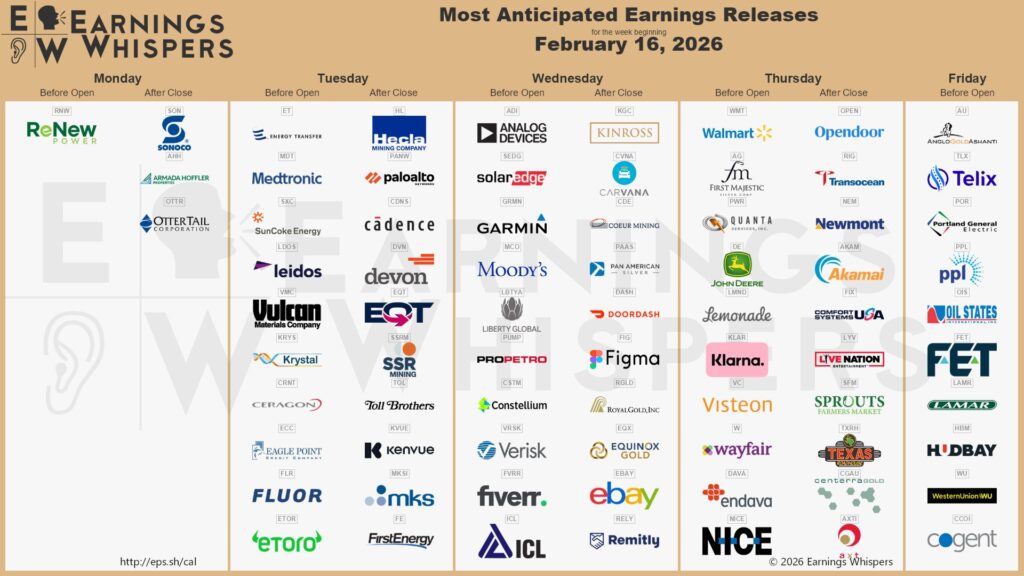
💼 Next week, attention turns to major names in retail, industrials, and cybersecurity. Their results will show how broad the market’s strength really is.
📅 Tuesday, Feb 17th
- Palo Alto Networks, Inc. (PANW): Palo Alto Networks reports fiscal Q2 2026 results, with management guiding revenue to a $2.57–$2.59 billion range, implying roughly 14–15% year-over-year growth. Analysts are forecasting EPS of about $0.94 for the quarter.
Next-Generation Security ARR, which was about $5.9 billion in Q1 FY2026 (up 29% year-over-year), is guided to reach roughly $6.11–$6.14 billion in Q2, and any upside here would reinforce the shift toward higher-quality, subscription-heavy growth. Remaining performance obligations (RPO) are another key line item after the company highlighted an acceleration toward a projected $18.65 billion RPO level for FY2026.
Management has set full-year FY2026 revenue guidance at $10.50–$10.54 billion with operating margins of 29.5–30%, so any change, up or down, to those targets will likely drive the post-earnings move alongside the headline results. Given the stock’s sensitivity to billings and forward metrics, commentary on large multi-year platform deals, consolidation wins, and competitive dynamics versus other next-generation security vendors will also be closely watched.
- Medtronic plc. (MDT): Medtronic is set to report its fiscal Q3 2026 results. Investors will anchor expectations on Q2 FY26 revenue of about $9.0 billion, which grew 6.6% as reported and 5.5% organically, and delivered EPS of $1.36, up 8% year over year.
Segment‑wise, Cardiac Ablation Solutions will be in the spotlight after posting a 71% organic growth surge in Q2 FY26 on the strength of its pulsed field ablation portfolio; investors will want to see if that momentum sustains or moderates. Comparisons to FY25, when company‑wide revenue reached $33.5 billion (3.6% reported, 4.9% organic) and EPS was $5.49 (up 6%), will shape the narrative on whether Medtronic is genuinely accelerating growth or simply maintaining its prior trajectory.
Management’s commentary on pipeline execution (including pulsed field ablation, Diabetes and other high‑growth franchises) and capital allocation priorities will also matter, especially after FY25 net income of about $7.1 billion and a long dividend‑growth track record.
📅 Wednesday, Feb 18th
- Analog Devices, Inc. (ADI): Analog Devices reports fiscal Q1 2026 results, with the Street expectations sitting around EPS of 2.29–2.31 and revenue near 3.10 – 3.11 billion, essentially in line with management’s prior Q1 guide of about 3.1 billion and a 43.5% adjusted operating margin. Investors will first focus on whether ADI can extend its recent streak of modest beats, after Q4 FY25 EPS of 2.6 topped consensus 2.22 and revenue of 3.08 billion exceeded the 3.02 billion forecast.
End-market commentary will matter as much as the headline numbers. In fiscal Q4 2025, Analog Devices reported double-digit sequential growth across its major end markets, led by Communications and Industrial, according to the company’s earnings release. Investors will be watching closely to see whether that broad-based strength carries into fiscal 2026 or begins to moderate.
Management highlighted strength in Communications and Industrial markets, and analysts have pointed to improving demand trends and bookings as key factors supporting the outlook. Any incremental color on demand patterns or order trends could influence sentiment. Following fiscal 2025 EPS of approximately $7.79, the tone of management’s guidance will be critical in shaping expectations for earnings growth into fiscal 2026.
📅 Thursday, Feb 19th
- Deere & Company (DE): Deere’s fiscal Q1 2026 report is expected to show an earnings slowdown, with consensus EPS around $1.90, down roughly 40% from $3.19 in Q1 2025, based on analyst estimates. Revenue is projected at approximately $7.5–$7.6 billion, according to consensus forecasts, pointing to a year-over-year decline amid softer equipment demand.
Investors will focus on whether management reaffirms its fiscal 2026 net income outlook of $4.0–$4.75 billion, which was issued alongside the Q4 results. Segment trends remain critical. In Q4 2025, Production & Precision Agriculture net sales rose about 10%, while Small Ag & Turf operating margin fell to roughly 1%. Construction & Forestry net sales increased about 27%, highlighting its contribution to overall results.
Deere has delivered EPS beats in the most recent quarters, but last quarter’s $3.93 EPS fell short of some expectations despite strong revenue, suggesting that margin performance and forward guidance remain key drivers of investor reaction.
- Walmart Inc. (WMT): Walmart reports Q4 and full-year results, with consensus estimates pointing to revenue in the ~$188–191 billion range, up roughly 5–6% year over year, so traders will be watching whether headline sales clear that bar and how much growth is driven by ticket versus traffic. Comparable-store sales momentum and any shift in average basket size will likely shape the initial reaction.
EPS is expected near ~$0.73 versus about ~$0.66 a year ago, keeping the focus on margin progression and revenue mix, including food versus general merchandise, along with higher-margin areas like advertising and membership, especially after last quarter’s 5.8% revenue growth to $179.5 billion and adjusted EPS of $0.62. Investors will be looking to see whether operating income once again grows faster than sales, reinforcing management’s profitability narrative, and whether guidance signals continued expense discipline.
For Walmart U.S., comparable sales are projected to remain in the mid-single-digit range, roughly in line with the prior ~4–5% pace reported in recent quarters, while commentary on spending trends across income cohorts will be closely watched. E-commerce also remains central after multiple quarters of mid-to-high-20% online growth, with attention on marketplace expansion, fulfillment efficiency, and productivity gains tied to automation and AI investments, particularly as the digital mix influences overall margins.
We hope this helps and happy trading!
– Trade and Travel Team
1 Comment
Related Blogs





Follow Us
Testimonials
Hear from students on why they chose the Trade and Travel Family and how it has changed their lives.


Thank you for your time.