

The stock market endured significant volatility last week, culminating in a dramatic selloff on Friday after President Trump announced new 100% tariffs on Chinese imports. The SPY (S&P 500) declined 2.42% for the week, while the QQQ (Nasdaq) fell 2.27%. The DIA (Dow Jones) also retreated 2.7% during the same period, with most of the damage occurring in Friday’s massive selloff.
Friday’s market collapse was triggered in part by President Trump’s announcement of an additional 100% tariff on Chinese imports, slated to begin November 1 (or sooner), which he said would be levied “over and above any tariff they are currently paying.”
The escalation was clearly tied to China’s recently expanded restrictions on rare-earth export controls, crucial for manufacturing everything from semiconductors to electric vehicles, a strategic move Beijing initiated earlier in the week. China controls over 69% of global rare-earth mining and 90% of processing capacity, making these restrictions particularly concerning for U.S. manufacturers.
Technology stocks, which are heavily dependent on Chinese supply chains and rare earth materials, were hit particularly hard. In the same announcement, Trump also said that the U.S. will impose export controls on “all critical U.S.-made software” in response to China’s actions.
The ongoing federal government shutdown, now in its second week, has created a significant information gap for markets and policymakers. Several key federal economic releases, including employment data, have been delayed. As a result, investors are operating with incomplete information, and uncertainty has risen.
In the week ahead, markets will look to major bank earnings for insight into economic health while contending with the implications of escalating U.S.-China trade tensions.
📅 Tuesday, Oct 14th
- Fed Chair Powell Speaks: Federal Reserve Chair Jerome Powell is scheduled to deliver the Adam Smith Award Lecture at the National Association for Business Economics (NABE) Annual Meeting in Philadelphia.
Market participants will be watching closely for Powell’s assessment of the economy following the Fed’s 25 basis point rate cut in September, which lowered the federal funds target range to 4.00–4.25%. The appearance comes roughly two weeks before the next FOMC meeting on October 28–29, where CME FedWatch data show markets pricing in over 98% probability of another quarter-point rate cut, which would bring the range down to 3.75–4.00%.
Powell’s comments will be closely scrutinized for any hints about the Fed’s outlook and its willingness to follow through on the two additional rate cuts projected in the September Summary of Economic Projections (SEP). The latest FOMC minutes revealed a divided committee, with many participants supporting two further cuts in 2025 while others preferred a slower pace amid inflation still running above the 2% target.
📅 Thursday, Oct 16th
Note: All of Oct 16th reports are tentative and may be delayed or not released while the government shutdown continues.
- Core PPI m/m: The upcoming report represents a shift from the previous reading of -0.1% to a forecast of 0.3%, marking a significant swing of 0.4 percentage points that could signal renewed inflationary pressures at the wholesale level.
Market participants are watching to see if higher prices are partly due to the recent tariffs, which the Congressional Budget Office (CBO) says could add about 0.4 percentage points to overall inflation through 2025–26. The latest government data also showed higher costs in transportation and warehousing services, which are areas often affected by trade and supply chain shifts.
While the Federal Reserve mainly tracks PCE inflation (which relies more on consumer data than producer prices), the PPI still helps signal early trends that could influence what happens next with inflation and interest rates.
- PPI m/m: Headline PPI is projected to rebound 0.3% m/m in the next release after a 0.1% decline in August, pointing to a mild pickup in upstream inflation. Market participants should also keep an eye on core PPI excluding food and energy, where a 0.2%-0.3% gain would signal sticky price pressures in services and could temper expectations for near-term rate cuts.
Key areas to monitor include trade services, transportation costs, and revisions to prior months. In August, margins for trade services fell 1.7%, while transportation and warehousing services rose 0.9%, resulting in a 0.2% decline in overall final demand services, the largest drop since April. With the CPI report now scheduled for October 24th, any renewed pickup in producer prices could shape inflation expectations heading into the next release.
- Core Retail Sales m/m: The upcoming report is expected to show a deceleration in consumer spending with a forecast of 0.3%, down from the previous month’s strong performance of 0.7%. This anticipated slowdown reflects that consumers may be hitting the pause button after solid back-to-school spending in prior months, as households preserve spending power ahead of the critical holiday shopping season.
Market participants should watch whether the report meets, exceeds, or falls short of the 0.3 percent market forecast, as retail sales, particularly the retail control group tracked by the Bureau of Economic Analysis (BEA), feed directly into gross domestic product (GDP) and help the Federal Reserve gauge consumer demand and inflation pressures.
- Retail Sales m/m: The upcoming report follows a 0.6% increase in September, with analysts forecasting a 0.4% gain for October. Market participants should watch the control group excluding autos for signs of underlying consumer strength or weakness in core spending. A print above 0.4% could reinforce expectations of resilient consumer demand and support equity markets, while a reading below 0.4% may elevate concerns over slowing consumption.
- Unemployment Claims: Unemployment claims data have been delayed as labor market information publishing has been paused during the federal shutdown. We will await the official release of those backlogged reports before writing further on the topic.
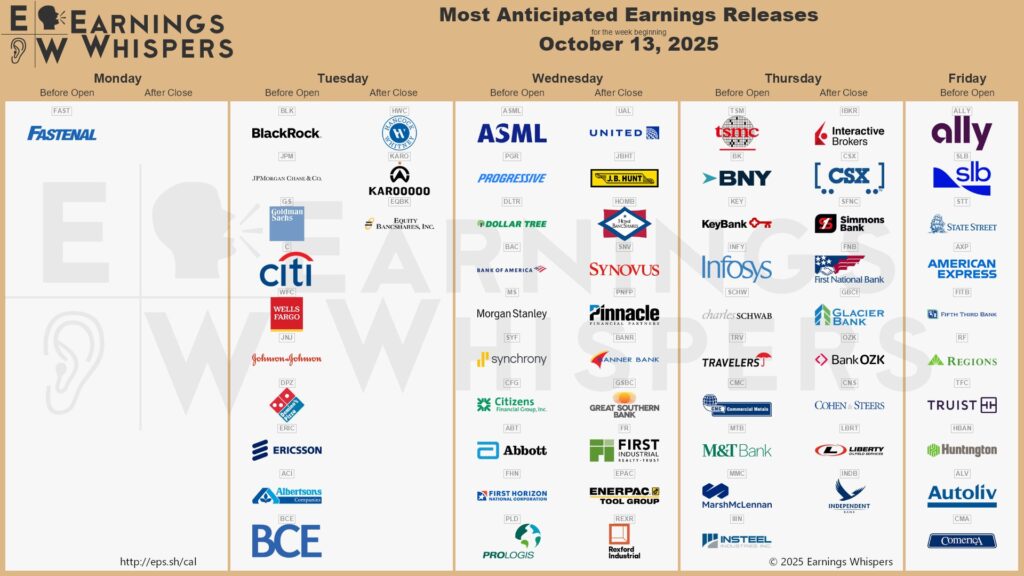
💼 Earnings season starts this week, with major U.S. banks among the first to report, alongside other companies:
📅 Tuesday, Oct 14th
- BlackRock, Inc. (BLK): BlackRock is scheduled to report its Q3 2025 results, with consensus analyst estimates projecting earnings per share around $11.30, and revenue expected to surge more than 20% year-over-year to around $6.26 billion.
Market participants should monitor growth in assets under management (AUM), where the consensus forecasts a record high of approximately $13.08 trillion, representing a 13.9% annual increase, driven by robust inflows and recent acquisitions that are expanding BlackRock’s presence in private markets.
Technology services revenue is another highlight, anticipated to climb over 23% year-on-year to $497 million, reflecting the firm’s push into digital and subscription-based offerings. Expenses are also expected to rise, up nearly 15% from last year, as BlackRock continues integrating acquisitions and investing in operating efficiency.
Given BlackRock’s ongoing strategic expansion into ETFs, alternatives, and technology, analysts and traders will be closely watching both the sustainability of top-line momentum and commentary on margin trends with a focus on fee and inflow dynamics for the rest of the year.
- Domino’s Pizza Inc (DPZ): Domino’s Pizza is set to release its third-quarter 2025 earnings, with analysts expecting earnings of around $3.98 per share, representing a 5% decline from the prior year. Revenue is projected to reach $1.14 billion, marking a 5.5% increase year-over-year from $1.08 billion in Q3 2024.
Market participants will focus on trends in U.S. same-store sales, where analysts expect moderate growth following a 3.4% increase in Q2 2025, with some forecasting continued momentum supported by the launch of the Parmesan Stuffed Crust pizza and expanded delivery partnerships, including DoorDash. Key metrics to watch include international same-store sales, which rose 2.4% year-over-year in Q2, and the company’s global store count, last reported at 21,536 locations as of June. Attention will also center on whether Domino’s can sustain its carryout strength while managing commodity and labor cost pressures that could affect margins.
📅 Wednesday, Oct 15th
- Abbott Laboratories (ABT): Abbott is scheduled to release third-quarter 2025 results. Consensus estimates call for EPS of $1.30, up 7.4% year-over-year, on revenue of $11.40 billion, a 7.2% increase from Q3 2024. Market participants should scrutinize segment trends, as Diagnostics revenue is expected to decline about 4.4% year-over-year, potentially offset by strength in Nutrition and Medical Devices, where management commentary on margins and volume drivers will be pivotal. Finally, Abbott’s Q3 EPS guidance range of $1.28 to $1.32 will offer critical insight into the company’s ability to deliver on its full-year 2025 objectives.
📅 Thursday, Oct 16th
- Taiwan Semiconductor Manufacturing Company (TSM): TSMC is set to release its third-quarter earnings. Revenue is expected at NT$989.9 billion (approximately US$32.47 billion), up over 35% year-on-year. Consensus EPS stands at US$2.63, versus US$1.95 a year ago, also reflecting roughly a 35% year-on-year increase.
Market participants will scrutinize the Q3 gross margin outlook, the midpoint was guided to 56.5%, with a lower end of 55.5%, amid a 6.6% appreciation of the NT dollar, and assess resilience against currency headwinds. Market participants should also watch U.S. dollar-denominated revenue against the US$31.8–33 billion guidance range and the share of high-performance computing business, which reached about 60% last quarter.
- Charles Schwab Corporation (SCHW): Charles Schwab is scheduled to release its third-quarter 2025 results. Analysts expect Charles Schwab to report adjusted EPS of $1.24, reflecting a year-over-year gain of about 61%. Revenue for the quarter is forecast at $5.98 billion, a 23.2% year-over-year growth.
Market participants should monitor net interest revenue, which in Q2 climbed to $2.8 billion (up 31% YoY) and is expected to exceed $2.9 billion this quarter amid rising rates. Attention will also focus on core net new client assets, which surged to $80.3 billion in Q2 and could top $85 billion if Schwab sustains its recent asset gathering momentum. Finally, trader engagement metrics such as daily average trades, which jumped 38% YoY to 7.6 million in Q2, will offer clues on trading revenue trends and client activity ahead of the call.
We hope this helps and happy trading!
– Trade and Travel Team
Related Blogs









Follow Us
Testimonials
Hear from students on why they chose the Trade and Travel Family and how it has changed their lives.

