
The stock market experienced heightened volatility last week as investors grappled with ongoing economic uncertainty despite the end of the historic government shutdown. The S&P 500 (SPY) edged higher with a modest 0.14% gain for the week, while the Nasdaq Composite (QQQ) posted a slight 0.14% decline, reflecting heightened concerns about technology sector valuations. The Dow Jones Industrial Average (DIA) outperformed both indices with a 0.41% advance, signaling relatively steady demand for large-cap equities amid the turbulent week.
The 43-day government shutdown officially concluded late Wednesday evening when President Trump signed funding legislation passed by Congress, bringing to an end the longest federal closure in American history. While the reopening offered some relief to markets, economists noted that much of the damage was already done. An analysis by EY estimated that the shutdown reduced annualized real GDP growth by 0.8 percentage points, about half of the United States’ average annualized growth during the first half of 2025.
Separately, the Congressional Budget Office projected that roughly $11 billion in economic activity will be permanently lost due to the prolonged disruption. These impacts stemmed from furloughed federal employees and reduced hours, disruptions to SNAP benefits for 42 million Americans, and thousands of flight cancellations during the period when the FAA ordered reduced operations.
Despite the volatility, corporate earnings continued to impress. With 452 companies, or nearly 91 percent of the S&P 500, having reported third-quarter results, earnings rose 11.75% on revenue growth of 8.2%. Ten of eleven sectors posted positive earnings growth, significantly exceeding pre-season expectations of 8% growth. However, concerns persisted around labor market weakness, with alternative data showing October layoff announcements reaching a 22-year high for the month.
Looking ahead, market attention shifts decisively to Nvidia’s fiscal third-quarter earnings report scheduled for Wednesday. The semiconductor giant’s results carry enormous weight given its central role in the artificial intelligence infrastructure buildout, with management forecasting $3 trillion to $4 trillion in AI infrastructure spending through 2030. Analysts have raised price targets ahead of the release, with expectations that strong results could reignite momentum in technology stocks.
The Federal Reserve’s December policy decision remains increasingly uncertain. Market-implied odds of a rate cut dropped from 67 percent to approximately 46 percent by week’s end, as officials cited persistent inflation running around 3 percent and mixed economic signals.
How This Impacts You
With the market still shaky and layoffs making headlines, it’s a good reminder that relying on one paycheck is risky, too. This week, take 10 minutes to check if you’re missing out on any benefits at work, like stock options or a 401(k) match. Then jot down one income idea outside your job, even if it’s small. Playing it safe feels comfortable, but sometimes the biggest risk is not exploring options that could give you more freedom.
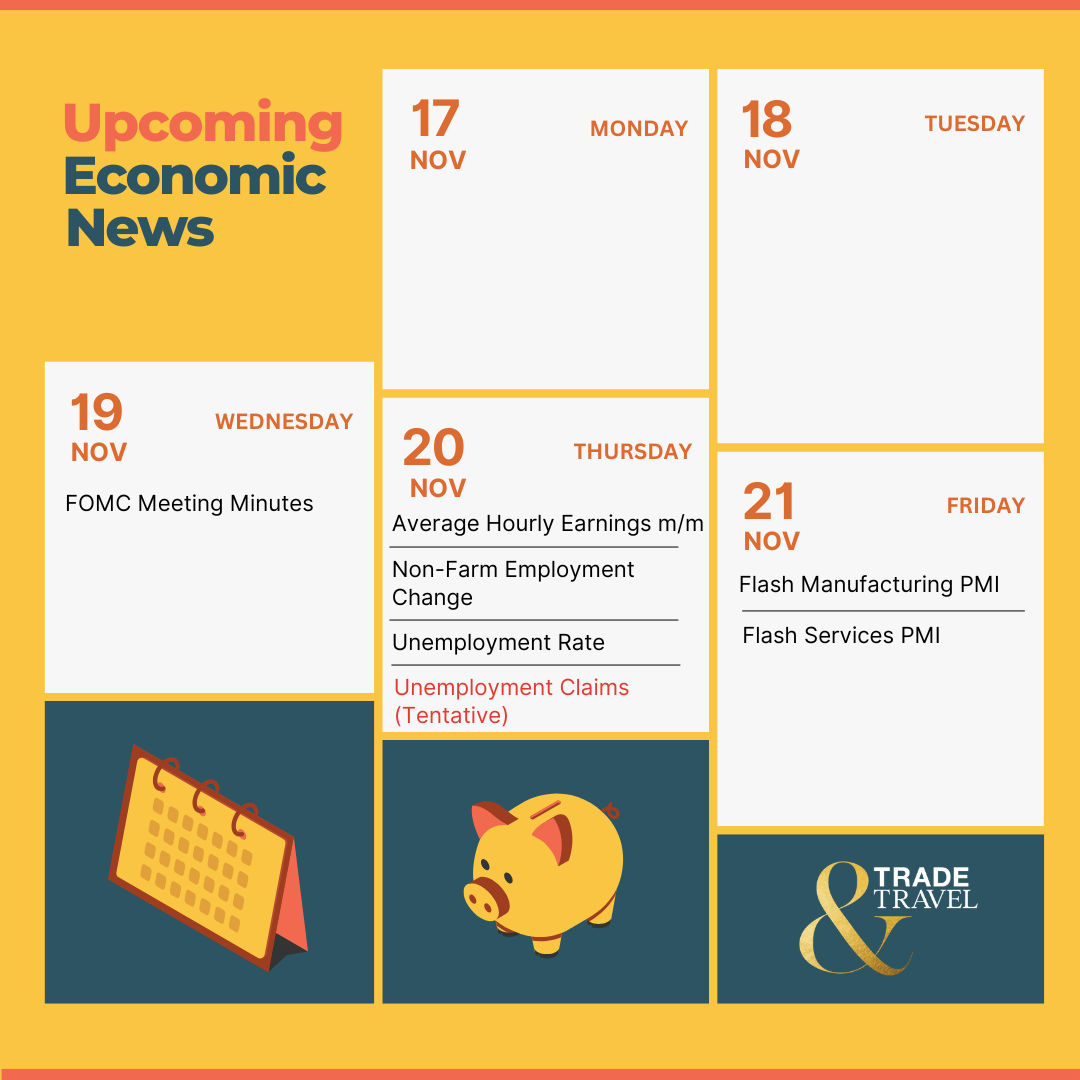
📅 Wednesday, Nov 19th
- FOMC Meeting Minutes: The Federal Reserve will release October meeting minutes, showing policymakers cut the federal funds rate by 25 basis points to 3.75-4.00% but signaled uncertainty about additional December cuts as inflation remains sticky above the 2% target despite softening labor market conditions.
The December 9-10 FOMC meeting will be closely scrutinized by investors watching for whether the Fed delivers another 25 basis point cut to 3.50-3.75%, with market pricing showing roughly 46% odds of this move, though Fed Chair Powell said a December cut is “not a foregone conclusion, far from it.” Traders should monitor the Fed’s data-dependent approach given data disruptions from the government shutdown, dissenting voices within the committee (with Governor Miran having advocated for a 50 basis point cut), and incoming November economic reports on employment and inflation to determine whether the central bank maintains its easing bias or pauses to assess sticky inflation trends.
📅 Thursday, Nov 20th
- Average Hourly Earnings m/m: The upcoming Average Hourly Earnings m/m report will follow the previous 0.3% reading, with economists and market participants closely monitoring whether wage growth maintains this pace or moderates further amid ongoing inflation concerns and labor market cooling.
Market participants should focus on whether average hourly earnings remain at the 0.3% monthly level or decelerate, as persistent wage growth above 0.3% could signal sticky inflation that challenges the Federal Reserve’s disinflation efforts and potentially impact monetary policy expectations, while a decline could suggest easing pay pressures consistent with the Fed’s 2% inflation target. Beyond the month-over-month figure, traders will watch the year-over-year growth rate, which has recently hovered around 3.7% to 3.9%, to assess whether wage inflation is aligning with the 3.0% to 3.5% annualized range compatible with price stability and whether labor market cooling is broad-based or concentrated.
- Non-Farm Employment Change: The September Non-Farm Payroll report, originally scheduled for October 3 but delayed due to the 43-day government shutdown, is set to be released on November 20, with economists projecting around 50,000 jobs added compared to the previous month’s weak 22,000 gain. Market participants are likely to focus on whether the labor market is stabilizing after August’s near-stagnation and whether wage growth continues at elevated levels, as any significant miss could reinforce recession concerns, given that long-term unemployment has surged to its highest share since 2022 and is rising while overall hiring has slowed sharply in recent months.
- Unemployment Rate: The September employment report, originally scheduled for October 3rd but delayed by the government shutdown, will be released on November 20th and is expected to provide the first reliable labor market data in nearly two months, with investors focusing on whether the unemployment rate remains at the 4.3% previous level or ticks higher amid signs of labor market softening.
Market participants will pay close attention to any further rise in the unemployment rate from 4.3%, since a sustained increase would underscore ongoing labor market deterioration and could strengthen expectations for additional Fed rate cuts. The data will be particularly critical because October’s employment report may be distorted by furloughed federal workers being counted as unemployed on temporary layoff, potentially inflating the jobless rate artificially to 4.8% if released, making the September baseline the cleaner indicator of underlying labor market health for policy decisions.
📅 Friday, Nov 21st
- Flash Manufacturing PMI: The S&P Global Flash Manufacturing PMI will provide early confirmation of whether the sector’s recent resilience holds. With the previous October reading at 52.5, market participants should focus on whether new orders remain above the 50-point expansion threshold and track the New Orders component specifically, as purchasing manager activity here serves as a critical leading indicator for future manufacturing health and broader economic momentum.
Key metrics to monitor include production changes, employment trends, and any signs of tariff-driven export weakness, as divergence between the flash estimate and the ISM manufacturing data, which fell to 48.7 in October, would signal mixed signals in manufacturing fundamentals that could influence risk asset positioning.
- Flash Services PMI: The November Flash Services PMI will provide critical early signals of service sector momentum heading into the final stretch of 2025, with investors watching whether activity can maintain the robust 54.8 reading from October or retreat closer to the 54.2 level from September amid persistent tariff uncertainty and business confidence that has fallen to levels last seen during the pandemic.
Key metrics to monitor include new order volumes and employment trends, as service sector firms have faced mounting pricing pressures and capacity constraints, with particular attention on whether input cost inflation and pricing power have stabilized following the acceleration observed in recent months. The Flash Services PMI is closely watched by markets and policymakers given that services comprise the majority of U.S. economic activity and new business expansion rates, coupled with employment metrics, could influence expectations around December rate cut probabilities.
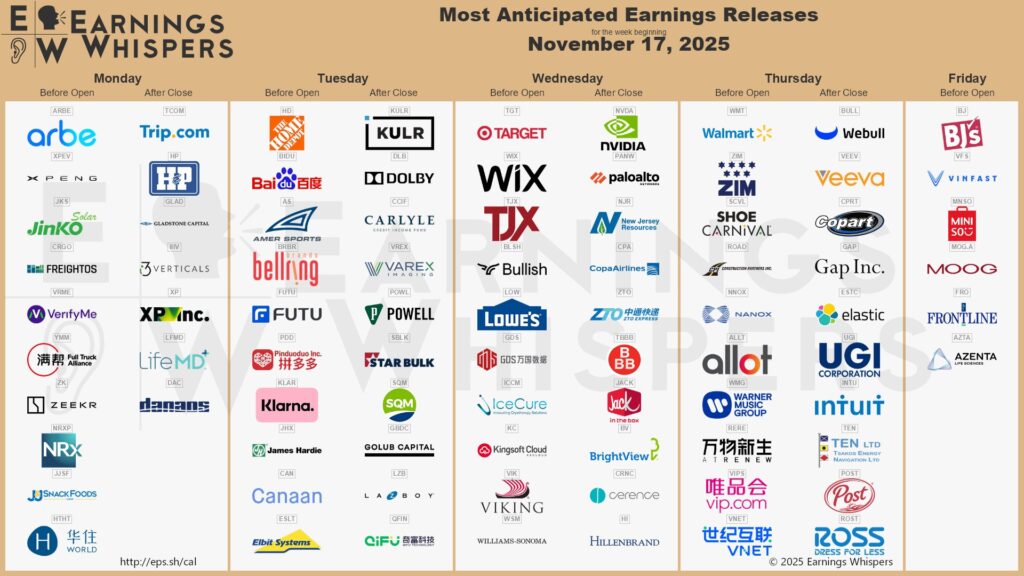
💼 It’s a slimmer earnings week, yet the companies reporting across tech and consumer sectors will still help shape the market’s read on the economy.
📅 Tuesday, Nov 18th
- Home Depot, Inc. (HD): Home Depot will report Q3 fiscal 2025 results, with the company expecting to announce earnings of approximately $3.84 per share on revenue of roughly $41.15 billion. This represents about 1.58% and 2.31% growth in EPS and revenue, respectively, compared to the prior-year quarter.
Market participants should focus on comparable sales trends, as management’s fiscal 2025 guidance projects only 1% comparable sales growth amid ongoing headwinds from elevated mortgage rates and consumer caution around discretionary home improvement projects. Investors should monitor any signals of improvement in the Pro business and digital channels, which have shown resilience, along with commentary regarding the integration of the recent SRS acquisition, which management reported has exceeded expectations so far.
Management has highlighted housing activity, average ticket trends, Pro backlogs, and integration of the recently acquired GMS business as important to its forward strategy, and updates on these areas are likely to feature in upcoming commentary.
📅 Wednesday, Nov 19th
- NVIDIA Corporation (NVDA): NVIDIA will report its Q3 fiscal 2026 earnings, with Wall Street expecting the company to demonstrate continued dominance in the AI chip market despite moderating growth rates. Analysts are forecasting revenue of approximately $54.83 billion, representing 56% year-over-year growth, while adjusted earnings per share are expected to reach $1.25, up 54% compared to the prior year.
Data center revenue, the primary growth driver, is projected to reach about $49 billion, reflecting strength from Blackwell GPU adoption and partnerships with hyperscalers like Microsoft, Amazon, and Google. Gross margins are expected to be about 73.3%. CEO Jensen Huang recently referenced roughly $500 billion in long-term GPU demand visibility tied to Nvidia’s Blackwell architecture and its next-generation Rubin platform. Subsequent clarifications indicate this is a long-term cumulative figure rather than a fully contracted near-term order book, but the scale has reinforced bullish long-range models, including some that now pencil in $200-plus billion in annual revenue by around fiscal 2027.
Beyond the Q3 print, traders will watch any commentary on fiscal Q4 and full-year FY26 demand and supply, as many Street models already assume another step-up in quarterly revenue into the low-$60-billion range even though Nvidia has not yet issued formal Q4 guidance. Geopolitical headwinds remain a risk, particularly U.S. export restrictions that previously halted Nvidia’s H20 shipments to China and continue to create uncertainty around future sales. Nvidia’s current guidance does not assume any H20 revenue from China, effectively excluding this impact from its near-term outlook.
- Target Corporation (TGT): Target is scheduled to report its Q3 fiscal 2025 earnings. Analysts estimate the retailer will post an EPS of $1.71, representing a 7.56% decline from the $1.85 reported in the prior-year Q3, reflecting persistent pressure on the bottom line amid a challenging consumer environment. Revenue expectations center around $25.34 billion, down approximately 1.28% year-over-year, as the retailer continues to navigate weak comparable store sales, offset partially by resilient digital growth.
The critical watch item is comparable sales growth, where investors should focus on whether the company can stabilize its store traffic and comparable store sales, which declined 3.2% in Q2 and have struggled throughout fiscal 2025 despite a modest 0.3% comp increase in Q3 2024. Digital comparable sales growth remains a bright spot in Target’s portfolio, having expanded 4.3% in Q2 and nearly 11% in Q3 2024, with same-day delivery services and Drive Up capabilities, though it continues to carry higher fulfillment costs.
Management commentary on the consumer health, promotional intensity, and pricing strategy will be essential, as weak discretionary spending has pressured categories like apparel and home goods that represent roughly 50% of Target’s sales.
- Lowe’s Companies, Inc. (LOW): Lowe’s Companies will report Q3 2025 results, with analysts expecting earnings per share of $2.97, representing 2.76% year-over-year growth from $2.89 in Q3 2024. Revenue is projected to reach $20.83 billion, up 3.27% from the year-ago quarter.
Market participants should closely monitor comparable store sales, as this metric will signal whether Lowe’s’ strategy of targeting professional contractors (“Pro”) and online channels can offset persistent weakness in discretionary home improvement projects among do-it-yourself customers. The company previously guided for full-year 2025 comparable sales to be flat to up 1%, and Q3 results will reveal whether this trajectory remains on track.
Pro segment performance is particularly critical to watch, as Lowe’s reported overall comparable sales up 1.1% in Q2 2025, driven in part by its Pro business, and continues to prioritize professional-contractor expansion through acquisitions such as Artisan Design Group and Foundation Building Materials.
Management commentary on tariff headwinds will be important, as Lowe’s has indicated that most tariff impacts are expected to be felt in the second half of fiscal 2025 and are already reflected in its outlook, while executives emphasize maintaining competitive pricing and using pricing tools to limit customer impact. The housing market outlook commentary will shape forward guidance, particularly whether Lowe’s sees stabilization in mortgage rates, housing turnover, or any shift in consumer sentiment that could boost DIY discretionary spending in the fourth quarter and beyond.
📅 Thursday, Nov 20th
- Walmart Inc. (WMT): Walmart will report Q3 fisical 2026 results. Analysts expect the retailer to post earnings per share of $0.60, representing 3.5% growth year-over-year from $0.58 in the prior-year quarter. Wall Street is forecasting quarterly revenue of approximately $177.47 billion, reflecting growth of 4.64% compared to Q3 fisical 2025.
Market participants should monitor comparable sales trends across Walmart U.S., which posted 4.6% comps excluding fuel in Q2, and track whether the company’s ecommerce momentum continues, the segment achieved 26% growth in Q2 and now accounts for about 18% of Walmart U.S. net sales, making it an important driver of top-line growth. A key focus should be gross margin performance, as Walmart U.S. reported a 26-basis-point increase in gross profit rate during Q2, while operating expenses deleveraged by 43 basis points, reflecting higher costs in the segment.
On the investor call, CEO Doug McMillon and CFO John David Rainey are expected to review quarterly results and take analyst questions. Based on recent commentary, investors are likely to focus on advertising and Walmart Connect revenue, Walmart+ membership and other subscription trends, management’s view of consumer demand and tariff-related cost pressures, and Walmart’s competitive positioning relative to Amazon and Target.
We hope this helps and happy trading!
– Trade and Travel Team
Related Blogs

Follow Us
Testimonials
Hear from students on why they chose the Trade and Travel Family and how it has changed their lives.

