
Last week extended the equity selloff to a fifth consecutive down week, with the S&P 500, tracked by SPY, declining approximately 2.2%, its lowest level since last summer. The Nasdaq-100, tracked by QQQ, dropped approximately 3.2% and entered official correction territory, more than 10% below its recent peak. The Dow Jones Industrial Average, tracked by DIA, also fell around 1% last week. The five-week losing streak has erased a substantial portion of the gains posted during the fourth-quarter 2025 advance.
The week’s defining catalyst was the collapse of U.S.-Iran diplomatic talks. Early Monday, optimism drove the S&P 500 up more than 1% on reports of a ceasefire framework, only for Iran to publicly reject negotiations and President Trump to extend the deadline without resolution by Friday. Oil absorbed the geopolitical premium in full: WTI crude settled at $94.48 per barrel, up 4.6% on the week, as the Strait of Hormuz blockade entered its fourth consecutive week and energy security concerns deepened across commodity markets.
Flight-to-safety positioning accelerated alongside the oil move. Gold surged approximately 2.6% to near $4,522 per ounce. The 10-year Treasury yield climbed to 4.44%, its highest level since July 2025. Energy was the week’s standout sector, while technology and consumer discretionary bore the steepest multiple compression as elevated yields and slowing growth expectations weighed on valuations. The corporate calendar produced results broadly in line with lowered expectations: acquisition-fueled services names delivered headline revenue growth, while consumer discretionary companies continued to guide cautiously against tariff-related cost uncertainty and softening consumer sentiment.
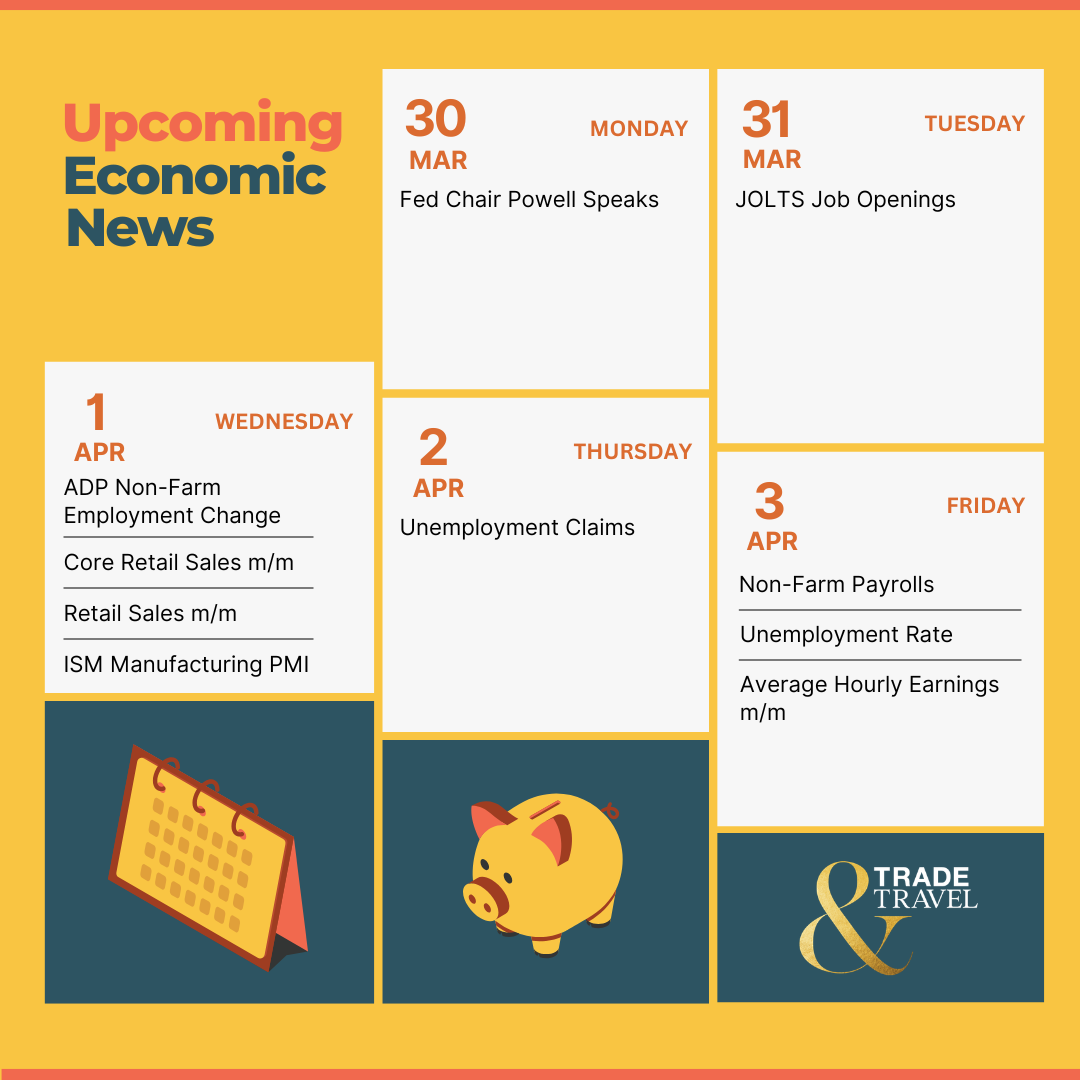
Looking ahead, the macro calendar turns entirely to labor markets. ISM Manufacturing PMI and ADP Employment Change on Wednesday deliver the first major reads on March factory and labor conditions, followed by Initial Jobless Claims on Thursday. The week’s marquee release, the March Employment Situation covering Non-Farm Payrolls, the Unemployment Rate, and Average Hourly Earnings, arrives on Friday.
One critical calendar note: April 3 is Good Friday, and U.S. equity markets are closed; the BLS has confirmed the release proceeds as scheduled, meaning the data will land with markets dark and the full price reaction deferred entirely to Monday’s open.
How This Impacts You
This week delivers an unusual calendar twist: the most important economic releases of the month drop on a Good Friday, when U.S. equity markets are closed. That means reports land, get absorbed by analysts and global markets, and sit untraded until Monday’s open. If you hold significant equity exposure heading into Thursday’s close, be aware that the weekend gap risk is asymmetric: a second deeply negative payroll reading following February’s -92,000, or an unemployment rate climbing above 4.5%, will accumulate in futures and international markets while U.S. stocks stand still.
You may want to take a few minutes before Thursday’s close to revisit what you’re currently holding and think about what feels comfortable to carry through a two-day information gap. This can be a good moment to gently check in on where your money is and how it’s positioned. If you’ve been wanting to feel more intentional with your investments, this is a timely opportunity to get a bit more clarity before the market reacts for you.
📅 Monday, March 30th
- Fed Chair Powell Speaks: Federal Reserve Chair Jerome Powell participates in a moderated discussion at Harvard University’s Principles of Economics class, his first live public appearance since the March 18 FOMC meeting, where the Fed held rates at 3.50%–3.75%.
While this is a classroom setting rather than a formal policy address, Powell’s remarks carry outsized weight because markets are searching for any signal on how the Fed is weighing the collision between rising inflation pressures and deteriorating employment data.
At the March 18 press conference, Powell stated that inflation is not coming down “as much as we had hoped” and flagged the oil shock from the Strait of Hormuz blockade as creating “downward pressure on spending and employment and upward pressure on inflation,” a framework that effectively describes stagflation without using the word. The Harvard format, a Q&A with students, tends to produce less scripted responses than prepared testimony.
Markets will listen for any shift in Powell’s characterization of the labor market, any updated view on how tariff-driven cost pressures are filtering into the Fed’s inflation forecasts, and whether he signals willingness to tolerate higher unemployment before cutting rates. This is also among Powell’s final public appearances before his term as Chair ends in May 2026, adding a legacy dimension to his remarks.
📅 Tuesday, March 31st
- JOLTS Job Openings: The Bureau of Labor Statistics releases the Job Openings and Labor Turnover Survey for February 2026, providing the most granular monthly read on labor demand, hiring activity, and worker confidence in the U.S. economy. The JOLTS report matters because it captures the demand side of the labor market that payroll data alone cannot: how many positions employers are actively trying to fill, how many workers feel confident enough to quit, and how many are being laid off.
In January, job openings rose to 6.946 million from a revised 6.6 million in December, with the job openings rate at 4.2%. Hires held steady at 5.3 million while total separations were little changed at 5.1 million. The quits rate remained at 2.0% for the seventh consecutive month, a level that signals workers view switching jobs as too risky in the current environment, and a meaningful deterioration from the 2.4% quits rate that characterized the 2023 labor market.
Analysts broadly expect a pullback from January’s 6.946 million, with estimates clustering in the 6.5 to 6.8 million range; a reading near the lower end would bring the figure closer to the revised December 2025 low of approximately 6.6 million, among the weakest readings of the cycle.
The “low-hire, low-fire” dynamic that has defined the labor market for nearly a year shows no signs of breaking. Financial activities led January’s opening gains while government and manufacturing quit rates sat below 1.5%, reflecting a frozen public sector and cautious industrial base. A February reading below 6.5 million would be the clearest signal yet that labor demand is contracting, not just stalling.
📅 Wednesday, April 1st
- Core Retail Sales m/m & Retail Sales m/m: The U.S. Census Bureau is releasing its February 2026 Retail Sales report, which tracks how much consumers are spending month to month across thousands of retailers. A key focus is core retail sales, which excludes car purchases to give a clearer view of everyday spending trends.
In January 2026, core retail sales were flat at 0.0% month over month, matching December 2025 and marking two straight months of no growth. However, a more refined measure of spending, the retail control group, rose 0.3%, beating the 0.2% estimate and rebounding from December’s -0.1%, standing out as the sole bright spot and a key driver of GDP.
Analyst consensus projects February 2026 core retail sales growth of approximately +0.2% month over month, with headline retail sales expected at +0.3%, but the Chicago Fed’s Advance Retail Trade Summary, which uses real-time card transaction data, projected core ex-autos at approximately -0.8% for February, a sharply bearish signal that would represent the worst monthly reading since the post-holiday retrenchment pattern of early 2024.
Markets will parse the February figure for evidence of whether the consumer remains engaged or is retrenching after two consecutive flat-to-negative months; the gap between the CARTS projection and the analyst consensus is unusually wide, and resolution in either direction will carry outsized weight for the consumer spending narrative heading into Q2. - ISM Manufacturing PMI: The Institute for Supply Management (ISM) releases its Manufacturing Purchasing Managers’ Index for March 2026, delivering the week’s first major read on U.S. factory sector conditions ahead of the labor-market complex (ADP on Wednesday, Initial Jobless Claims on Thursday, and the Employment Situation on Good Friday morning).
The prior month’s ISM Manufacturing PMI registered 52.4%, sustaining the factory sector’s expansion above the neutral 50.0% threshold. New Orders held at a robust 55.8% while the Prices Paid sub-index surged to 70.5%, the highest reading since June 2022, as manufacturers accelerated raw material stockpiling ahead of anticipated tariff cost implementation.
ISM Manufacturing Survey Committee Chair Susan Spence characterized those prior-month conditions as reflecting the tension between resilient near-term domestic demand and rapidly deteriorating cost visibility. March data will test that dynamic as the tariff pull-forward that boosted Q1 factory activity fades and the underlying demand run-rate becomes clearer. - ADP Non-Farm Employment Change: ADP Research, in partnership with the Stanford Digital Economy Lab, releases the ADP National Employment Report for March 2026, providing the private-sector employment estimate that serves as the most widely tracked precursor to the BLS Employment Situation, which this week releases on Good Friday.
The prior month’s ADP figure registered a gain of +63K private-sector jobs, a recovery from +22K a month earlier but well below the +100K to +150K monthly pace that characterized the 2024 expansion phase. The small- and mid-size business cohort that ADP uniquely disaggregates showed the most pronounced hiring restraint, consistent with elevated credit costs and input cost uncertainty among non-enterprise employers navigating a rapidly shifting trade-policy environment.
The March figure arrives at an inflection point: the prior two months’ pattern of stalled private-sector hiring reflects a labor market where businesses are neither aggressively expanding nor materially cutting headcount, a “low-hire, low-fire” equilibrium driven by demand uncertainty rather than acute financial stress.
With Wednesday’s ADP print as an early tradeable labor signal before NFP, markets will look into the size-cohort breakdown, particularly whether large enterprises (250+ employees) are sustaining hiring momentum even as smaller firms remain frozen.
📅 Thursday, April 2nd
- Initial Jobless Claims: The U.S. Department of Labor releases the advance Initial Jobless Claims figure for last week. The most recent reading came in at 210,000, up from 205,000 the week before. The four-week average is now 210,500, which is slightly higher than the sub-200,000 levels seen during the strongest parts of the 2024 labor market, but still well below the 250,000 to 300,000 range that typically signals a weakening economy.
No formal analyst consensus is published for Initial Jobless Claims. The key question is whether claims begin to capture the wave of federal worker separations that Goldman Sachs and J.P. Morgan have flagged as a potential source of volatility through Q2 2026; these separations have been delayed in claims data because state unemployment systems process administrative-leave conversions with a multi-week lag, meaning the true scale of public-sector job losses has been invisible in weekly filings until now.
The April 2 print also carries the continuing claims figure for the week ending March 21, which has emerged as the more informative metric: it measures how long newly separated workers remain on benefits, and the rehiring pace for displaced workers is slowing even in sectors not directly exposed to federal spending contraction, suggesting the labor market’s ability to absorb displaced workers is weakening.
📅 Friday, April 3rd: ⚠️ Good Friday (Markets Closed, Full Reaction Monday)
- Non-Farm Payrolls: The Bureau of Labor Statistics releases the March 2026 Employment Situation on Good Friday, when U.S. equity markets are closed. The report lands with no immediate price discovery available, and the full market reaction is deferred to Monday’s open, which elevates Wednesday’s ADP release and Thursday’s Initial Jobless Claims as the last tradeable labor-market signals of the week.
The prior month’s Non-Farm Payrolls delivered a headline figure of −92,000, the sharpest monthly job loss since the pandemic, driven by a convergence of federal workforce reductions, continued contraction in rate-sensitive construction and manufacturing, and a partial statistical reversal of the weather-distorted payroll base from a month earlier.
That prior-month figure also carried two significant revisions: January was revised down to +126,000 from the originally reported +130,000, and December 2025 was revised sharply lower to −17,000 from the original +48,000 advance estimate, reinforcing that the labor market entered 2026 on a weaker footing than initial data indicated.
A technical rebound from the prior month’s −92,000 is broadly anticipated, as some of that weakness reflected seasonal and administrative timing factors, but the range of estimates is exceptionally wide as forecasters attempt to quantify both the scale of federal separations converting from paid administrative leave to documented unemployment and the degree to which private-sector hiring has stalled in response to trade-policy uncertainty and the Iran conflict’s drag on business investment.
The Fed’s reaction function to the March print is asymmetric: a stronger-than-expected figure reinforces the “hold” posture the FOMC adopted at its March 18 meeting and reduces the probability of a June rate cut, while a second consecutive deeply negative report forces a rapid recalibration of the dual mandate, with ISM Manufacturing Prices Paid already at 70.5% constraining the Fed’s ability to ease even as the labor market deteriorates.
- Unemployment Rate: The March 2026 Unemployment Rate, the U-3 headline measure derived from the monthly Current Population Survey of approximately 60,000 households, is released as part of the Employment Situation report.
The prior month’s U-3 rate registered 4.4%, up from 4.3% the month before and up materially from 4.0% a year ago, a 40-basis-point year-over-year climb that represents one of the steepest sustained deteriorations outside of recessionary periods. The broader U-6 underemployment rate edged down to 7.9% from 8.0% a month earlier, a positive signal that was offset by the Labor Force Participation Rate falling to 62.0% from 62.5% the prior month, the sharpest single-month LFPR decline since the pandemic.
Chair Powell noted at the March 18 FOMC meeting that the labor market had not yet deteriorated enough to justify rate cuts, a threshold a March reading above 4.5% would directly test, particularly if the LFPR decline persists and the true available labor pool proves larger than the headline U-3 figure implies. - Average Hourly Earnings m/m: The Bureau of Labor Statistics releases March 2026 Average Hourly Earnings. The prior month’s figure rose +0.4% month over month to $37.32 per hour, matching the gain from the month before ($37.17), while the year-over-year growth rate registered +3.8%, an above-trend pace that sits well outside the Fed’s implied neutral wage growth corridor of roughly 3.0% to 3.5% and signals nominal wage pressures have not yet normalized despite cooling hiring activity.
Analysts expect wages to rise about +0.3% in March, which would bring average hourly earnings to around $37.43 and show some slowing in year-over-year growth. However, this month’s data may be harder to interpret than usual. That’s because higher-paid federal workers leaving the workforce could pull the average wage down, while increased competition in the private sector could push wages up. This creates a push and pull in the data that may make the underlying trend less clear.
The market should treat the March wage figure as a noisy signal requiring decomposition rather than a clean read on labor market health: employment mix is shifting toward lower-wage service sectors, federal workforce exits are distorting the average, and tariff-driven price increases may be inflating nominal wages without improving purchasing power.
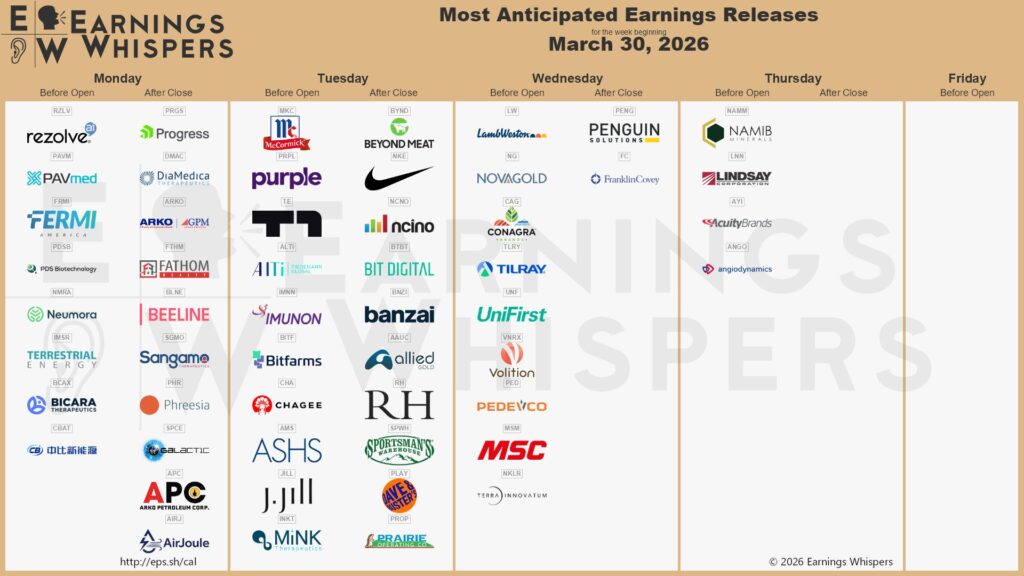
💼 Earnings season winds down this week with a light calendar, giving traders a chance to digest recent results and position ahead of the next wave of reports kicking off in mid-April.
📅 Monday, March 30th
- Progress Software Corporation (PRGS): Progress Software, the Bedford, Massachusetts-based enterprise software company whose portfolio spans OpenEdge application development, Telerik and Kendo UI developer tools, Sitefinity content management, Chef infrastructure automation, and MOVEit managed file transfer, reports its fiscal Q1 FY2026 results. Analyst consensus projects EPS of $1.57, a 19.8% increase from the $1.31 EPS reported a year ago.
Progress runs an “acquire, integrate, optimize” consolidation model: the company acquires mature enterprise software assets at disciplined multiples, standardizes operations, and extracts recurring revenue and margin expansion. Revenue consensus stands at approximately $246.4 million, a 3.5% increase from the $238 million reported a year earlier.
Growth is anchored by the portfolio’s high recurring-revenue composition; OpenEdge, MOVEit, and Chef all carry multi-year maintenance and subscription contracts that generate predictable annuity cash flows. Investors will watch whether net retention rates are holding at levels consistent with full-year guidance.
CEO Yogesh Gupta, who has led Progress Software since 2016 and architected the shift to the acquisition-driven consolidation model, enters the call managing residual legal and financial exposure from the May 2023 MOVEit zero-day vulnerability. The vulnerability was exploited by the Clop ransomware group and affected thousands of downstream MOVEit customers. Capital allocation will also be on the agenda: the company has historically paired acquisitions with share repurchase activity and a recently established dividend, and investors will assess the tuck-in acquisition pipeline available at current software sector valuations.
Macro sensitivity is structurally lower than for growth-oriented SaaS companies, as the core OpenEdge customer base carries high switching costs and multi-year renewal patterns, but the broader software spending environment still affects expansion revenue and demand for newer products.
📅 Tuesday, March 31st
- McCormick & Company (MKC): McCormick & Company reports fiscal Q1 FY2026 results covering the December 2025 through February 2026 period, the first full quarter to consolidate the acquisition of a controlling interest in McCormick de Mexico, which management expects will contribute 11–13% to FY2026 reported net sales growth.
Analyst consensus projects EPS of approximately $0.61, a 1.7% year-over-year increase from the $0.60 earned in the year-ago quarter, as Mexico consolidation lifts and continued Consumer segment volume growth offset incremental tariff costs and elevated interest expense on the $750 million acquisition financing. Revenue consensus stands at approximately $1.79 billion, reflecting 11.4% year-over-year growth from the $1.606 billion reported a year earlier.
The headline advance is almost entirely acquisition-driven: McCormick de Mexico generates approximately $810 million in annual net sales, while underlying organic growth is expected to track near the company’s 1–3% full-year guide. The Mexico deal closed at $750 million, securing an additional 25% stake that brought total ownership to 75%; management expects the acquisition to be accretive to adjusted operating margin and EPS in FY2026 and to position McCormick for broader Latin American expansion across spices, sauces, condiments, and tea.
Tariff mitigation will be the focal topic on the call: McCormick faces approximately $50 million in incremental tariff costs in FY2026, driven by Chinese-sourced spices (garlic, ginger, star anise, and cassia cinnamon) that faced peak Section 301 rates of 145% before a May 2025 U.S.-China trade agreement.
- TD SYNNEX (SNX): TD SYNNEX, the world’s largest IT products and solutions distributor serving more than 100 countries through its network of IT manufacturers, resellers, and cloud service providers, reports fiscal Q1 FY2026 results. Analyst consensus projects EPS of $3.24, a 15.7% increase from the $2.80 delivered a year ago, as artificial intelligence infrastructure demand and the company’s newly enhanced Microsoft Frontier Distributor designation drive above-market growth in high-margin Advanced Solutions products.
Revenue consensus stands at approximately $15.59 billion, within the company’s issued Q1 FY2026 guidance range of $15.1–$15.9 billion and consistent with management’s full-year outlook for approximately 10% top-line expansion as enterprise AI buildout accelerates spend across networking, storage, and server infrastructure.
The strongest leading indicator heading into the report was TD SYNNEX’s Q4 FY2025 performance: the company reported accelerating gross billings growth of 15% and guided to full-year FY2026 EPS growth of 10–12%, demonstrating that the AI-driven enterprise IT spending cycle is translating into durable margin expansion beyond the commodity hardware distribution model.
Central to the growth thesis is TD SYNNEX’s Destination AI program, a structured framework connecting vendors, resellers, and enterprise customers across edge computing, advanced networking, validated AI labs, and professional services deployment. The company achieved Microsoft’s newly established Frontier Distributor designation in 2026, a global credential held by only a select group of distributors that enables accelerated monetization of Microsoft AI offerings across the channel ecosystem.
Tariff exposure is the primary macro risk as the company imports substantial volumes of IT hardware and components subject to 25–30% Section 301 tariffs on Chinese-origin goods, and while the company’s multi-sourcing strategy and regional inventory optimization provide partial mitigation, tariff pass-through dynamics could weigh on gross margins in the near term.
- Nike (NKE): Nike reports fiscal Q3 FY2026 results, one of the most consequential prints in CEO Elliott Hill’s first full year leading his “Win Now” turnaround, as tariff headwinds and six consecutive quarters of China market deterioration converge on the release. Analyst consensus projects EPS of $0.29, a 46.3% decline from the $0.54 earned a year earlier, as gross margin compression from tariffs, direct-to-consumer restructuring costs, and China losses collectively outpace the wholesale rebound and promotional discipline Hill has spent the past year engineering.
Revenue consensus stands at approximately $11.27 billion, essentially flat with the $11.27 billion reported in the year-ago quarter, landing at the optimistic end of management’s guidance for low-single-digit revenue contraction as North America recovery partially offsets continued weakness in Greater China and EMEA.
The most instructive leading indicator from last quarter was channel divergence: wholesale expanded 8% to $7.5 billion as Hill rebuilt retailer partnerships, while Nike Direct contracted 8% to $4.6 billion, reflecting deliberate clearance discipline and a deliberate pullback from the promotional model that once inflated near-term revenue at the expense of brand health.
Q3 channel dynamics are expected to track a similar split, with wholesale projected to grow approximately 3% and Nike Direct anticipated to decline roughly 10%. Nike Membership reached 160 million active members, providing a re-engagement funnel as marketing investment pivots toward performance sports ahead of the FIFA World Cup 2026, beginning June 11.
Greater China remains the sharpest structural drag: Greater China revenue declined 17% to $1.42 billion last quarter, the sixth consecutive quarterly contraction, as domestic competitors Anta and Li-Ning continued to capture share, and Q3 is expected to deliver a comparable year-over-year decline with no near-term stabilization catalyst visible.
📅 Wednesday, April 1st
- ConAgra Brands (CAG): ConAgra Brands, one of North America’s largest packaged food companies with a portfolio spanning Healthy Choice, Marie Callender’s, Banquet, Birds Eye, Duncan Hines, Orville Redenbacher’s, Slim Jim, Hunt’s, Vlasic, Reddi-Wip, and Angie’s Boomchickapop across grocery, frozen, and snack categories, reports fiscal third-quarter 2026 results, covering the December 2025 through February 2026 period, the heart of the winter eating season that typically represents one of the company’s strongest consumption windows for its Refrigerated & Frozen and Grocery & Snacks franchises.
Analyst consensus projects EPS of $0.40, a 21.6% decline from the $0.51 reported a year ago, as persistent private-label competition, consumer down-trading in center-store grocery, and incremental tariff-related input cost pressure compress profitability despite early benefits from pricing normalization and productivity savings. Revenue consensus stands at approximately $2.77 billion, a 2.6% decline from the approximately $2.844 billion reported in the same quarter last year.
Volume erosion across the Grocery & Snacks and Refrigerated & Frozen segments reflects elevated retail shelf prices and intensifying private-label competition, partially offset by a modest recovery in foodservice channel throughput as away-from-home dining stabilizes. CEO Sean Connolly, who has led the company since 2015, has pursued a multi-year strategy of portfolio optimization, including divestitures of lower-margin commodity businesses and reinvestment in brand innovation, protein snacking, and frozen premium meals, but the payback timeline has stretched as inflation-fatigued households continue to trade down to store brands at above-historical rates.
ConAgra’s four-segment structure (Grocery & Snacks, Refrigerated & Frozen, International, and Foodservice) provides geographic and channel diversification, yet all four have faced simultaneous headwinds: the International segment carries tariff exposure on Chinese-origin ingredients and packaging materials, while the Foodservice segment has faced softer quick-service restaurant traffic as elevated menu prices constrain consumer visits.
The company’s balance sheet carries the legacy debt from the 2018 Pinnacle Foods acquisition at approximately $8 billion, a burden that constrains financial flexibility and elevates investor focus on free cash flow generation and dividend sustainability. The trajectory of volume recovery is the focal metric for the April 1 call.
We hope this helps and happy trading!
The Trade and Travel Team
Related Blogs








Follow Us
Testimonials
Hear from students on why they chose the Trade and Travel Family and how it has changed their lives.

