
Wall Street closed out its first full trading week of 2026 on a strong note, with all three major indexes finishing Friday at or near record highs, buoyed by a jobs report that signaled a cooling but resilient labor market and reinforced expectations for a softer interest-rate path. The S&P 500 (SPY) climbed about 1.6% for the week, while the Dow Jones Industrial Average (DIA) surged roughly 2.36%, and the NASDAQ composite (QQQ) advanced about 2.21%.
The positive week was anchored by December’s employment report, which revealed the U.S. added 50,000 jobs, below economists’ expectations of around 70,000, but the unemployment rate ticked down to 4.4% from 4.5%. This resilient labor market narrative, while slightly disappointing on headline job creation, reinforced that the Federal Reserve will likely maintain its current interest rate stance for now. The CME FedWatch tool currently prices in just two quarter-point rate cuts for the entire year, with the first cut expected later in the year (timing remains data-dependent).
Beyond employment, policy headlines also shaped markets. President Trump said he was directing the purchase of $200 billion in mortgage bonds in a bid to bring down housing costs, with Federal Housing Finance Agency Director Bill Pulte later confirming that Fannie Mae and Freddie Mac would execute the purchases. Separately, the White House held a meeting with major oil executives to explore potential private investment in Venezuela’s oil sector, with analysts noting that companies would likely seek government guarantees before committing, given the political and commercial risks.
Looking ahead to the upcoming week, investors face critical tests. The earnings season officially kicks off Tuesday, with JPMorgan Chase, followed by the “Big Four” banks reporting through midweek. Inflation will also be in focus, with the December CPI report due Tuesday morning, a release that could shape expectations for the Federal Reserve’s policy path later in 2026.
How This Impacts You
Savings accounts and high-yield savings accounts are no longer paying what they once did, in part because the Federal Reserve reduced interest rates last year.
That shift can feel unsettling, especially when you did the right thing by saving and being patient. With inflation still present, money sitting only in savings can lose buying power over time, even if the balance does not go down. One option you can consider is separating your money into two buckets: one for safety and easy access, and another for longer-term growth in the stock market, at a pace that feels manageable.
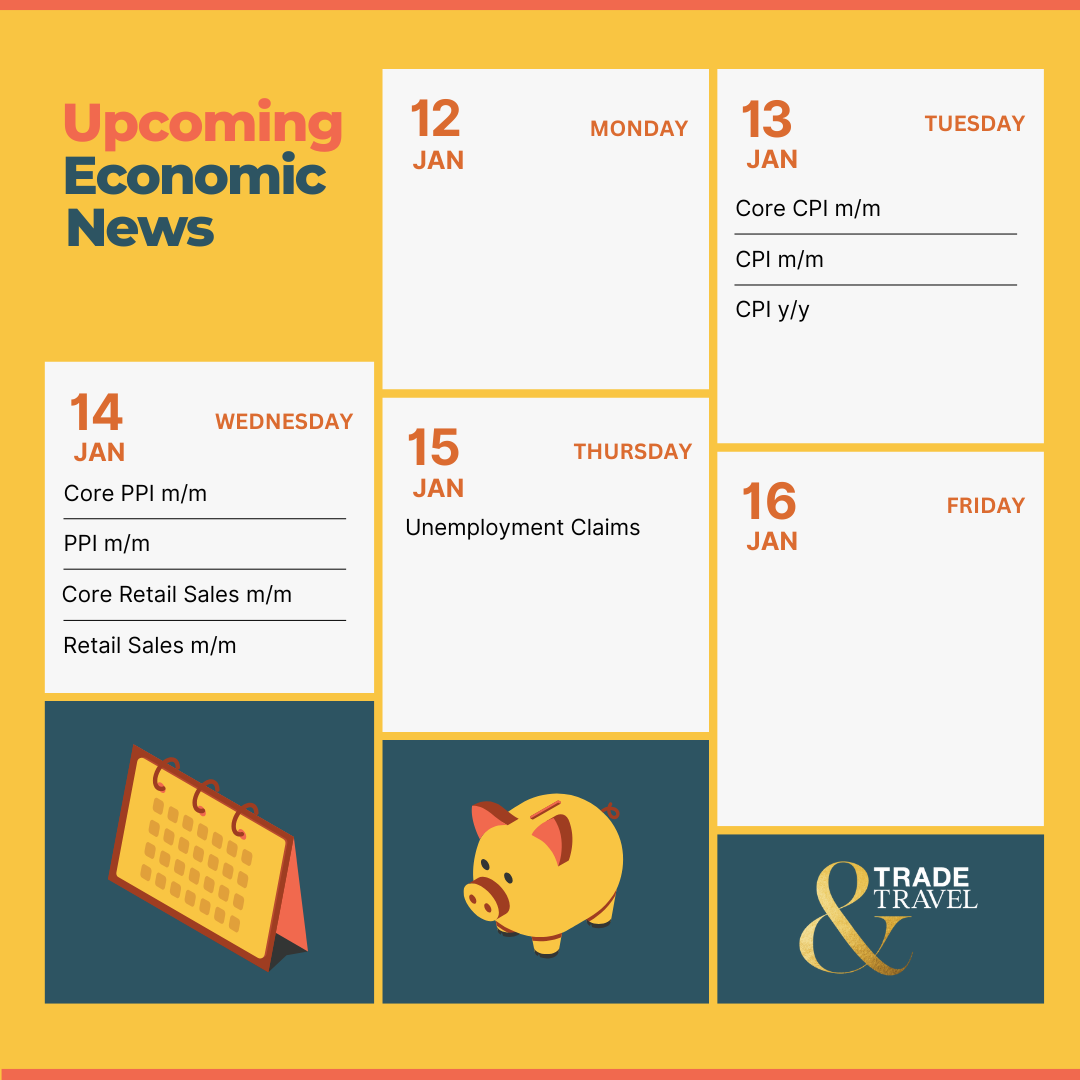
📅 Tuesday, Jan 13th
- Core CPI m/m: December core CPI is expected to rise about 0.3% month over month. Comparisons to November’s 0.2% should be made cautiously, as last year’s government shutdown disrupted CPI data collection and caused November’s report to emphasize two-month changes rather than a clean month-to-month print.
Market participants should closely monitor shelter and services components, as the latest CPI data show shelter up about 3.0% year over year and services inflation excluding energy near 3.0% year over year, trends that could shape expectations for the Fed’s policy path in the coming quarters. Economists say holiday discounting may have softened some goods prices in November, setting up the potential for a rebound in those components in December.
Any significant deviation above the 0.3% forecast or evidence that services inflation is not moderating could support a more hawkish Fed stance, while a miss lower might reinforce narratives of sustained disinflation and support equities.
- CPI m/m: Headline CPI is expected to rise about 0.3% m/m in December, in line with consensus forecasts. Market participants should closely monitor goods price pressures tied to tariff implementation, which analysts have flagged as a potential source of upside risk to monthly inflation relative to consensus. At the same time, economists caution that residual data distortions from the government shutdown may continue to mute reported goods and rental price readings, complicating the signal in near-term CPI prints.
Rates futures largely price a hold at the Fed’s Jan 27–28 meeting, making December’s CPI release an important input for expectations around the Fed’s March decision and the broader path of policy in 2026.
- CPI y/y: The headline CPI is forecasted to hold at 2.7% year-over-year, matching the previous month’s reading. Core CPI, excluding volatile food and energy, is also forecast to rise 2.7% year-over-year in December compared to 2.6% in November, signaling a slight uptick in underlying inflation momentum.
📅 Wednesday, Jan 14th
- Core PPI m/m: The upcoming Core Producer Price Index report is expected to show a 0.2% month-over-month increase, following the prior month’s 0.1% gain in the Bureau of Labor Statistics’ core measure of producer prices. A reading above that 0.2% forecast would point to firmer input cost pressures that could eventually pass through to consumer prices and complicate expectations for Federal Reserve easing later in the year.
Within the report, traders will be paying close attention to the services components of core PPI, particularly transportation and healthcare-related categories, which major outlets often highlight as drivers of stickier inflation dynamics. Persistent strength in these areas would suggest that underlying price pressures remain embedded beneath the surface.
A softer outcome in the 0.0% to 0.1% range would reinforce the recent disinflation narrative and signal that wholesale cost pressures continue to cool. By contrast, a hotter print would raise questions about how durable that progress is and could shift near-term rate-cut expectations for 2026.
- PPI m/m: The Bureau of Labor Statistics is scheduled to release the Producer Price Index report for November 2025. Due to the fall 2025 lapse in federal appropriations, the October 2025 PPI will not have a standalone news release and will instead be published alongside the November report, meaning the upcoming release will deliver two months of PPI data at once.
Market participants will be watching how closely the headline figure aligns with the roughly 0.3% consensus forecast, as this release will provide the first uninterrupted look at producer inflation since the government-related reporting delay.
Traders should also evaluate the sequential momentum, comparing the 0.3% forecast against recent monthly trends and watching for any acceleration in goods prices or services components that could suggest inflation remains stickier than policymakers anticipate and complicate the Fed’s path to its 2% target.
- Core Retail Sales m/m: The Core Retail Sales report will provide critical insight into American consumer spending patterns, excluding volatile categories. The forecast expects a 0.4% month-on-month increase, matching the previous reading of 0.4%, indicating steady underlying demand momentum as the new year begins.
Market participants should monitor the actual result since Core Retail Sales represents a cleaner gauge of consumer behavior than headline retail sales. A beat above 0.4% would signal resilient household consumption supporting economic growth, while a miss could indicate softening consumer demand amid elevated interest rates and suggest caution about the inflation trajectory.
- Retail Sales m/m: The November Retail Sales report arrives with economists forecasting a 0.4% month-over-month increase following October’s 0.0% reading, signaling a modest rebound in consumer spending after flatness in the prior month.
A beat above the 0.4% forecast would validate that post-holiday consumer momentum remains intact and support equity markets, while a miss could suggest weakening purchasing power and shift focus toward potential Federal Reserve rate cuts in 2026. Investors should also track category-level trends in discretionary versus non-discretionary spending and compare three-month moving averages rather than relying on the single monthly figure, given the data’s substantial volatility and historical tendency toward significant revisions.
📅 Thursday, Jan 15th
- Unemployment Claims: Initial jobless claims rose to 208,000 for the week ending January 3rd, falling slightly below the 210,000 forecast and representing an 8,000-claim increase from the prior week’s 200,000.
The four-week moving average fell to 211,750, the lowest since April 27th, 2024. Continuing claims rose by 56,000 to 1.914 million, suggesting some workers are taking longer to find new jobs even as layoffs remain relatively contained.
Market participants should closely monitor whether the upcoming weekly claims print deviates meaningfully from the 210,000 area, as a sustained upward trend in continuing claims could influence how markets reassess the Fed’s policy outlook and the near-term tone for equities. Readings that remain near recent lows around 210,000 would reinforce the view that layoffs are still contained, supporting risk sentiment.
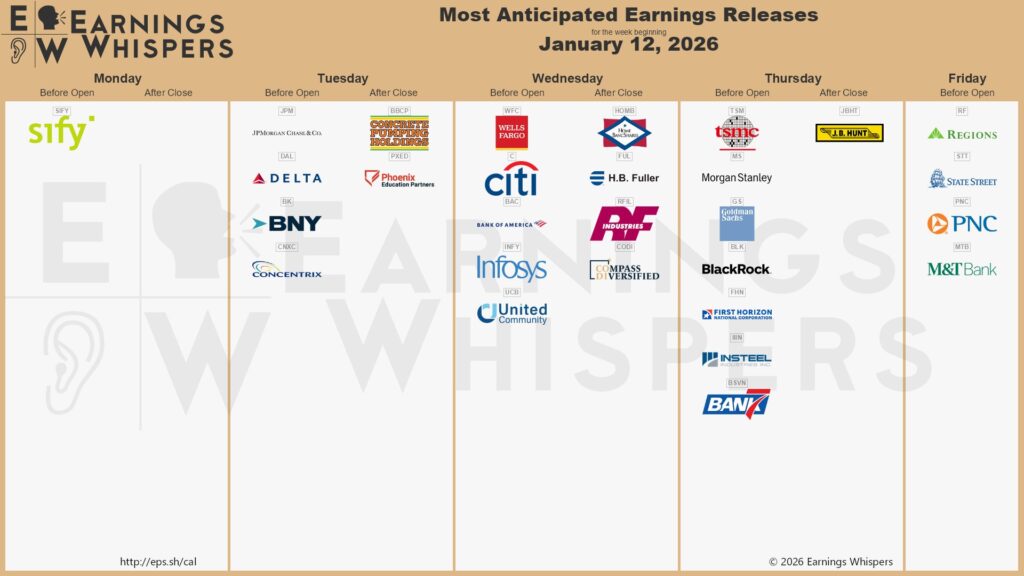
💼 Earnings season gets underway with the market’s first look at results from the “Big 4” U.S. banks, marking the start of a much heavier reporting cycle.
📅 Tuesday, Jan 13th
- JP Morgan Chase & Co. (JPM): JPMorgan Chase will report its Q4 2025 earnings with forecast expecting earnings per share of $4.88, representing a 1.4% year-over-year increase from $4.81 in the prior year period. Revenue is projected to reach $46.17 billion, reflecting a 7.9% year-over-year increase.
The bank has guided for approximately $25 billion in net interest income (NII) for Q4 2025, bringing full-year 2025 NII to roughly $95.8 billion. Markets revenue is expected to grow in the low-teens percentage range, with equity markets revenue forecast at $2.82 billion (up 38.2% year-over-year) and fixed-income markets revenue at $5.61 billion (up 12.1% year-over-year), driven by strong trading activity and market volatility.
Investment banking revenue in the corporate and investment banking segment is anticipated to rise in low-single digits, with consensus estimates of $2.71 billion (up 4.2% year-over-year), reflecting improved dealmaking activity heading into 2026. Credit quality metrics show non-performing loans projected at $10.54 billion (up 19.4% year-over-year) and non-performing assets at $11.16 billion (up 20.2% year-over-year), suggesting normalization from historically low delinquency rates.
Investors should monitor management’s 2026 expense guidance, which Marianne Lake, CEO of Consumer and Community Banking, recently signaled could reach about $105B, above analysts’ average estimate of $100.84B, driven largely by growth and volume-related costs and strategic investments.
- Delta Air Lines, Inc. (DAL): Delta Air Lines is set to report its Q4 2025 earnings with analysts expecting earnings per share of around $1.53 and total revenue at about $14.68 billion. The company’s guidance for the quarter projects a 2% to 4% year-over-year revenue increase with an operating margin between 10.5% and 12%, which would be modestly above the Q3 operating margin of 10.1%.
Investors should watch unit revenue trends, particularly the continued outperformance of premium cabin revenue, which surged 9% year-over-year in Q3, against main cabin weakness, as premium bookings are now expected to exceed coach revenue in 2026. The critical metric to keep an eye on is the company’s full-year 2025 earnings guidance of approximately $6 per share.
Delta has reiterated its long-term financial framework heading into 2026, outlining a path toward “top-line growth, margin expansion and earnings improvement,” alongside a leverage target of around two times or less. In its most recent quarterly update, the company pointed to improving domestic fundamentals and meaningful improvement in Transatlantic unit revenue as key pillars of its outlook.
Against that backdrop, Delta’s operational metrics, including Cost per Available Seat Mile (CASM) trends and progress on debt reduction, will serve as markers of whether management is executing on that framework as the company moves into 2026.
📅 Thursday, Jan 15th
- BlackRock, Inc. (BLK): BlackRock will report Q4 2025 earnings marking a critical opportunity for investors to assess the world’s largest asset manager’s momentum heading into 2026. Analysts expect BlackRock to deliver adjusted earnings per share of $12.30, representing a 3.1% increase from $11.93 in the year-ago quarter, though this marks more modest growth compared to recent quarters.
For full-year 2025, BlackRock is projected to achieve EPS of $47.51, up 8.9% year-over-year from $43.61 in 2024, while 2026 earnings are forecasted to grow 12.5% to $53.46 per share. The company enters the quarter with record assets under management of $13.46 trillion as of Q3 2025, up 17% year-over-year, providing a strong foundation for fee growth across all asset classes.
The successful integration of the $12 billion HPS Investment Partners acquisition completed in July 2025 should be scrutinized for contribution to private credit revenues and fee-paying asset expansion of $118 billion. Management’s outlook on net inflows, margin expansion, and the impact of the Citi wealth management partnership overseeing approximately $80 billion in assets will be critical metrics for assessing 2026 growth prospects.
- Taiwan Semiconductor Manufacturing Co., Ltd. (TSM): Taiwan Semiconductor Manufacturing Company is scheduled to release its Q4 and full-year 2025 earnings report with investors and traders keenly watching for the company’s 2026 guidance and capital expenditure plans amid the ongoing artificial intelligence boom.
TSMC’s Q4 revenue reached NT$1.046 trillion ($33.1 billion), representing a 20.5% year-over-year increase and surpassing estimates of NT$1.036 trillion, reflecting sustained demand for AI-related semiconductors and advanced computing chips. For the full year 2025, the company reported record consolidated sales of NT$3.81 trillion, up 31.6% from 2024, underscoring the scale of the AI-driven growth cycle now shaping the semiconductor industry.
Attention remains on TSMC’s advanced packaging capacity, which industry coverage has identified as a key constraint in the AI chip supply chain as demand continues to surge.
Major bank research has highlighted that, despite elevated capital spending tied to overseas expansion and next-generation nodes, TSMC’s gross margins are expected to remain resilient, with forecasts pointing to margins sustaining or exceeding 60% as new facilities ramp. That outlook is supported by expectations of tight supply and high utilization for advanced 3nm and 5nm nodes through at least 2027, reflecting the durability of AI-driven demand across leading-edge semiconductors.
- Goldman Sachs Group, Inc. (GS): Goldman Sachs will report its Q4 2025 earnings with estimates calling for earnings per share of $11.64 and revenue of $14.48 billion. The firm has delivered exceptional performance throughout 2025, with an average quarterly revenue of roughly $15 billion across the first three quarters and a standout Q1 EPS of $14.12, while Q3 results beat expectations with $12.25 EPS against a $11.02 estimate.
The stock has surged approximately 66% over the past twelve months, vastly outpacing the S&P 500’s roughly 17% return, and investors will be watching for continued earnings strength and operational momentum.
Goldman’s Q4 results will be closely watched because trading and advisory revenue tend to be highly sensitive to market conditions, and major coverage of the quarter has pointed to stronger dealmaking activity alongside robust trading across banks. Separately, commentary has long highlighted that Goldman’s results can be volatile given its exposure to capital markets and investment banking cycles, and CEO David Solomon has faced scrutiny at times following uneven performance.
Global dealmaking showed signs of recovery in 2025, and investors will be watching whether that momentum continues into the new year. Goldman finished 2025 as the world’s top M&A adviser, leading all banks with $1.48 trillion in announced deals, according to LSEG data. Ahead of its January earnings report, management’s commentary on deal pipelines will be closely followed for clues on whether advisory strength can carry into 2026.
We hope this helps and happy trading!
– Trade and Travel Team
2 Comments
Related Blogs


Follow Us
Testimonials
Hear from students on why they chose the Trade and Travel Family and how it has changed their lives.


Thanks for the detailed update, appreciated.
Thank you for supporting us in our trading/investing journey! This is excellent!