
Wall Street started February mixed. Markets were pulled in different directions by interest-rate worries, major earnings reports, and investors shifting money into traditional, established companies.
That push and pull showed up clearly across the major indexes. The S&P 500 ETF (SPY) dipped about 0.2%, basically flat, suggesting investors are starting to question whether most of the good news is already reflected in prices. The Nasdaq-heavy QQQ did worse, falling around 1.97%, as traders pulled back from large growth stocks after earnings and reduced exposure. Meanwhile, the Dow ETF (DIA) jumped about 2.45%, helped by a strong shift into industrials, financials, and other cyclical stocks as investors looked for value outside of expensive tech.
That rotation was reinforced by a busy earnings week. Earnings season stayed in full swing. Major tech, semiconductor, consumer, and healthcare companies reported, including Alphabet, Amazon, Microsoft, AMD, and Palantir. Results were mixed but far from disastrous, keeping markets choppy rather than clearly directional. Several companies beat expectations, but stocks often sold off on cautious guidance or higher spending plans. Overall, revenues are holding up, but margins and forward outlooks are under closer scrutiny. Even mildly conservative guidance is being punished more than it was in 2025, signaling that investors are no longer complacent.
At the same time, macro data added another layer of caution. Macro data also kept investors cautious. The week brought several important releases, including ISM manufacturing and services reports and weekly jobless claims, giving a fresh read on economic momentum and labor-market conditions. Together, the data reinforced that the labor market remains relatively resilient while the Federal Reserve has paused rate cuts but stopped short of signaling an outright pivot.
Looking ahead, that macro focus only intensifies. Markets face a delayed nonfarm payrolls release, followed by the January CPI print, two releases that will heavily shape expectations for the Fed’s next move and, by extension, the durability of this year’s rally. Between those data hits and another dense earnings calendar, volatility risk is elevated. For both traders and investors, this week is less about chasing price and more about recalibrating narratives: growth versus value, AI story stocks versus cash-generative compounders, and above all, how long the economy can run this hot without forcing the Fed’s hand.
How This Impacts You
With markets pulling back from last year’s big growth winners, you can start by reviewing where most of your money is currently invested and identifying which stocks are driven by future potential versus businesses already producing consistent results.
This earnings season is a good opportunity to stress-test your assumptions by asking yourself: If this stock dropped after earnings, would I still feel comfortable owning it for the next year? Before buying new stock, it helps to tighten your criteria by being clear on why you’re buying, how much downside you’re willing to tolerate, and what would make you change your mind.
If you made gains last year, this may be a good moment to rebalance on your own terms rather than being forced to make decisions during a stressful market pullback. This is not financial advice.
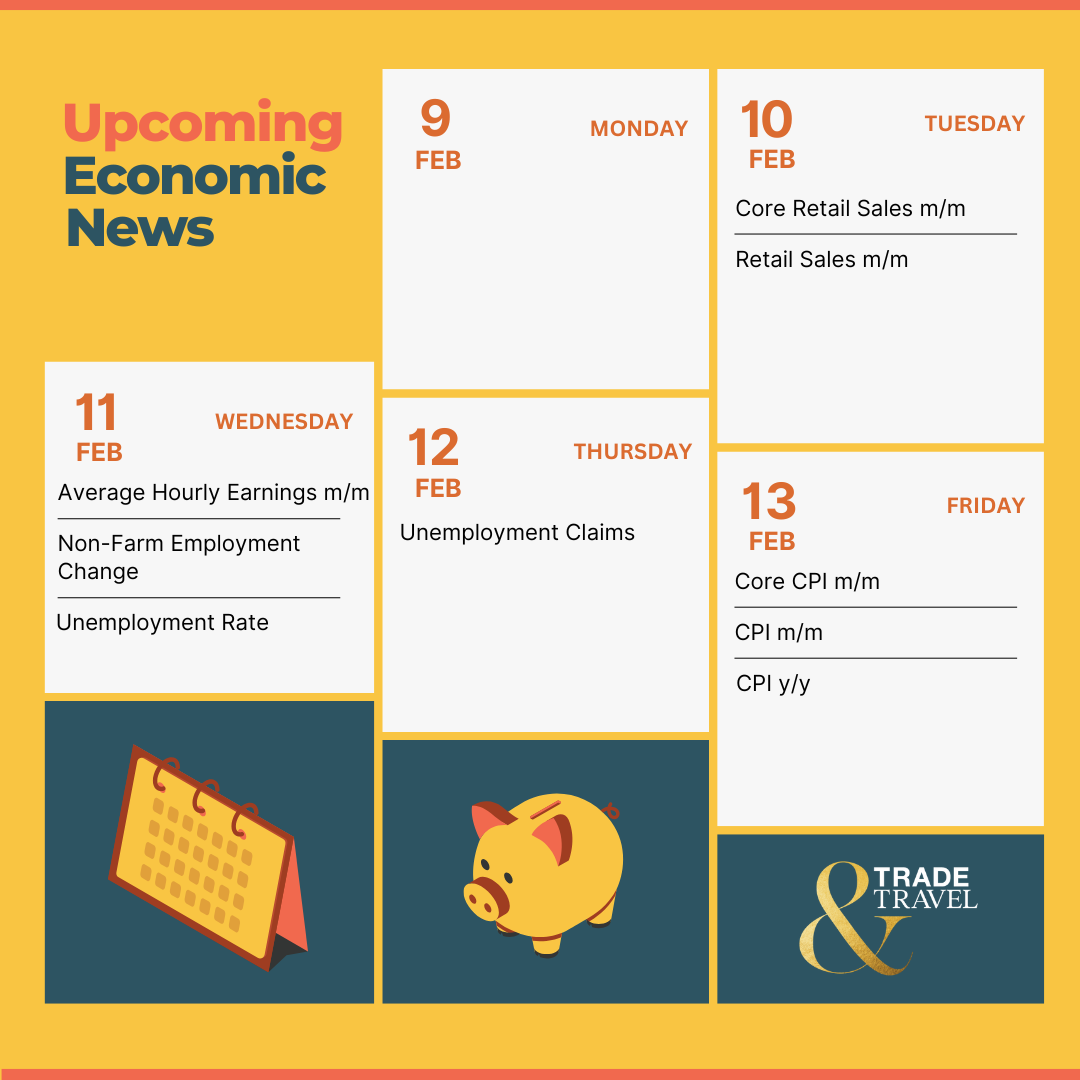
📅 Tuesday, Feb 10th
- Retail Sales & Core Retail Sales m/m: Retail sales data will provide a key read on the health of U.S. consumers and its implications for growth, inflation, and policy. Headline Retail Sales are expected to slow to 0.4% from 0.6%, pointing to demand that remains resilient but is beginning to cool. Markets will focus on the control group, which feeds directly into GDP, as confirmation of whether real economic activity is holding up despite tighter financial conditions.
At the same time, Core Retail Sales, which strip out autos and gas, are expected to rise around 0.4% after 0.5% previously. This measure will be watched more closely by equity investors as a gauge of underlying household demand. Strength in categories such as online sales, electronics, and food services would support earnings expectations for consumer discretionary and retail names, while any downside surprise or negative revisions could reinforce rate-cut expectations and weigh on the dollar.
📅 Wednesday, Feb 11th
- Average Hourly Earnings m/m: Average Hourly Earnings is expected to hold steady at 0.3% after a prior 0.3% gain, signaling still firm wage growth that the Federal Reserve will watch closely as it assesses inflation risks.
A print at or below 0.2% would suggest wage pressures are easing, which could support expectations for lower future policy rates and be constructive for equities and Treasuries. A surprise upside to 0.4% or higher would point to reaccelerating wage inflation, likely pushing yields and the dollar up while pressuring rate-sensitive growth stocks.
Market participants should also focus on the year-over-year wage figure, since a move materially above 3% to 4% would reinforce concerns that services inflation could stay sticky even if headline CPI drifts lower. Investors will be watching how the wages data align with nonfarm payrolls and the unemployment rate to judge whether the labor market is cooling enough for the Fed to feel comfortable with eventual rate cuts.
- Non-Farm Employment Change: The upcoming Non-Farm Payrolls report, following a 50,000 increase previously and a ~70,000 forecast, will help clarify whether job growth is stabilizing after recent cooling or showing early signs of reacceleration. Markets will focus less on the headline and more on revisions to prior months, which have meaningfully altered recent labor-market narratives.
A payroll gain concentrated in lower-wage or part-time roles would reinforce the view that the labor market is cooling without breaking, while broader job growth across higher-paying sectors would challenge expectations for near-term policy easing. Investors will also assess how payrolls align with Average Hourly Earnings and the unemployment rate to determine whether slowing inflation pressures are being matched by softer labor demand.
- Unemployment Rate: The unemployment rate is expected to hold at 4.4%, reinforcing the view that the labor market is cooling gradually rather than deteriorating sharply. More than the headline, investors will look to broader measures of slack, including the labor force participation rate (around 62.4%) and the U-6 underemployment rate (near 8.4%), to assess whether softness is spreading beyond the surface.
A stable unemployment rate alongside modest job growth would support the “cooling but intact” narrative, while a sustained rise in unemployment, particularly if participation weakens or underemployment rises, would signal that labor market slack is building more decisively. How these measures evolve relative to payroll growth and wage trends will shape confidence in whether easing inflation pressures are being reinforced by a loosening labor market.
📅 Thursday, Feb 12th
- Unemployment Claims: Weekly jobless claims remain the market’s fastest read on labor-market stress, and the upcoming print is expected to ease to around 222k from 231k. More than the one-week number, investors will focus on the trend in continuing claims and four-week averages to assess whether layoffs remain isolated or are beginning to spread.
Persistently low claims would suggest employers are still reluctant to shed workers, reinforcing labor-market resilience. By contrast, a sustained rise in continuing claims would indicate that displaced workers are taking longer to find new jobs, an early sign that slack is building beneath the surface, even before it shows up in payrolls or the unemployment rate.
📅 Friday, Feb 13th
- Inflation (CPI): The upcoming CPI report will be closely watched as a test of whether disinflation is continuing, and whether it is happening in the areas that matter most for policy. Headline CPI year over year is expected to ease to 2.5% from 2.7%, reinforcing progress toward the Fed’s target but still leaving inflation above comfort levels.
At the monthly level, CPI is expected to rise 0.3%, matching the prior reading and implying an annualized pace of roughly 3.6%. That keeps near-term inflation pressure elevated and shifts attention away from the headline and toward the underlying drivers. Core CPI is also expected to print around 0.3%, up from 0.2%, suggesting that inflation momentum has slowed but not fully broken.
As a result, markets will focus less on whether inflation is falling and more on where it is proving sticky. Key areas include services inflation, shelter, and core services excluding shelter (“supercore”), which policymakers view as better gauges of underlying pressure. Broad-based moderation across these components would reinforce confidence that disinflation is becoming more durable, while renewed firmness would raise questions about how much policy flexibility the Fed truly has in the months ahead.
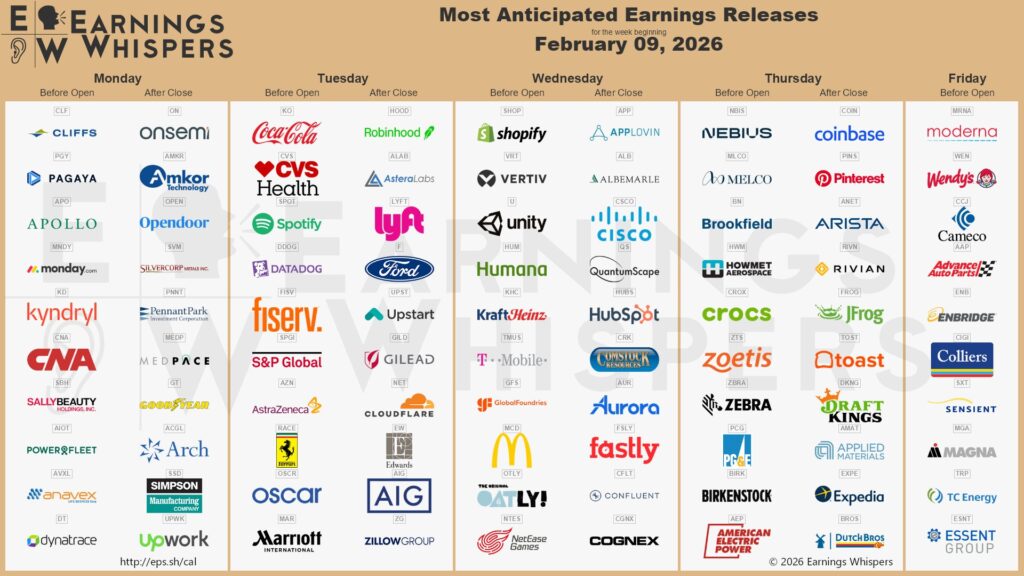
💼 As earnings season rolls on next week, attention turns to a wide range of major U.S. companies, providing insight into how the broader market is holding up after big tech results.
📅 Tuesday, Feb 10th
- Coca-Cola Company (The): Coca-Cola will report its Q4 and full-year 2025 earnings, capping a year in which organic revenue growth is expected to be within the company’s guided 5–6% range, supported by resilient consumer demand. Analysts expect mid-single-digit year-over-year revenue growth in Q4 and comparable EPS of approximately $0.56–$0.57, reflecting modest growth from Q4 2024.
Key metrics to watch include global unit case volume, which has been posting low single-digit growth, and whether emerging markets such as India can continue to offset softer demand in developed markets. Margins will also be pivotal: Q3 benefited from efficiency-driven operating income growth, and investors will be watching whether currency-neutral operating margins remain strong amid seasonal mix effects and input costs in Q4.
Full-year 2025 comparable EPS guidance sits around 3% growth to roughly $2.98 from $2.88 in 2024, including a 5% FX headwind, and any tweak there signals 2026 trajectory. Free cash flow outlook remains a highlight at $9.8 billion excluding one-offs, supporting dividends and buybacks.
Geographic breakdowns, especially North America pricing, Europe volumes, and Asia recovery, will reveal consumer elasticity and portfolio strength in sparkling, zero-sugar, and non-carb categories. Management commentary on promotional intensity, Zero Sugar acceleration (up 14% in Q3), and refranchising progress will shape views on sustained 5-6% organic growth into 2026.
📅 Wednesday, Feb 11th
- Cisco Systems, Inc. (CSCO): Cisco Systems’ upcoming earnings will be a key test of whether the company can deliver on its recently raised outlook. Management guided revenue to $15.0–$15.2 billion with non-GAAP EPS of $1.01–$1.03, ahead of prior expectations. Analysts are currently forecasting revenue of about $15.11 billion and EPS of $1.02, placing results near the upper end of management’s guidance range. Investors are now looking for confirmation that Cisco can sustain solid revenue growth as year-over-year comparisons become more challenging.
For traders, product orders and backlog trends will be important drivers of post-earnings reaction. In its most recent quarter, Cisco reported product orders up 13% year over year, with broad-based strength across networking. Order momentum is closely watched because it can provide insight into near-term revenue visibility.
AI networking remains a major focus. Cisco disclosed $1.3 billion in AI-related orders from hyperscaler customers, and management expects to recognize around $3 billion in AI-related revenue in FY26, building on the company’s expanding AI infrastructure business. Investors will pay close attention to management’s commentary on AI demand, hyperscaler engagement, and revenue visibility, as sustained progress in these areas could influence longer-term growth expectations.
📅 Thursday, Feb 12th
- T-Mobile US, Inc. (TMUS): T-Mobile US will report Q4 and full-year 2025 results, and the company has confirmed that this earnings call will be paired with a Capital Markets Day update, including refreshed financial targets for 2026 and 2027, making it an important event for investors and analysts alike.
Investors will be watching whether Q4 service revenue growth can sustain the roughly 9% year-over-year pace reported in Q3 2025, when service revenue totaled about $18.2 billion and total revenue was approximately $22.0 billion. These figures provide the benchmark heading into the final quarter. A key area of focus will be postpaid momentum. T-Mobile has guided to 2025 total postpaid net customer additions of 7.2–7.4 million, including around 3.3 million postpaid phone net adds. Q4 disclosures on net additions, churn, and ARPA (Average Revenue Per Account) will help investors assess whether the company met or exceeded its full-year targets.
Management has highlighted operating margin running above 20% and net margin near 13% on 2025 forecasts, so investors should watch for any sign in Q4 of competitive pressure eroding pricing power or pushing up promotion costs. Strategically, updates on integration of recent deals (such as the U.S. Cellular-related expansion and fiber/5G broadband initiatives) and fixed wireless net adds will help frame how much incremental revenue growth is left beyond the core mobile franchise.
- Humana Inc. (HUM): Humana will report Q4 and full-year 2025 results. Consensus expectations point to a swing to a quarterly estimated EPS loss of $4.00, versus profitability a year earlier, despite revenue projected in the low-to-mid $30 billion range for the quarter, reflecting elevated medical and benefit costs. For full-year 2025, analysts continue to expect revenue growth toward the high-$120 billion range alongside positive earnings, putting greater emphasis on the company’s 2026 outlook than on the volatile quarterly result.
The primary focus will be on medical cost trends in Medicare Advantage, particularly the medical loss ratio and management’s commentary on utilization. Analysts broadly expect benefit expense to run higher than last year, making any evidence of cost stabilization or early normalization important for sentiment.
Markets will also closely watch medical membership trends, where consensus points to continued pressure. Any indication that attrition is stabilizing, or worsening, could drive post-earnings volatility. Beyond the headline numbers, investors will be listening for updates on cost control, margin recovery initiatives, and expectations for utilization trends in 2026, which are likely to carry more weight for valuation than the near-term earnings swing itself.
📅 Friday, Feb 13th
- Applied Materials, Inc. (AMAT): Applied Materials reports fiscal Q1 2026 with the Street looking for EPS of roughly $2.21, reflecting a still-challenged wafer-fab equipment environment. Investors will benchmark guidance against management’s recent commentary, pointing to muted near-term revenue trends, placing greater emphasis on signals around demand later in the year.
In particular, markets will listen closely for management’s tone on a potential second-half 2026 recovery, especially tied to AI-related and advanced-node semiconductor spending, which analysts and industry commentary have identified as key drivers of any cyclical upturn.
Q4 2025 revenue came in at 6.80 billion, down about 3.4% year over year, so traders will watch whether Q1 revenue and orders confirm this mild digestion phase or show an earlier inflection. With record FY 2025 revenue of 28.37 billion and EPS of $9.42, the market will focus on whether management can at least sustain, if not grow, earnings power into 2026 despite export restrictions and cyclical headwinds.
Watch segment color on leading-edge foundry and logic as well as memory, particularly tools tied to advanced nodes, HBM, and advanced packaging, as these areas have driven the vast majority of Semiconductor Systems orders in recent periods. Regional mix will also matter. Traders should track any quantified impact from U.S.–China export restrictions versus offsetting demand in the U.S., Europe, Korea, and Taiwan, as management commentary around deferred or at-risk orders can move the stock quickly.
We hope this helps and happy trading!
– Trade and Travel Team
Related Blogs







Follow Us
Testimonials
Hear from students on why they chose the Trade and Travel Family and how it has changed their lives.

