
Last week’s market action told an interesting story. Investors are beginning to price in stabilization after a volatile start to the year. The tone shifted from defensive positioning toward cautious optimism, driven largely by signs of government recovery efforts and improving macro clarity.
For the week, major U.S. indexes finished modestly higher. The SPY (S&P 500) gained approximately +1.1%, the QQQ (Nasdaq) rose +1.14%, and the DIA (Dow Jones Industrial Average) added roughly +0.3% for the week.
One of the most important catalysts was the evolving government recovery backdrop. Economic growth data came in softer than expected, with U.S. Q4 GDP slowing to approximately 1.4%, partly influenced by earlier government shutdown disruptions. Rather than alarming investors, the data reinforced expectations that policymakers may need to support economic momentum as the economy moves through a normalization phase.
Earnings season continued to highlight a key theme. Corporate America remains resilient even as leadership rotates beneath the surface. Instead of mega-cap technology alone driving performance, investors increasingly rotated toward value-oriented and cyclical areas of the market. Broader participation across sectors pointed to improving market breadth, which many traders view as a healthier foundation for sustained advances.
Heading into next week, investors will be watching whether the recovery narrative holds. Markets remain sensitive to macroeconomic data, policy developments, and signals about the pace of economic stabilization.
How This Impacts You
You are seeing markets shift from uncertainty toward cautious optimism, making this an ideal time to study market behavior rather than rushing to place trades. You can watch how leadership rotates across sectors and note which stocks show strength or weakness during market pullbacks, helping you recognize trading cycles in real time. You might use this phase to begin tracking a small watchlist and observing how prices respond to economic news and market sentiment. This content is educational only and not financial advice.
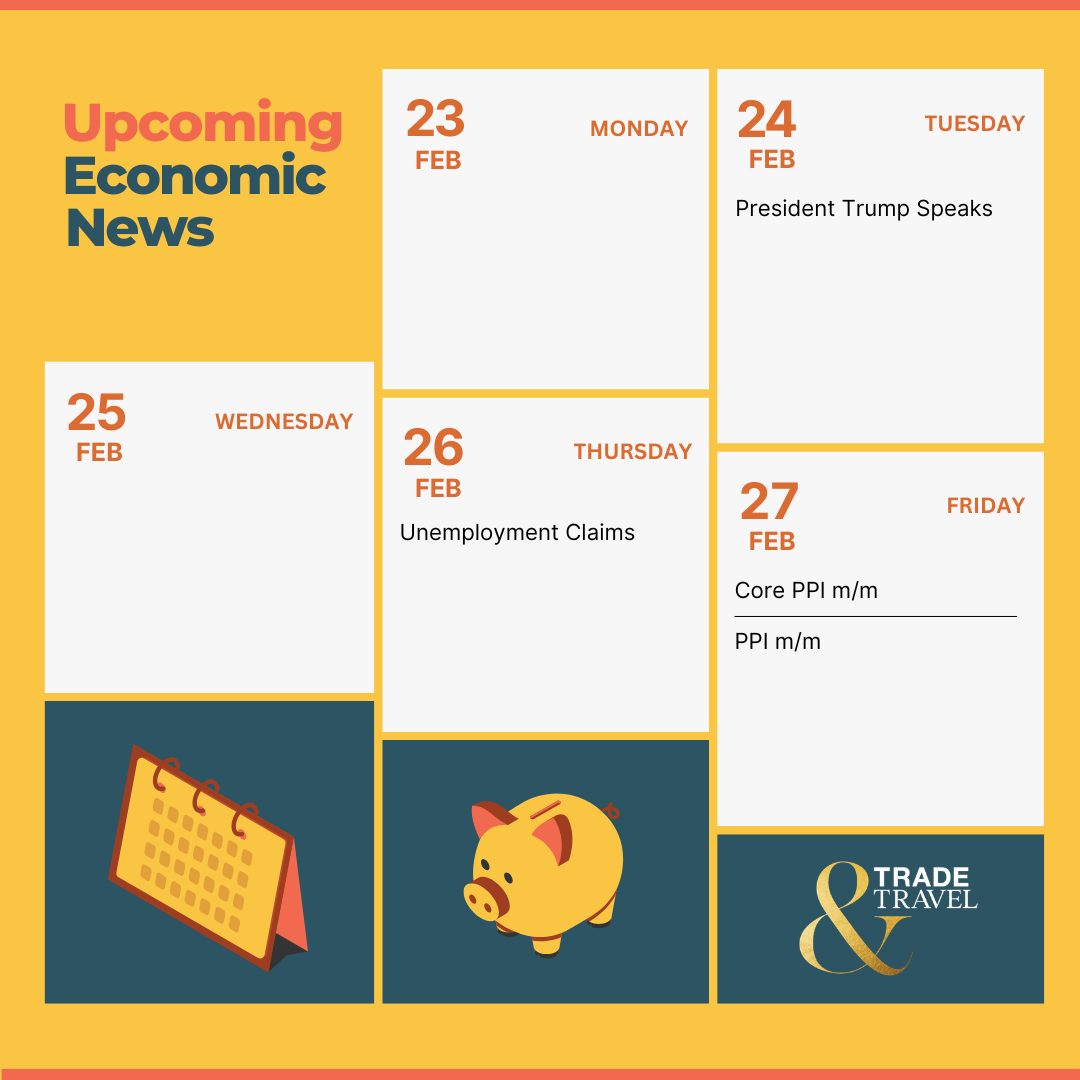
📅 Tuesday, Feb 24th
- President Trump Speaks: President Donald Trump is scheduled to deliver the State of the Union Address before a joint session of Congress in Washington, D.C., where he is expected to outline the administration’s economic outlook and legislative priorities for the year ahead.
Markets will focus on signals related to trade policy, tariffs, government spending, taxation, and domestic industry, areas that historically shape investor expectations and sector performance. Recent trade actions have kept tariffs and supply chain policy in focus, making any additional guidance particularly relevant for multinational companies and U.S. manufacturers.
Traders will be monitoring potential volatility across major indexes, including the S&P 500 and Nasdaq, as investors assess implications for inflation trends, fiscal policy direction, and interest rate expectations, with energy, defense, financials, and industrials among sectors most sensitive to policy developments.
📅 Thursday, Feb 26th
- Unemployment Claims: The upcoming Initial Jobless Claims report is expected to rise to 216K from the previous 206K, signaling a modest cooling in labor market strength.
Investors will watch whether claims continue trending higher, as sustained increases could indicate slowing hiring conditions and reduced economic momentum. A reading near or below 206K would reinforce labor market resilience and may support expectations that the Federal Reserve can keep rates higher for longer. Conversely, a move meaningfully above 216K could increase recession concerns and strengthen expectations for future rate cuts.
Traders should also monitor the 4-week moving average of jobless claims, which currently stands at 219K, as it smooths weekly volatility and helps investors identify the underlying trend in layoffs rather than short-term fluctuations.
📅 Friday, Feb 27th
- Core PPI m/m: The upcoming Core PPI m/m report is forecast to moderate to around 0.3% from the prior 0.7%, suggesting underlying inflation pressures may be stabilizing after last month’s acceleration. Because Core PPI excludes volatile food and energy prices, this release provides a clearer view of persistent pricing trends that Federal Reserve officials closely monitor.
A reading near expectations would reinforce the idea that inflation momentum is gradually easing, helping markets maintain confidence that policy tightening has already done much of its work. Softer core inflation could ease upward pressure on real yields and support risk sentiment. Conversely, another strong print would signal that underlying price pressures remain sticky, potentially delaying rate-cut expectations and increasing sensitivity in interest-rate-driven sectors.
- PPI m/m (Headline): The headline Producer Price Index m/m is projected by market economists to slow to roughly 0.3% from the previous 0.5%, offering insight into how cost pressures are evolving across the broader production pipeline. Unlike Core PPI, this measure captures energy and commodity price movements, making it a useful gauge of near-term shifts in input costs and supply-side dynamics.
A softer reading would suggest that pricing pressures on businesses are easing, which could eventually slow consumer inflation and shape expectations around Federal Reserve policy and corporate profitability. A stronger-than-expected reading, however, may signal renewed inflation pressures, particularly in commodities or energy, potentially driving reactions in bond markets, currencies, and inflation-sensitive assets.
Market participants will also watch revisions to prior data and immediate reactions in Treasury yields and the U.S. dollar, as headline PPI releases frequently drive short-term positioning and cross-asset volatility following the release.
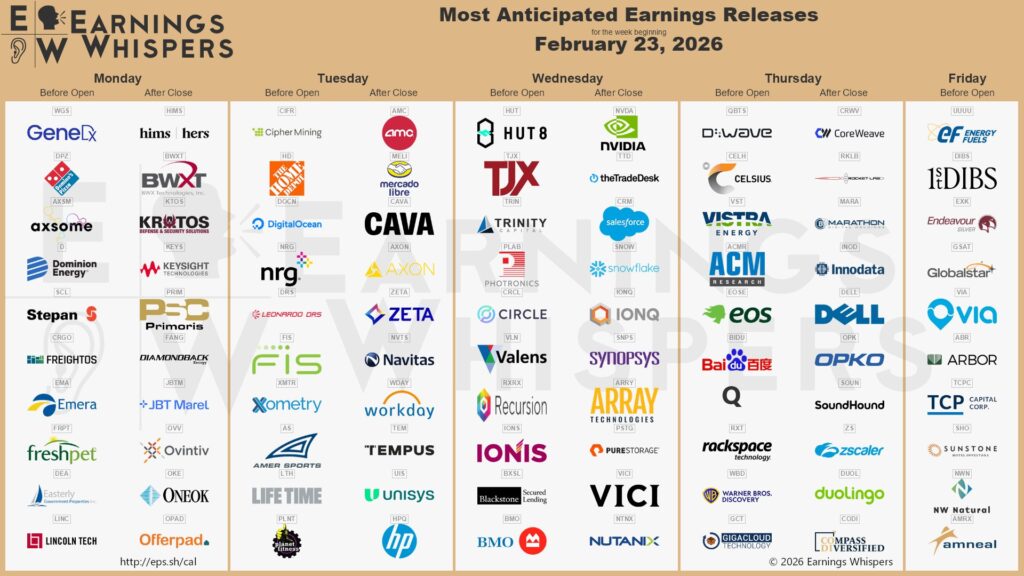
💼 Earnings season continues next week as major companies report, giving markets fresh insight into economic momentum and where growth is holding up.
📅 Tuesday, Feb 24th
- Home Depot, Inc. (HD): Home Depot is scheduled to report fiscal Q4 2025 earnings. Analysts currently expect earnings per share of about $2.51–$2.53, representing a roughly 19–20% year-over-year decline, while revenue is projected at about $38.25 billion, down about 3.6–3.7% year-over-year.
The primary focus will be comparable sales growth, as management previously guided fiscal 2026 same-store sales to range from flat to +2%, reflecting continued pressure from elevated mortgage rates and slower home turnover. Traders will watch whether professional contractor demand (“Pro” customers) offsets softer discretionary DIY spending, which has been constrained by high financing costs and delayed renovation projects.
Management commentary on large-ticket categories such as kitchens, flooring, and appliances will serve as a real-time read on U.S. consumer confidence and housing activity. Guidance may matter more than headline results, especially since Wall Street forecasts full-year EPS around $14.50, slightly below the prior year, before a potential recovery into fiscal 2026. From a macro perspective, the earnings call is often treated as a proxy update on the broader home improvement industry and U.S. housing health.
📅 Wednesday, Feb 25th
- The Trade Desk, Inc. (TTD): The Trade Desk is scheduled to report Q4 2025 earnings, with investors focused on whether growth stabilizes after a volatile period for the stock and the broader digital advertising sector. Wall Street expects approximately $0.34 in earnings per share alongside roughly $840 million in quarterly revenue, pointing to continued double-digit year-over-year growth, though at a more measured pace compared with the company’s earlier hyper-growth years.
One key metric will be performance in Connected TV, now the company’s largest and fastest-growing advertising channel and a primary structural growth driver. Management commentary around the Kokai AI advertising platform will also be important, as adoption has become central to efficiency gains and competitive positioning in programmatic advertising.
Investors should also evaluate advertiser spending trends and whether macro ad budgets are recovering, particularly as competition from large platforms and retail media networks intensifies. Margin performance will be important, with expectations that operating profitability could exceed 20% EBIT margins in the longer term if scale efficiencies continue.
Ultimately, this earnings report will likely hinge less on the quarter itself and more on guidance, advertising demand trends, and execution in AI-driven ad buying, which together will shape expectations for The Trade Desk’s 2026 growth trajectory.
- NVIDIA Corporation (NVDA): Nvidia is set to report its fiscal Q4 earnings, an event many investors view as one of the most important catalysts for global equity markets, given the company’s central role in the artificial intelligence boom.
Expectations remain high after several consecutive quarters of explosive growth driven by demand for AI infrastructure. Wall Street analysts are projecting revenue of roughly $65–66 billion and earnings per share near $1.50–$1.52, implying approximately 65–70% year-over-year revenue expansion if forecasts are achieved.
The primary area of focus will again be Nvidia’s data center segment, which has become the dominant driver of performance. In the previous quarter, data center revenue exceeded $50 billion, fueled by large-scale purchases from cloud providers, enterprise AI deployments, and sovereign AI initiatives worldwide. Investors will look for confirmation that hyperscalers and major technology companies continue allocating significant capital toward AI infrastructure buildouts heading into 2026.
Another major topic will be the rollout of Nvidia’s next-generation Blackwell architecture, which is expected to power the next wave of AI training and inference workloads. Markets will be watching closely for updates on production ramp-up, shipment timelines, and whether supply constraints are easing or persisting. Commentary around order visibility and backlog strength will help investors assess how sustainable current demand levels may be.
Market participants will also pay attention to customer concentration and competitive dynamics. Large cloud companies remain Nvidia’s biggest buyers, but ongoing investments in internally developed chips by hyperscalers introduce longer-term questions about diversification of AI hardware demand. Any discussion of evolving customer behavior or shifts in purchasing patterns could influence sentiment beyond this quarter.
📅 Thursday, Feb 26th
- Salesforce, Inc. (CRM): Salesforce is scheduled to report Q4 fiscal 2026 earnings, with Wall Street expecting roughly $3.03–$3.05 earnings per share on about $11.17–$11.18 billion in revenue, implying approximately 11% year-over-year growth. Investors will focus on whether Salesforce can sustain its recent streak of earnings beats after posting $3.25 EPS last quarter versus roughly $2.86 expected, signaling continued operating leverage and improving profitability.
A major theme this quarter is AI monetization, particularly growth from Agentforce and Data Cloud, which recently reached nearly $1.4 billion in annual recurring revenue, up 114% year over year. Margin performance remains another key catalyst, as Salesforce targets approximately 34.1% non-GAAP operating margins, reflecting ongoing cost discipline and efficiency gains.
Forward guidance may matter more than headline results, especially management commentary around fiscal 2027 growth following full-year FY2026 revenue guidance of roughly $41.45–$41.55 billion. Investors will also closely analyze remaining performance obligations near $59.5 billion, a key indicator of future contracted revenue visibility.
Overall, the upcoming report will likely hinge on three variables: AI-driven revenue acceleration, margin durability above 30%, and whether management signals confidence in sustaining high-single-digit to low-double-digit growth into the next fiscal year.
- Synopsys, Inc. (SNPS): Synopsys is scheduled to report fiscal Q1 2026 earnings, with analysts expecting approximately $3.57 EPS on about $2.39 billion in revenue. Investors will focus first on whether Synopsys can sustain the strong growth momentum seen in fiscal 2025, when revenue reached a record $7.05 billion, representing roughly 15% year-over-year growth.
A major driver to watch is the ongoing integration of the $35 billion Ansys acquisition, which expanded Synopsys beyond chip design tools into full engineering simulation software.
Another key metric investors will monitor is recurring software and maintenance revenue, which reflects the stability of Synopsys’ subscription-heavy business model. Backlog strength will also matter, as the company exited fiscal 2025 with more than $11 billion in backlog, providing visibility into future demand from semiconductor and AI customers.
Investors will watch commentary on AI-driven chip design spending, since Synopsys tools sit upstream in the semiconductor supply chain and often act as an early indicator of industry capital investment cycles. Geopolitical risks, China exposure, and foundry-related uncertainties remain areas analysts continue to flag as potential growth constraints during what management has described as a transition period following the Ansys integration.
We hope this helps and happy trading!
– Trade and Travel Team
Related Blogs

Follow Us
Testimonials
Hear from students on why they chose the Trade and Travel Family and how it has changed their lives.

