
Last week proved to be one of cautious consolidation for equity markets, as investors navigated a complex mix of corporate earnings surprises, economic crosscurrents, and fiscal stimulus expectations. The SPY (S&P 500) climbed 0.4% for the week, while the technology-heavy QQQ (Nasdaq) edged lower by a modest 0.14%. The DIA (Dow Jones Industrial Average) suffered the steepest losses, falling 0.39%.
Last week’s market volatility was largely driven by the opening salvos of Big Tech earnings, which produced sharply divergent stock reactions that unsettled investors. On Wednesday, Meta, Microsoft, and Tesla all reported fourth-quarter results that exceeded Wall Street’s earnings and revenue expectations, but market responses varied. Meta shares surged roughly 10% on strong results and optimistic AI-driven guidance, while Microsoft’s stock fell sharply following its report as investors focused on slowing cloud growth and margin pressures despite the earnings beat. Tesla shares, meanwhile, posted a modest gain after delivering results that topped expectations.
The Federal Reserve paused its rate-cutting cycle at its January 2026 meeting, holding the target federal funds rate at 3.50%–3.75%, marking a halt after three consecutive quarter-point cuts late last year. Fed Chair Jerome Powell said the U.S. economy continues to expand at a solid pace, while inflation remains above the Fed’s target and labor market conditions remain solid, supporting the committee’s decision to keep policy unchanged. The meeting also included dissenting votes in favor of a quarter-point rate cut, underscoring ongoing debate within the committee about the appropriate policy path. Market pricing now broadly reflects expectations that rates will remain unchanged through at least mid-2026, with any potential cuts later in the year likely to depend on incoming economic data.
The coming week will bring closely watched earnings reports from Palantir, Amazon, AMD, and a wide range of other companies, which are expected to play a key role in shaping sentiment around the durability of large-cap technology earnings momentum as the market heads into the second quarter.
How This Impacts You
You’re seeing a market that is no longer lifting everything at once, which can make decision-making clearer rather than harder. Notice where strong company results are met with hesitation, as this often reflects shifting expectations beneath the surface.
With interest rates likely to remain steady for months, you can use this environment to practice separating price behavior from emotion and headlines. Observe which moves follow through and which fade quickly, without feeling pressure to participate yet. Developing this kind of market awareness often makes the transition into trading feel more intentional and less overwhelming.
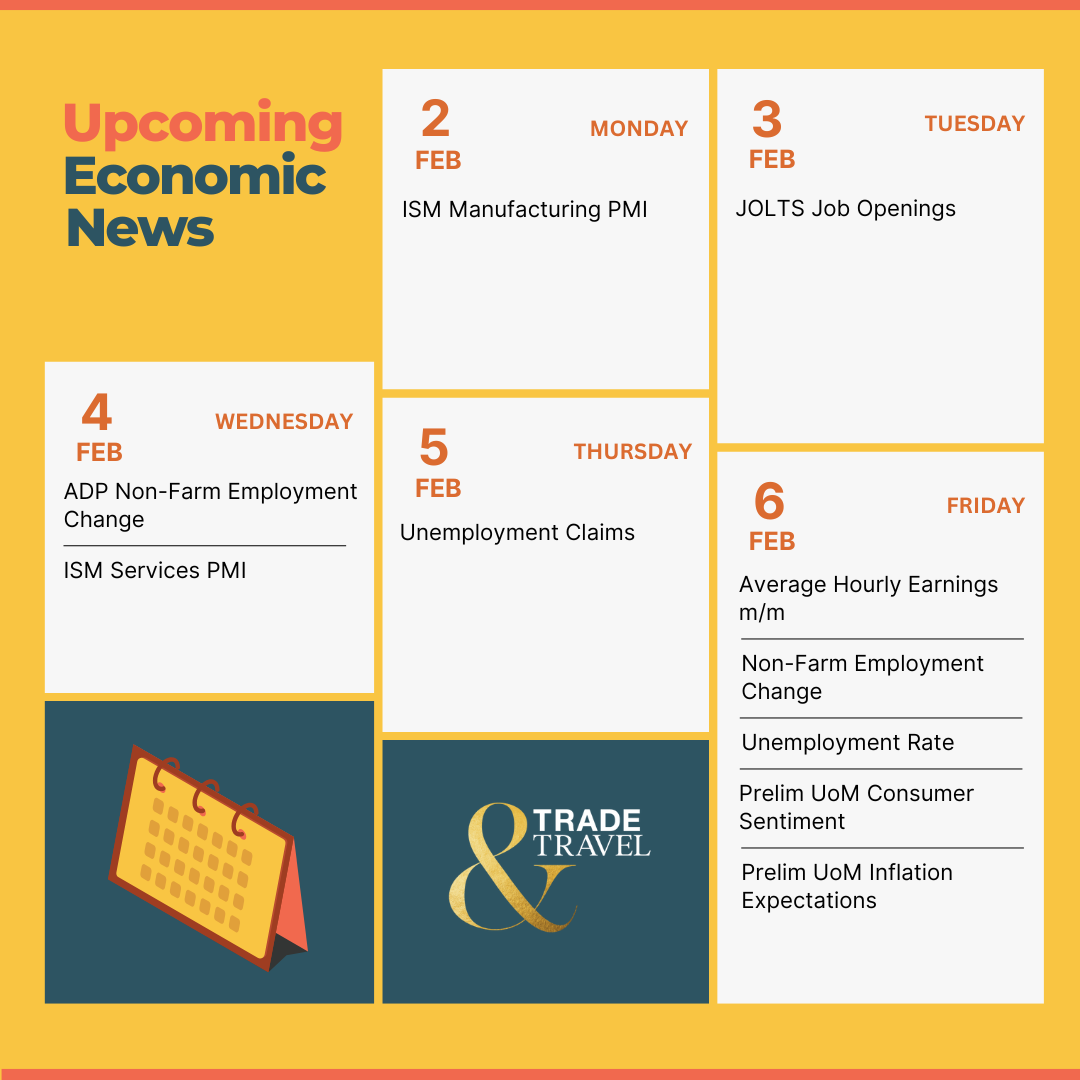
📅 Monday, Feb 2nd
- ISM Manufacturing PMI: The ISM Manufacturing PMI is expected to print at 48.5 in January, a 0.6-percentage point improvement from December’s 47.9 reading, though it will remain comfortably in contraction territory below the 50 threshold that signals expansion.
Market participants should closely monitor the New Orders subindex, which stood at 47.7 in December and is widely viewed as a forward-looking indicator of demand. A move toward 50 or higher would signal stabilization in customer demand following a prolonged period of manufacturing contraction. The Employment Index, which registered 44.9 and marked its eleventh consecutive month in contraction, remains an important gauge of labor conditions within the manufacturing sector and is closely watched for broader economic signals.
Watch the Prices Paid component, which has remained stubbornly elevated at 58.5 in December, as elevated input costs could indicate whether tariff passthrough is accelerating or easing in the production pipeline.
The manufacturing sector’s underlying health will ultimately hinge on whether the modest improvement reflects genuine demand recovery or simply seasonal adjustments, with ISM’s December reading of 47.9 corresponding to approximately 1.6% annualized GDP growth, suggesting a broad economic slowdown ahead.
📅 Tuesday, Feb 3rd
- JOLTS Job Openings: The upcoming JOLTS Job Openings report for December 2025 data will reveal crucial labor demand signals after November’s reading of 7.146 million job openings fell short of the prior month’s 7.449 million. The forecast of 7.21 million represents a modest recovery from November but remains significantly lower than the September peak of 7.658 million, signaling continued labor market deceleration.
Investors should closely monitor the industry-level breakdown and the quits rate, which are widely watched components of the JOLTS report and provide insight into labor demand and worker confidence. A reading above expectations would point to underlying labor market resilience, while continued weakness would reinforce signs of cooling labor conditions.
Traders should also note that December job openings data is published with a one-month lag, meaning this report offers retrospective insight into labor market conditions during the holiday hiring season rather than real-time guidance on January employment trends.
📅 Wednesday, Feb 4th
- ADP Non-Farm Employment Change: The upcoming ADP Non-Farm Employment Change report carries heightened importance following December’s disappointing 41,000 job additions against the analyst forecast of 48,000, raising questions about labor market durability entering 2026.
Economists and market participants will scrutinize the upcoming ADP Non-Farm Employment Change report for early signals about labor market momentum, especially in light of ADP’s weekly NER Pulse showing an average of 7,750 weekly job gains for the four weeks ending January 3, among the slowest recent readings, which could help distinguish between genuine stabilization and purely seasonal hiring patterns.
Investors can look at the sector-level breakdown and establishment size categories in the ADP report to understand where job gains are occurring. In December, small establishments added jobs after losses the prior month, while service-providing industries contributed the bulk of hiring, offering data points that help gauge labor market variations across parts of the economy.
- ISM Services PMI: The U.S. ISM Services PMI is forecast to decline from December’s 54.4 to 53.6 in February, signaling a moderation in services sector expansion while remaining in expansion territory above the 50-point threshold. This 0.8-point contraction would still represent solid activity given that the services sector comprises over two-thirds of the U.S. economy.
Investors should monitor the Employment Index closely, as it rose to 52.0 in December, returning to expansion after a prolonged period of contraction, and any renewed decline would signal softening labor conditions within the services sector.
The Prices Paid Index, which remained elevated at 64.3, continues to be an important watch point as it reflects ongoing input cost pressures in services. Traders should also scrutinize the Business Activity Index and New Orders Index for signs of whether the strong demand readings seen in December persist, as weakness in these forward-looking indicators would heighten concerns about first-quarter economic momentum.
📅 Thursday, Feb 5th
- Unemployment Claims: The next weekly unemployment claims report is expected to show initial jobless claims rising from the previous reading of 209,000 to a forecast of 213,000, marking a modest deterioration in labor market layoff activity.
This anticipated increase would remain well below historical averages and align with the low-firing environment that has persisted since late 2025, as continuing claims have fallen to their lowest levels since September 2024 at 1.827 million. Investors should focus on trend developments rather than single-week prints, particularly the four-week moving average, which sits near 206,250 and is widely used to assess underlying labor market momentum.
Federal Reserve officials and fixed-income markets monitor jobless claims as part of the broader labor market picture, alongside payroll growth and wage data, as policymakers have emphasized a stabilizing labor market and gradual cooling in labor demand. A sustained rise in claims over several weeks would reinforce evidence of labor market softening, while continued low readings would support the view that layoffs remain contained and economic conditions are moderating without signs of abrupt deterioration.
📅 Friday, Feb 6th
- Average Hourly Earnings m/m: The January Average Hourly Earnings report, expected to show a 0.3% month-over-month increase matching both the previous December reading and consensus forecasts, will serve as a critical gauge of wage inflation pressures as markets assess the trajectory of labor costs and consumer purchasing power.
Investors should watch for potential upside risks following minimum-wage increases across 19 U.S. states that took effect in January 2026, which may add modest upward pressure to wage growth and influence assessments of underlying wage inflation trends. The year-over-year wage growth context remains elevated at 3.8% as of December, the fastest pace in four months, underscoring persistent labor market tightness that could complicate the Federal Reserve’s efforts to bring inflation durably back toward its 2% target.
Traders should monitor whether wage growth remains broad-based across sectors or concentrated in wage-floor-sensitive industries, as this distinction will determine whether the Fed views wage acceleration as temporary policy noise or a genuine threat requiring an extended rate pause.
- Non-Farm Employment Change: The Non-Farm Employment Change report carries significant weight as markets reassess labor market momentum following months of subdued hiring. The latest Non-Farm Employment Change report showed that the U.S. economy added just 50,000 jobs, highlighting persistent weakness in hiring compared with historical averages that often exceed 100,000 per month.
Ahead of the next release, economists’ forecasts suggested modest job gains, generally in the range of roughly 50,000 – 70,000. Traders should closely monitor whether the actual figure beats, meets, or misses expectations, as even modest deviations can quickly ripple through Treasury yields, currency markets, and equity indexes, especially rate-sensitive sectors such as technology.
- Unemployment Rate: The January jobs report, due next week, follows a December unemployment rate of 4.4%, and most labor market models project the jobless rate will hover around that same level in January. This pattern reflects a labor market still adding jobs but at a slower pace amid low layoffs, consistent with a modest “slow hiring, slow firing” environment.
Investors should closely monitor wage growth, particularly average hourly earnings year-over-year gains, which rose to 3.8% in December from 3.6%, as elevated wage pressures could influence Federal Reserve rate decisions and inflation trajectories.
Labor force participation, which dipped to 62.4% in December, remains a critical focal point, as declines in participation can mask underlying labor market softness even when the unemployment rate changes only marginally. The divergence between weak nonfarm payroll growth of just 50,000 jobs in December and an unemployment rate that eased slightly to 4.4% highlights growing scrutiny around job composition, revisions to prior months, and sector-specific employment trends as key data points for investors and traders assessing labor-market momentum.
- Prelim UoM Consumer Sentiment: The University of Michigan is scheduled to release its preliminary Consumer Sentiment reading, following January’s final reading of 56.4. Markets will be watching whether sentiment shows further deterioration, as renewed weakness would reinforce concerns about fragile consumer confidence amid ongoing economic uncertainty.
The January preliminary reading of 54.0 exceeded the economist consensus forecast of 53.5 and was later revised higher to 56.4 in the final release. The upward revision confirms that consumer sentiment in January was stronger than initially reported. This improvement stood in contrast to other major consumer confidence surveys released during the same period, which showed softer readings, underscoring continued divergence across sentiment measures.
Investors should closely monitor the Current Economic Conditions subcomponent and inflation expectations data, as the one-year inflation expectation has declined to 4.0% (the lowest since January 2025) while five-year expectations remain sticky at 3.3%, suggesting conflicting signals about pricing pressures.
- Prelim UoM Inflation Expectations: The University of Michigan Preliminary Inflation Expectations report will reveal consumers’ one-year price outlook following January’s downward revision to 4.0% from the preliminary estimate of 4.2%, marking the lowest reading since January 2025 despite remaining elevated above the 3.3% level seen a year ago.
The report carries significant market weight because inflation expectations directly influence wage-setting behavior, with workers demanding higher compensation when expecting future price increases, creating potential second-round inflationary pressures that central banks monitor closely for credibility signals.
Investors and traders should watch whether the preliminary reading holds steady at 4.0%, declines further to suggest cooling consumer inflation fears, or surprises higher to indicate mounting price anxieties related to tariff concerns and supply chain uncertainties.
The five-year component, which recently moved to 3.3%, requires equal attention as it tracks long-term expectations anchoring, critical for Fed policy transmission and validation of price stability narratives beyond near-term uncertainty.
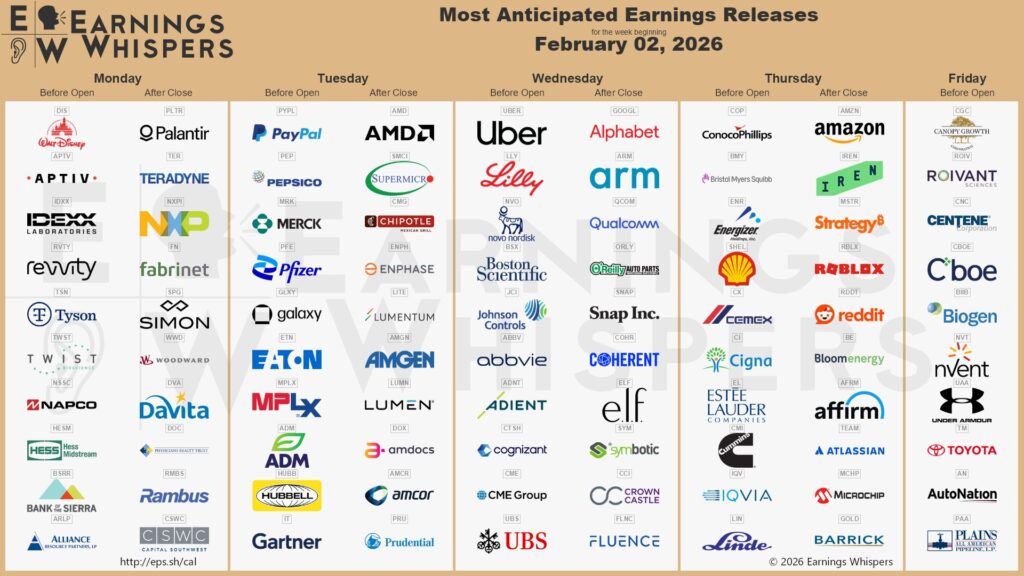
💼 With earnings reports ramping up in the upcoming week, investors will hear from a broad mix of major U.S. companies, setting the tone before big tech weighs in.
📅 Monday, Feb 2nd
- Palantir Technologies Inc. (PLTR): Palantir Technologies will report Q4 2025 earnings with management guiding for record revenue between $1.327 billion and $1.331 billion, representing 61% year-over-year growth and a sequential increase of roughly $150 million from Q3’s $1.181 billion.
The consensus estimate calls for adjusted earnings per share of $0.23, up 64.3% year-over-year, driven by accelerating AI platform adoption across both government and commercial segments that analysts expect to continue demonstrating strong operating leverage.
Investors should closely monitor U.S. commercial revenue growth, which surged 121% year-over-year in Q3 to $397 million and now represents approximately 40% of total revenue, signaling the company’s successful diversification beyond government contracts and validating sustained enterprise AI demand. Customer growth metrics warrant attention, too, as the customer base expanded 45% year-over-year to 911 clients in Q3, with dollar-based net retention reaching 134%, signaling strong pricing power and expansion within existing accounts.
Traders should pay close attention to government revenue trends, given ongoing U.S. defense and public-sector spending priorities, as well as management commentary on AIP adoption, international business momentum, and whether the company continues to demonstrate a capital-efficient operating model while sustaining elevated growth rates.
📅 Tuesday, Feb 3rd
- Advanced Micro Devices Inc (AMD): Advanced Micro Devices is set to report its Q4 and full-year 2025 financial results, having guided for approximately $9.6 billion in Q4 revenue (plus or minus $300 million). This outlook implies roughly 25% year-over-year growth and sits above the consensus estimate of about $9.15 billion, underscoring continued demand across AMD’s core end markets.
Consensus forecasts call for Q4 2025 EPS near $1.32, implying approximately 21% year-over-year earnings growth, with adjusted gross margins expected to hold in the mid-50% range. Performance in the quarter is expected to be led by the data center segment, where continued EPYC CPU adoption and solid server demand are supporting expectations for double-digit revenue growth.
Looking beyond the near term, AMD’s long-term guidance projects more than 35% annual revenue growth over the next three to five years, with AI-focused data center revenues expected to grow at over an 80% CAGR. This outlook is underpinned by strategic partnerships, including its multi-billion-dollar agreement with OpenAI and expanded AI infrastructure collaborations with Oracle, positioning the company to benefit from sustained AI investment cycles.
As investors look ahead to the earnings report, attention will also focus on whether AMD can sustain its mid-50%+ gross margins while maintaining momentum across its business. Market participants are likely to weigh AMD’s competitive gains versus Intel in CPUs alongside how its expanding presence in data-center GPUs and AI accelerators continues to evolve relative to Nvidia’s ongoing leadership in that market.
📅 Wednesday, Feb 4th
- Eli Lilly and Company (LLY): Eli Lilly is set to report Q4 2025 results, with analysts expecting EPS of around $6.95 and revenue of approximately $17.92 billion, reflecting continued year-over-year growth. Performance is expected to remain heavily driven by the company’s tirzepatide franchise, which includes Mounjaro for diabetes and Zepbound for obesity. Together, these products generated $24.8 billion in combined sales during the first nine months of 2025, accounting for roughly 54% of total company revenue.
Momentum in the tirzepatide franchise is expected to continue into the fourth quarter, with analysts pointing to sustained strong demand for both Mounjaro and Zepbound following a blockbuster performance earlier in the year. Growth is being supported by expanded U.S. manufacturing capacity and a recent agreement with the U.S. government to expand Medicare coverage for obesity medicines, developments that broaden patient access and could further expand the addressable market for weight-loss treatments.
Beyond injectables, Lilly’s oral obesity candidate orforglipron represents a key longer-term catalyst as the company works to diversify treatment options for patients who prefer alternatives to injectable GLP-1 therapies. Investors will be watching for updates on pipeline progress and broader portfolio expansion, particularly around oral GLP-1 development, as Lilly looks to extend its leadership in weight-loss treatments beyond injections.
At the same time, key risks to monitor include pricing competition with Novo Nordisk, the execution of ongoing manufacturing expansions needed to support elevated demand, and competitive dynamics in the evolving oral GLP-1 landscape. Against this backdrop, Lilly’s recent results have reflected strong operational execution and solid performance relative to expectations, reinforcing its track record heading into the upcoming earnings report.
- QUALCOMM Incorporated (QCOM): Qualcomm is set to report Q1 fiscal 2026 results, with analysts expecting earnings of around $3.39 per share and revenue of approximately $12.12 billion, both broadly in line with prior-year levels.
Performance in the quarter is expected to be anchored by the company’s handset business, historically its largest revenue contributor. New Snapdragon-powered flagship Android device launches are anticipated to support solid sequential growth in QCT revenues, even as overall earnings are projected to remain relatively stable year over year. Alongside handsets, a key watch item will be QTL (licensing) revenue, with analysts expecting results around $1.5 billion for the quarter. The licensing segment remains sensitive to China-related regulatory dynamics and broader handset market conditions, making QTL a potential swing factor in Qualcomm’s overall earnings mix.
Beyond mobile, automotive continues to stand out as a key growth engine, with quarterly revenue around the $1 billion level and continued double-digit year-over-year growth extending the company’s momentum in the segment. Qualcomm also benefits from its approximately $45 billion automotive design-win pipeline and has outlined a long-term objective of reaching roughly $4 billion in annual automotive revenue by fiscal 2026. Meanwhile, IoT segment performance remains important for diversification, with consensus expectations pointing to mid-$1.7 billion revenue levels and modest year-over-year growth, though results are typically influenced by seasonal softness in consumer-focused products.
Looking beyond the near term, investor focus will center on management commentary around the longer-term earnings outlook. Consensus estimates currently point to FY2026 earnings in the high-$9 per-share range, followed by a potential rebound into the low-$12 range in fiscal 2027. How management frames visibility and confidence around this trajectory is likely to play a key role in shaping near-term stock performance and addressing investor concerns over earnings durability.
📅 Thursday, Feb 5th
- Amazon.com, Inc. (AMZN): Amazon is set to release its Q4 2025 and full-year 2025 earnings, with analysts expecting revenue of approximately $211.4 billion, representing about 12.5% year-over-year growth and likely marking the company’s first $200 billion-plus quarter. Earnings per share are projected at around $1.96, reflecting modest year-over-year growth, while operating income is expected to land toward the upper end of management’s previously guided range, assuming results fall within Amazon’s $206–$213 billion Q4 revenue outlook.
Beyond the headline numbers, a central focus for institutional investors remains Amazon’s elevated capital expenditure trajectory. The company has guided to more than $125 billion in capital spending for 2025 and has signaled further increases in 2026 as investment in AWS and AI-related infrastructure continues to scale. This heavy investment cycle has weighed on cash generation, with trailing twelve-month free cash flow declining to roughly $14.8 billion, underscoring the capital-intensive nature of Amazon’s current growth phase.
Investors will closely monitor the retail segment’s performance through Q4’s critical holiday period, including Prime Big Deal Days, Black Friday/Cyber Monday, and Christmas shopping. Results will be evaluated against broader consumer spending trends, as well as Amazon’s ability to maintain retail margins amid ongoing inflationary pressures and supply-chain dynamics.
Rounding out the picture, Amazon’s expanding AI investment footprint remains firmly in focus. As AWS continues to scale spending on foundational models and generative AI infrastructure, these investments are intended to strengthen the company’s long-term competitive positioning in the cloud, even as they heighten near-term free cash flow sensitivity. This balance between AI-driven growth and capital discipline is likely to remain a central theme for investors heading into the earnings report.
We hope this helps and happy trading!
– Trade and Travel Team
Related Blogs









Follow Us
Testimonials
Hear from students on why they chose the Trade and Travel Family and how it has changed their lives.

