
The stock market delivered a solid close to the opening week of December, with all three major indices posting gains as investors digested a critical mix of economic signals and earnings reports.
The S&P 500 (SPY) advanced 0.34% for the week, while the tech-heavy NASDAQ (QQQ) outpaced the broader market with a 1.01% gain, and the Dow Jones (DIA) climbed 0.60%. The modest but consistent rally reflects a market increasingly confident in the prospect of additional Federal Reserve rate cuts and bolstered by evidence of resilient consumer demand heading into the final stretch of the year.
The week’s momentum was largely driven by a single dominant narrative: the likelihood of a quarter-point rate cut at the Fed’s December 9-10 meeting now stands at roughly 87% according to market pricing.This powerful undercurrent of dovish sentiment helped the market overcome lingering concerns about stretched valuations in mega-cap technology stocks and persistent divisions within the Federal Open Market Committee. The economic data void created by the government shutdown, which had halted critical reports on unemployment, inflation, and retail spending, has begun to clear, providing policymakers and investors with clarity as the year winds down.
Consumer spending emerged as a bright spot, with Black Friday and the Thanksgiving shopping weekend delivering record-breaking online sales and the highest-ever shopper participation since tracking began.
Approximately 202.9 million American shoppers participated in the five-day stretch from Thanksgiving through Cyber Monday, marking the highest tally since tracking began in 2017. Online sales reached $44.2 billion for the five-day period, reflecting a 7.7% year-over-year increase, while Black Friday alone saw $11.8 billion in digital purchases, up 9.1% from the prior year. Together, these data points suggest that holiday demand started the season on solid footing, offering investors a measure of reassurance despite ongoing concerns about household budgets and broader economic uncertainty.
Earnings season continued its winding path, with major technology companies including Salesforce, CrowdStrike, Marvell, MongoDB, and others reporting during the week, offering investors critical insights into AI adoption and enterprise spending trends.
The week ahead features a closely watched event: the Federal Reserve’s December 9–10 policy meeting and Chair Jerome Powell’s press conference. Market participants will focus not only on whether policymakers deliver the widely expected rate cut but also on the Fed’s guidance and tone regarding the path of future moves, which markets expect to influence positioning into year-end and early 2026.
How This Impacts You
Now that the busiest shopping days of the year are behind you, this is a great time to slow down, review your financial goals, and get honest about what you want to achieve in the new year. When you look at where you currently are, it becomes easier to see where investing or trading might help you grow your money more intentionally instead of letting it sit still.
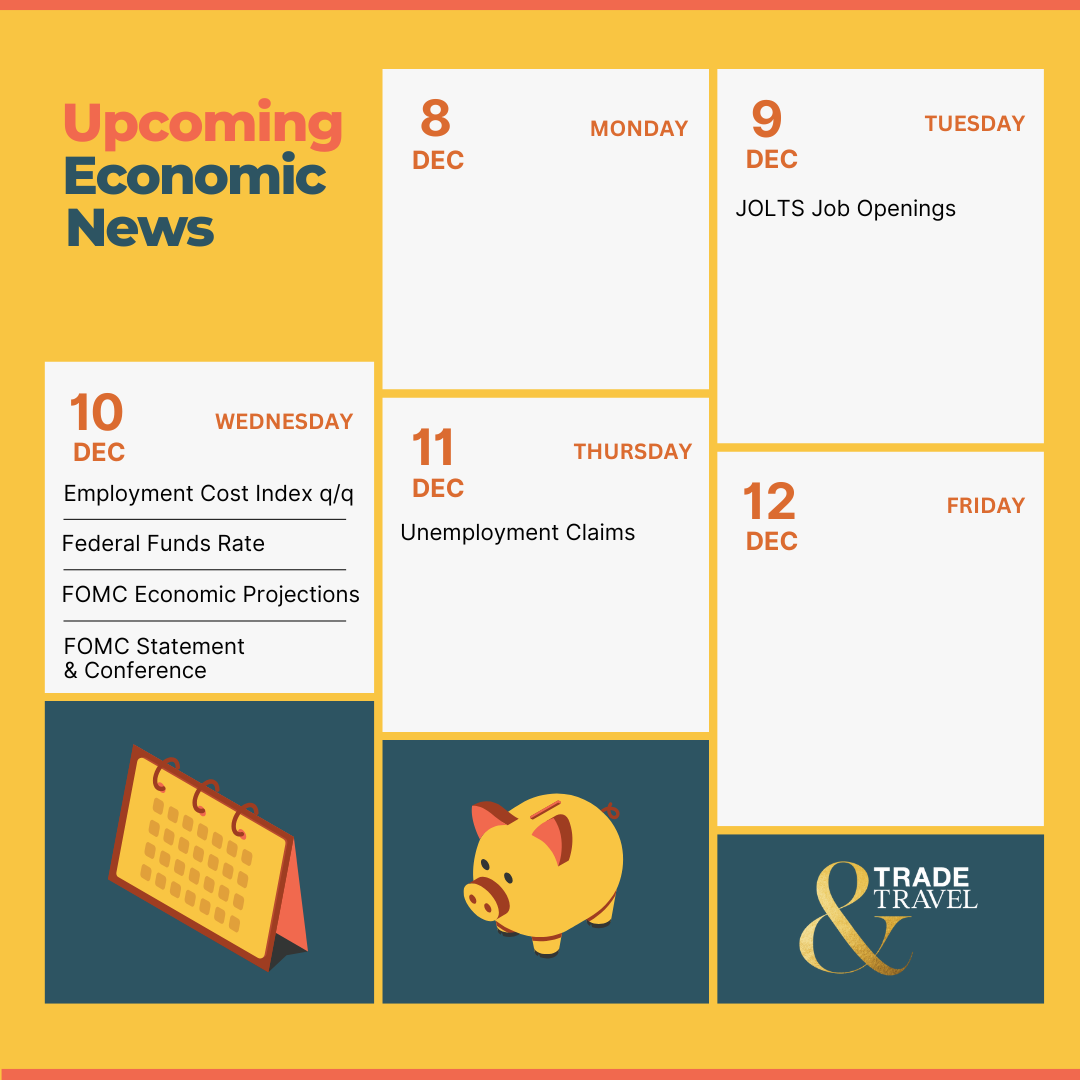
📅 Tuesday, Dec 9th
- JOLTS Job Openings: The Bureau of Labor Statistics is scheduled to release the JOLTS report for October, with consensus estimates projecting a decline to 7.14 million job openings. This figure would represent a cooling of labor demand compared to the previous month’s reading of approximately 7.23 million, reinforcing the trend of a softening economy.
Market participants should closely monitor the ratio of job openings to unemployed workers, as a further decrease would signal a return to pre-pandemic labor balance and reduce upward pressure on wages. Traders will also scrutinize the quits rate for signs of waning worker confidence, which typically precedes broader consumer spending slowdowns and indicates reduced leverage for employees.
📅 Wednesday, Dec 10th
- Employment Cost Index q/q: The Employment Cost Index (ECI) for Q3 2025 is widely expected by market economists to come in around 0.9% quarter-over-quarter, matching the previous quarter’s official BLS reading.
The ECI measures the quarterly change in wages, salaries, and benefits for civilian workers, making it one of the Federal Reserve’s key indicators for assessing labor-cost pressures and inflation risk. If compensation growth slows below the 0.9% pace, it would suggest easing labor-cost momentum, something that could support the Fed’s efforts to control inflation without tightening financial conditions abruptly.
Conversely, an upside surprise above 0.9% would imply firmer wage inflation, a development that has historically raised concerns about sustained price pressures and encouraged markets to price in the possibility of higher interest rates. Such a reaction often weighs on equities while boosting certain fixed-income assets, though actual market impact would depend on the broader macro environment at the time.
A steady 0.9% reading, however, would likely reinforce the “soft landing” narrative: labor costs growing at a moderate pace, the labor market holding firm, and the Fed retaining flexibility to adjust policy without fearing a renewed surge in inflation.
- FOMC Meeting: Statement, Economic Projections and Federal Funds Rate: The Federal Reserve’s December 10 decision is currently priced with roughly an 87% probability of a quarter-point rate cut, which would lower the federal funds rate to a 3.50% to 3.75% range, though this remains far from guaranteed given unusually sharp divisions among Fed officials.
Market participants should closely watch the number and direction of dissenting votes, especially after the October meeting, where two members broke ranks, one opposing any cut and another arguing for a larger 50 basis point move. A rate cut would align with a softening labor market and recent data, as core PCE inflation held at 2.8% in September while the unemployment rate climbed to 4.4%, giving the Fed support for easing even though inflation is still above the 2% target. Chair Powell has reinforced uncertainty by stating that another cut is “not a foregone conclusion,” highlighting the depth of internal disagreement.
Powell’s language at the post-meeting press conference will be critical, particularly whether he frames this move as the final “insurance” cut before an extended pause or indicates that additional easing in 2026 is still possible.
The Fed will also release its Summary of Economic Projections, including the updated dot plot, which traders will dissect for signals about how aligned or divided the Committee is on the future rate path. A major point of focus will be the Fed’s inflation projections, since the median PCE forecast is expected to remain above the 2% target through 2027. Any upward revision in these projections could indicate a more cautious stance on further easing, especially with concerns about fiscal stimulus and tariff pass-through effects in early 2026.
Given all of these factors, market volatility is likely regardless of the specific outcome. The combination of delayed economic data from the government shutdown, elevated equity valuations, and a divided Federal Open Market Committee means that almost any decision or nuance in communication could trigger sharp moves in both bonds and stocks.
📅 Thursday, Dec 11th
- Unemployment Claims: The upcoming week’s Unemployment Claims report carries significant importance as markets anticipate a reading of 221,000 claims, representing a potential 30,000-claim increase from the prior week’s 191,000.
Investors should closely monitor whether actual claims meet, exceed, or fall short of the 221,000 forecast, as lower-than-expected jobless claims would signal continued labor market resilience and potentially cool expectations for Federal Reserve rate cuts, while higher-than-expected claims could fuel recession concerns. The four-week average of claims, currently sitting near 214,750, provides crucial context for volatility management, as this smoothed metric helps distinguish genuine labor market deterioration from weekly noise and holiday-related distortions.
The December report arrives with heightened significance given the delayed November employment report (pushed to December 16 due to government shutdown), making this jobless claims data one of the key labor market indicators investors will rely on for the next two weeks.
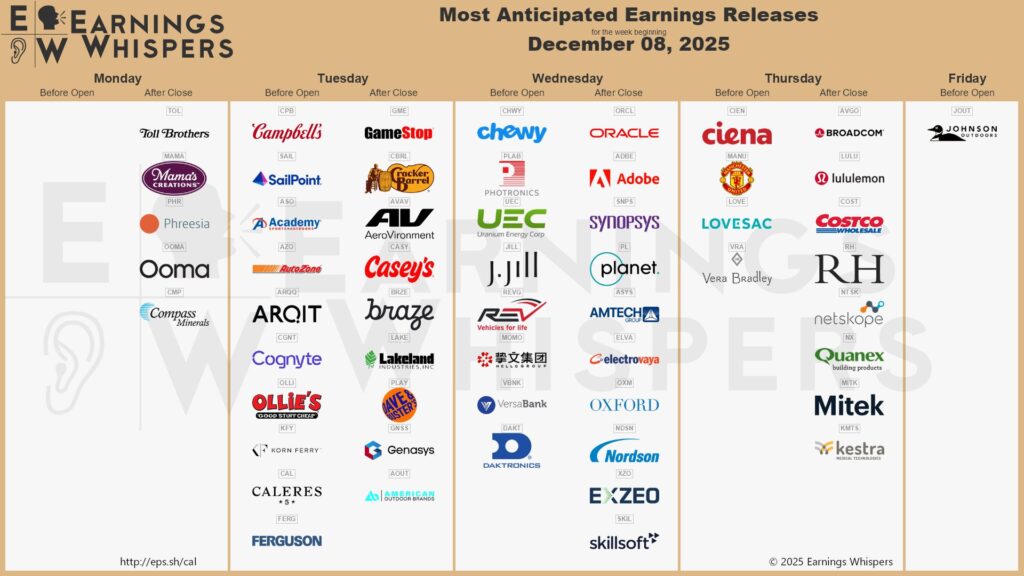
💼 A somewhat quiet earnings week on paper, but fresh quarterly reports from tech and consumer discretionary players could still shake the tape and spark short-term moves.
📅 Wednesday, Dec 10th
- Oracle Corporation (ORCL): Oracle is scheduled to release its Q2 FY 2026 earnings report. Analysts forecast consensus revenue to reach approximately $16.19 billion, representing roughly 15.1% year-over-year growth. On the bottom line, Wall Street is looking for adjusted EPS of $1.64, compared to $1.47 in the same quarter last year.
The primary catalyst for price action will be the growth rate of Oracle Cloud Infrastructure (OCI), which management previously guided to accelerate significantly. Investors should specifically watch if OCI revenue growth meets or exceeds the aggressive 77% year-over-year targets projected in previous guidance. Market participants will also scrutinize the Remaining Performance Obligations (RPO) backlog, which exploded to $455 billion in Q1, to see if that momentum is sustainable.
Any updates to the full-year Fiscal 2026 outlook will be vital, particularly regarding whether the company maintains its long-term revenue targets of $67 billion for the year. Finally, listen for commentary on Oracle’s database-to-cloud migration efforts, since moving its large base of legacy on-premise database customers to OCI remains a key strategic and margin driver, and watch for updates on the company’s expanding partnership with OpenAI and its build-out of large, GPU-dense data centers, including the multi-gigawatt “Stargate” facilities.
- Adobe Inc. (ADBE): Adobe is set to report Q4 fiscal 2025 earnings, with analysts expecting earnings of $5.40 per share and revenue of approximately $6.11 billion, representing year-over-year growth of roughly 9% from the prior-year quarter.
Market participants should closely monitor Digital Media subscription revenue growth, which is expected to reach approximately $4.41 billion, reflecting about 8.2% year-over-year growth based on current analyst consensus. A critical focus will be Adobe’s AI monetization strategy, including Firefly, where paid subscriptions nearly doubled sequentially in Q2, and GenStudio, whose key components have already surpassed $1 billion in annualized recurring revenue and grew over 25% year-over-year in Q3.
The street will examine margin expansion potential, particularly operating margins, as Adobe scales AI features across its subscription-based model. Adobe has beaten earnings estimates in four consecutive quarters, so a miss or modest beat could significantly influence near-term sentiment.
Finally, watch for guidance revisions or commentary on enterprise adoption of AEP AI Assistant (which had 70% adoption among eligible customers in Q3) and Acrobat AI Assistant (engagement up nearly 50% in Q3), as these metrics indicate pricing power and long-term ARR durability.
📅 Thursday, Dec 11th
- Broadcom Inc. (AVGO): Broadcom is scheduled to report its fiscal Q4 2025 earnings. Wall Street consensus estimates project revenue of approximately $17.47 billion, representing a robust 24.5% year-over-year increase. Earnings per share (EPS) are expected to come in at $1.87, a significant 31.7% jump compared to the same quarter last year.
The primary focal point for market participants will be AI-related revenue, specifically whether Broadcom meets or exceeds its Q4 target of $6.2 billion in AI semiconductor sales. Investors should also watch for any early commentary or framework on fiscal 2026 AI revenue, as management has only said growth will be ‘significantly improved’ next year, while analysts currently estimate FY2025 AI revenue above $17 billion and see a path toward $30–40 billion or more in FY2026.
Performance in the Infrastructure Software segment, now dominated by VMware, will also be critical, with investors expecting revenue in line with Broadcom’s guidance of roughly $6.7 billion and continued operating margin expansion driven by integration cost synergies.
Beyond AI, watch for signs of stabilization across non-AI semiconductor categories, particularly in server storage and enterprise networking, which management has said remain slow to recover, while broadband has already shown sequential improvement. Finally, pay attention to any updates on Broadcom’s custom ASIC programs, as the company already counts Google, Meta, ByteDance, and OpenAI among its major AI silicon customers, and additional design wins would strengthen the outlook for durable long-term growth.
- Costco Wholesale Corporation (COST): Costco Wholesale Corporation is scheduled to report fiscal Q1 2026 earnings, with analysts expecting EPS of approximately $4.28. Market participants should scrutinize same-store sales growth, which accelerated to 6.9% company-wide in November’s pre-announcement versus the 5.7% reported in Q4 that missed the 5.9% consensus.
The e-commerce segment remains critical, having grown 13.6% in Q4 and an even faster 20.5% during the first quarter, and while Costco most recently reported online sales at about 7% of total net sales in its 2024 annual report, it has not yet disclosed an updated mix figure for 2025.
Membership fee income, which reached $1.72 billion in Q4 (up 14% year-over-year), will be closely watched for the full impact of membership fee increases implemented earlier in 2024. Renewal rates, currently at 92.3% in the U.S./Canada and 89.8% worldwide, showed slight sequential declines last quarter and merit attention for subscriber retention trends.
Gross margin pressure will remain a key focus, as Q4 merchandise costs increased roughly 7.8% year over year and selling, general, and administrative expenses rose about 10.1%, with SG&A clearly outpacing the 8% growth in net sales. Traders should also monitor inventory levels and turns, particularly given the 27 warehouse openings in fiscal 2025, which brought Costco’s global footprint to 914 locations.
- lululemon athletica inc. (LULU): Lululemon reports its Q3 fiscal 2025 earnings, with analyst estimates calling for revenue of about $2.48 billion (3.3% year-over-year growth) and EPS of $2.21. The company recently posted disappointing Q2 results with revenue of about $2.5 billion, up 7% year over year but slightly missing analyst expectations, while same-store sales growth decelerated sharply to just 1% year over year, down from historical average growth of about 5.3%.
Americas same-store sales fell 4% in Q2, considering that the region represents 70% of total revenue, signaling potential demand softness in core markets. Gross margin contracted 110 basis points to 58.5% due to higher markdowns and tariff pressures, while operating margin dropped to 20.7% from 22.8% year-over-year.
Lululemon operates 784 stores and continues rapid expansion, but investors should monitor whether new store openings are offsetting weak performance at existing locations. The company has beaten EPS estimates for four consecutive quarters, including Q2’s $3.10 actual versus $2.84 consensus (9.15% surprise), though the stock declined 18.6% following those results.
Key metrics to watch include same-store sales trajectory, particularly in the Americas, inventory levels, and margin pressure from promotional activity and tariffs. Management commentary on product innovation, competitive positioning, and market share trends will be critical for assessing whether the brand can reaccelerate growth. Investors should focus on forward guidance revisions and any signals regarding consumer demand recovery in the athleisure category.
We hope this helps and happy trading!
– Trade and Travel Team
Related Blogs
Follow Us
Testimonials
Hear from students on why they chose the Trade and Travel Family and how it has changed their lives.

