
The stock market experienced a mixed week as the Federal Reserve delivered its final interest rate cut of 2025, while mixed economic signals and government recovery efforts created divergent sentiment across equities. The S&P 500 (SPY) declined 0.57% for the week, the Nasdaq (QQQ) fell 1.90%, and the Dow Jones Industrial Average (DJI) gained 1.12%. A split decision that underscores the tension currently gripping markets.
The standout event driving sentiment was the Fed’s rate cut of 25 basis points, bringing the federal funds rate to a range of 3.5% to 3.75%. While markets rallied on the announcement itself, the celebration proved brief. Three Federal Reserve officials dissented against the cut, the most since September 2019, signaling deep divisions about the path forward. Fed Chair Jerome Powell emphasized the committee’s cautious stance, stating the Fed is “well positioned to wait and see how the economy evolves,” with potentially only one additional cut possible in 2026.
The 43-day government shutdown, which ended on November 12th, delayed the release of key economic reports, but agencies have now begun working through the backlog. The resumption of data releases, including jobs, inflation, and GDP figures, is helping restore clarity around labor market conditions and inflation trends. The Bureau of Economic Analysis has tentatively scheduled the delayed Q3 GDP release for December 23rd, although some dates may still shift as agencies continue to catch up.
Inflation remains above the Federal Reserve’s 2% target, even as recent readings have softened slightly. Core personal consumption expenditures, the Fed’s preferred inflation gauge, rose 0.2% month-over-month and 2.8% year-over-year based on the most recent data. While this represents some cooling, inflation remains above the Fed’s target, which has led officials to signal a more patient, data-driven approach to future rate cuts.
Looking ahead, upcoming economic data releases and corporate earnings will play a central role in shaping market sentiment. Investors are closely monitoring delayed reports as the Federal Reserve maintains a cautious, data-driven approach.
How This Impacts You
The split between the Dow Jones Industrial Average (DIA) rising and the Nasdaq (QQQ) falling is a signal worth noting. It may point to a shift toward more steady, reliable industries and away from high-growth tech. Noticing these changes can help you better understand how people are responding to uncertainty and what that reveals about overall sentiment in the economy.
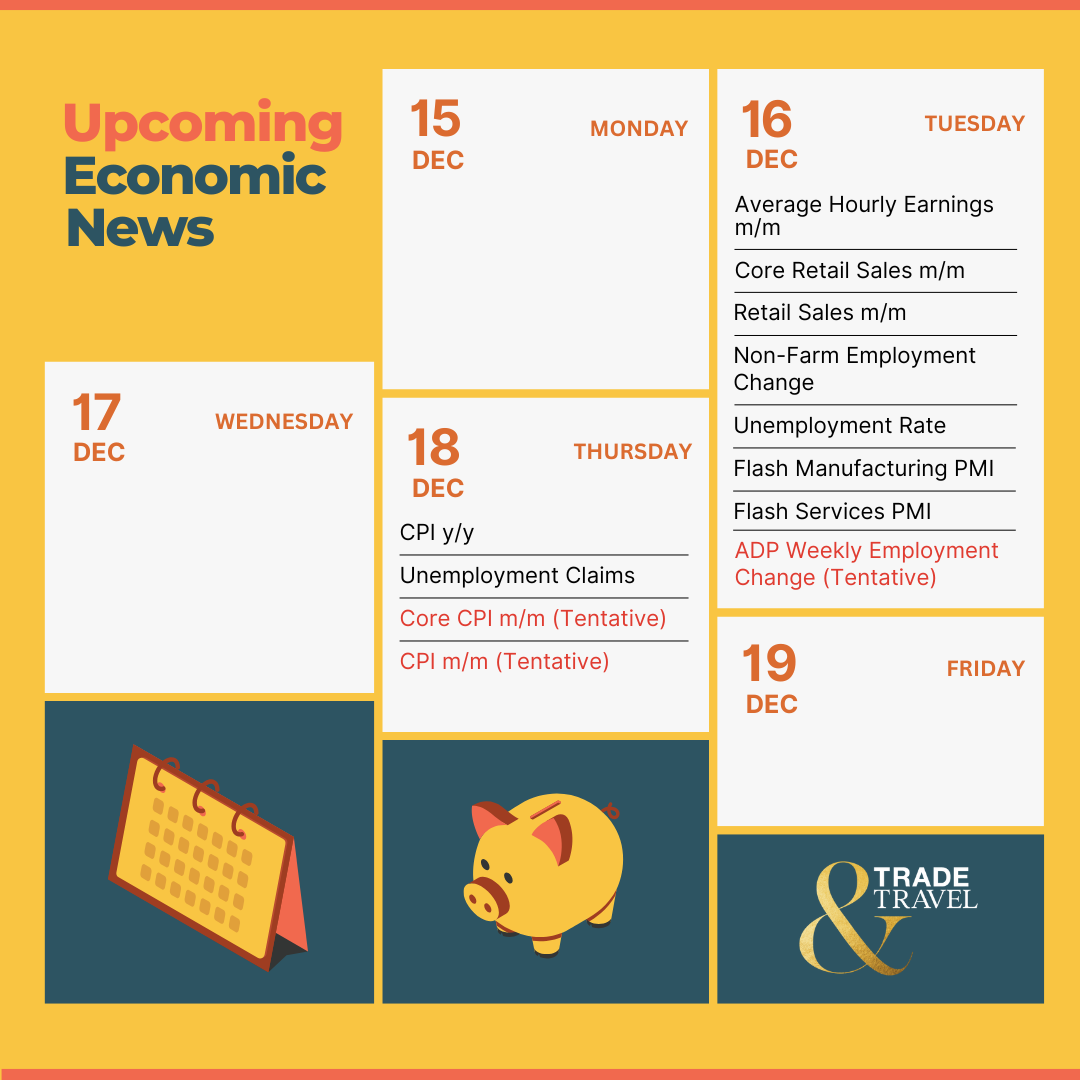
📅 Tuesday, Dec 16th
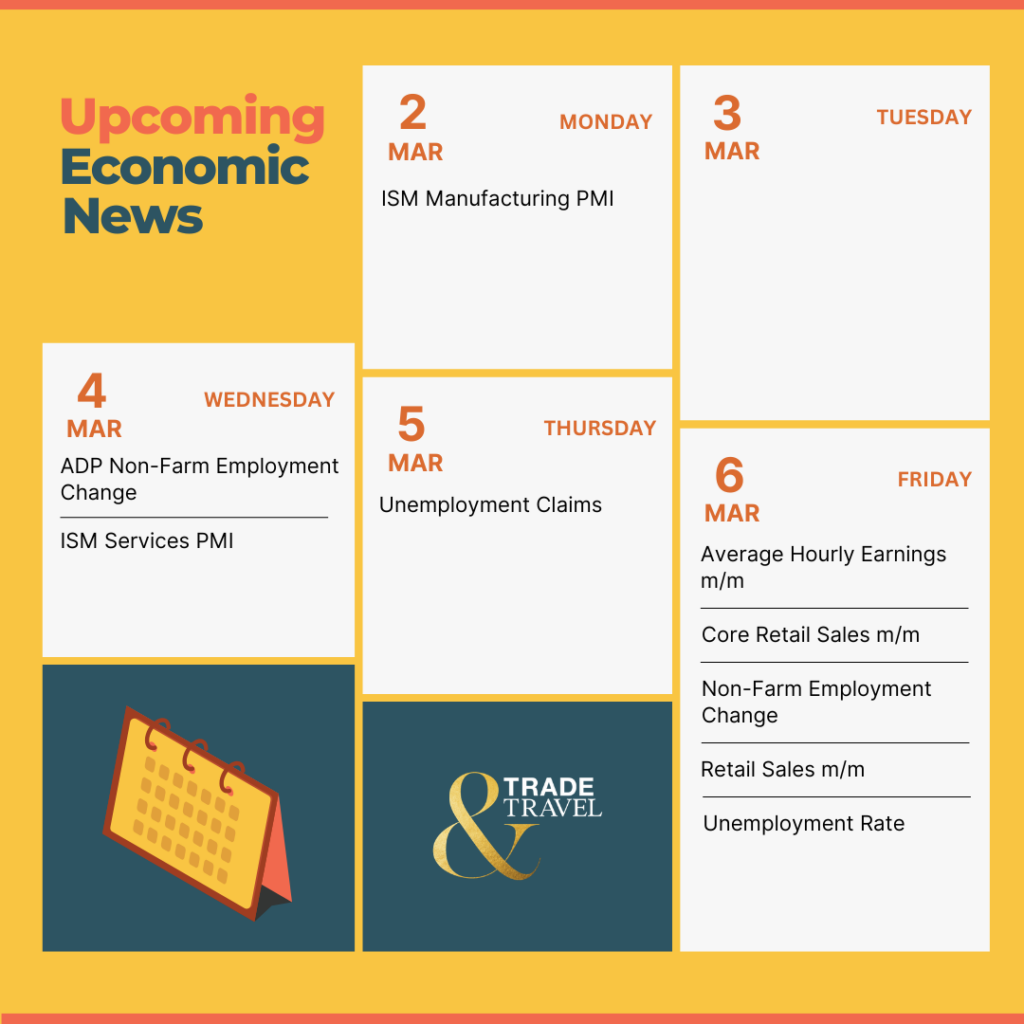
- Average Hourly Earnings m/m: The December Average Hourly Earnings report is expected to show a 0.3% month-over-month increase in wage growth following a softer 0.2% reading in September. This modest expected acceleration to 0.3% would represent a continuation of gradual wage growth and carries implications for Federal Reserve policy decisions, as wage pressures remain a key inflation indicator the Fed monitors closely.
Market participants should focus on whether actual results meet the 0.3% forecast or surprise to the upside, as stronger-than-expected wage growth could signal persistent inflation pressures. The year-over-year wage growth context is equally critical, with September’s 3.8% annual increase remaining elevated, making the upcoming report a potential market mover for equity and fixed income positioning.
Watch for any guidance clues in the employment situation report’s accompanying data on hours worked and broader compensation trends, as real wage growth adjusted for inflation has been modest, limiting consumers’ purchasing power for sustained economic expansion.
- Core Retail Sales m/m: The Core Retail Sales month-over-month report is expected to show a 0.2% increase, down from the prior reading of 0.3%, signaling a deceleration in underlying consumer spending growth.
This metric, which excludes volatile automotive, gasoline, building materials, and food service categories, serves as a critical barometer of economic health. Market participants should monitor whether the 100-basis-point slowdown reflects temporary holiday-driven volatility or the beginning of a sustained consumer spending pullback amid persistent inflation concerns and recent labor market softening.
The control group measurement within this report, which feeds directly into GDP calculations, will be important for gauging Q3 economic growth projections and informing forward guidance from policymakers.
- Retail Sales m/m: The U.S. Retail Sales month-over-month report for November is scheduled to be release, with economists forecasting a 0.2% increase that would match the previous reading. This report is particularly significant as consumer spending comprises approximately 70% of U.S. GDP, making it a critical economic indicator that can influence investment and trading decisions across asset classes.
Key metrics to examine include the control group figure, which excludes volatile categories, as well as category breakdowns for clothing, e-commerce, and discretionary spending to identify which retail segments are driving or lagging growth. A reading that exceeds the 0.2% forecast would support economic resilience and benefit risk assets, while a miss below expectations could amplify concerns about consumer spending weakness and potentially pressure equities and the dollar.
- Non-Farm Employment Change: The upcoming Non-Farm Payrolls report is expected to compare sharply with the prior reading of roughly 50,000 jobs added, with forecasts calling for around 119,000 positions, signaling a potential rebound in labor market momentum after months of cooling employment growth.
Market participants should closely monitor whether the actual result beats or misses this 119,000 expectation, as the NFP serves as a critical real-time proxy for U.S. economic health and helps inform Federal Reserve interest rate decisions.
A beat to the 119,000 forecast could suggest strengthening consumer demand and business confidence, potentially pushing stock indices higher and supporting the U.S. dollar against other major currencies, while a miss could reinforce concerns about economic slowdown and increase market odds for additional Fed rate cuts in early 2026.
The report also carries weight for sector-specific traders tracking healthcare, retail, and transportation hiring patterns, which have shown resilience despite overall labor market softness through 2025.
- Unemployment Rate: The upcoming unemployment rate report will provide crucial insights into labor market conditions as investors assess whether the recent cooling trend continues or stabilizes. With the previous reading at 4.4% and forecasts expecting 4.5%, markets will scrutinize this report alongside payroll data as the Federal Reserve calibrates its policy stance for 2026.
Key metrics to monitor include the total number of unemployed workers and labor force participation rates, as Federal Reserve officials have emphasized data uncertainty and the importance of looking beyond headline job gains, particularly given ongoing revisions and signs of cooling labor market momentum.
A rise in the unemployment rate to 4.5% from the 4.3% low in August would underscore signs of labor market cooling, potentially reinforcing market expectations for easier Fed policy if the trend continues.
- Flash Manufacturing PMI: The Flash Manufacturing PMI is expected to tick up to 52.3 in the upcoming report, marginally above the previous reading of 52.2, signaling continued but modest expansion in the manufacturing sector. Any reading above 50 indicates growth, and this expected result would maintain the positive momentum seen over the past months, though the small increase suggests the sector’s expansion is moderating rather than accelerating.
Investors should pay close attention to the key components, including new orders, production output, and employment levels, as these subcomponents provide early signals about economic strength and business confidence. The Flash PMI’s significance lies in its timeliness, released well before official government data, making it a valuable tool for traders and portfolio managers to assess manufacturing health and adjust their positioning ahead of broader market movements.
Watch closely for any divergence from the 52.3 forecast, as a reading significantly below expectations could trigger market concerns about slowing economic momentum, while a stronger-than-expected result would reinforce confidence in continued manufacturing resilience.
- Flash Services PMI: The Flash Services PMI is set to release with a previous reading of 54.1 and a consensus forecast of 54.0, signaling continued but marginal expansion in the U.S. service sector.
This early survey covers approximately 85-90% of total PMI responses and provides critical early signals ahead of final data, making it important for market participants monitoring economic health across finance, healthcare, retail, and professional services industries.
Investors and traders should focus on three key components: the Business Activity Index measuring service sector expansion, the New Orders Index reflecting client demand amid tariff pressures and uncertainty, and the Employment Index indicating labor market strength in services.
A reading above 50 signals expansion, consistent with a 54.0 forecast, though any meaningful deviation from expectations could spark short-term market volatility, particularly in service-sensitive cyclical stocks as investors reassess Federal Reserve policy expectations. Watch for commentary on inflation in input costs and output prices, which have remained elevated or shown renewed pressure in recent months, as these metrics help shape central bank expectations and broader market sentiment around monetary policy.
📅 Thursday, Dec 18th
- CPI y/y: The next Consumer Price Index report will reveal whether the recent acceleration in pricing has begun to moderate after headline CPI reached 3.0% in September. Market participants should closely monitor whether headline CPI remains anchored near this level or ticks higher toward the 3.1 to 3.2 percent range that some forecasters project.
Core CPI, excluding volatile food and energy components, is expected to remain sticky at 2.9 to 3.0 percent year-over-year, well above the Federal Reserve’s 2% target and a critical factor in determining whether rate cuts continue in 2026. Key drivers to watch include gasoline prices, which have shown renewed volatility, food costs amid avian flu-driven egg price increases, and persistent shelter inflation, which accounts for roughly 30% of the CPI basket.
- Unemployment Claims: The initial jobless claims report for the week is expected to show 224,000 claims compared to the previous week’s reading of 236,000, representing a potential decline of 12,000 and signaling possible labor market stabilization after last week’s outsized seasonal volatility.
Market participants should be attuned to how much of the recent 44,000-claim spike was driven by post-holiday seasonal adjustment challenges, as the four-week moving average near 216,750 suggests underlying labor conditions remain relatively contained despite headline volatility.
A print at or below the 224,000 forecast would reinforce the resilience of the labor market and potentially support Fed expectations of measured rate policy, while any significant misses could reignite concerns about labor market deterioration heading into year-end.
Watch for the continuing claims figure, which has declined to 1.84 million, the lowest since April 2025, as improvements here would indicate robust hiring momentum despite seasonal headwinds. Market reaction will likely hinge on whether claims demonstrate mean-reversion toward the 215,000 to 220,000 range that prevailed before the recent spike, versus persistence of elevated readings that could prompt broader recession fears.
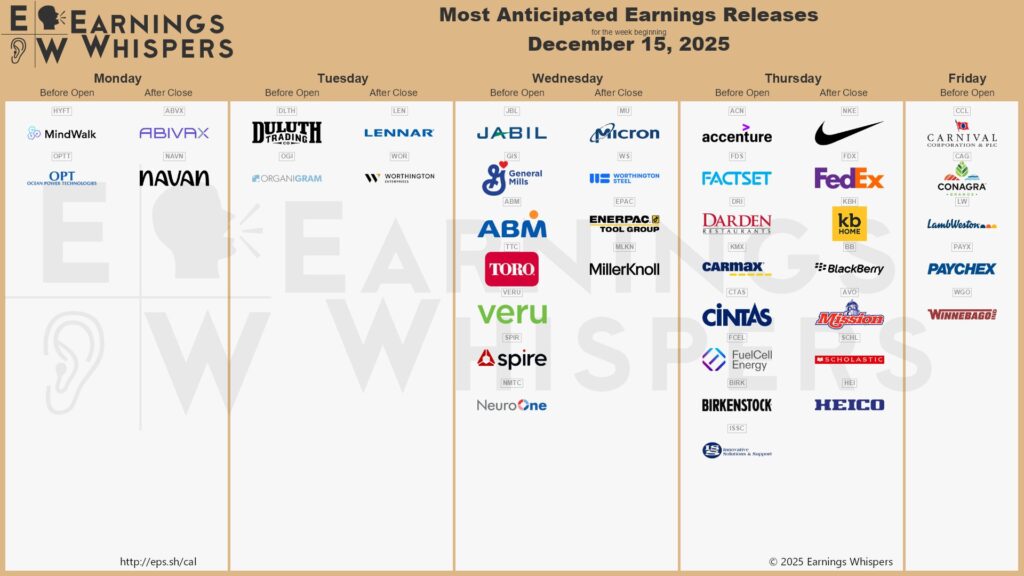
💼 Earnings slow this week, but a small group of reports could still act as catalysts for near-term moves and help set the tone for the rest of the year.
📅 Wednesday, Dec 17th
- Micron Technology, Inc. (MU): Micron Technology will report fiscal first-quarter 2026 earnings, with results expected to showcase continued AI-driven momentum as the company capitalizes on surging demand for memory chips in data center applications.
Analysts expect earnings per share of $3.93, representing a staggering 119% year-over-year increase, while consensus revenue forecasts target $12.82 billion, a 47% gain compared to the prior-year quarter. The company’s own guidance projects slightly more conservative figures of $3.75 earnings per share and $12.5 billion in revenue, positioning the midpoint guidance as potentially achievable given recent analyst upward revisions and a positive earnings surprise history.
Data center demand remains a central focus heading into Micron’s upcoming earnings report. The company said its data center business accounted for 56% of total revenue in fiscal 2025, reflecting the growing importance of AI-driven workloads.
High-Bandwidth Memory (HBM) is expected to be a key driver, with the company’s HBM3E products hitting an annualized run rate of nearly $8 billion in the prior quarter and already having sold out its entire 2025 HBM supply, with pricing agreements locked in for most of 2026 capacity.
Key execution items to watch include Micron’s ability to execute on its stated plan to ramp HBM4 in calendar 2026, navigate a highly competitive NAND market, and smoothly complete its announced exit from the Crucial consumer business by February 2026. The company has indicated this transition is intended to reallocate resources toward higher-value enterprise and AI data-center memory, where demand remains closely tied to ongoing AI infrastructure buildouts.
- General Mills, Inc. (GIS): General Mills is scheduled to report its fiscal second-quarter 2026, with analysts forecasting net sales to decline 8.7% year-over-year to approximately $4.78 billion, with EPS expected to reach $1.02, down 27.14% from the prior-year quarter’s $1.40 per share.
General Mills’ North America Retail segment (its largest division) is expected to face the most pressure this quarter, with analysts projecting sales down about 15% year over year to roughly $2.8 billion. Recent company commentary has pointed to unfavorable net price realization and mix, reflecting price investments (and related timing impacts) in North America Retail.
Key margin drivers to monitor include the impact of input cost inflation (including tariffs) and the company’s expectation that these pressures, along with growth investments and other items, will outpace its cost-savings initiatives.
General Mills also says the net impact of the North American yogurt divestitures and the North American Whitebridge Pet Brands acquisition will reduce adjusted operating profit growth by about 5 points in fiscal 2026. On the segment side, analysts project the North America pet unit will grow about 9% to $649 million this quarter, with results continuing to reflect the impact of the Whitebridge Pet Brands acquisition.
Market participants should watch management commentary on demand and volume initiatives, the trajectory of organic sales beyond Q2, and whether the company reaffirms or changes its full-year outlook. General Mills has guided for constant-currency adjusted operating profit and adjusted EPS to decline 10–15% in fiscal 2026, while continuing to emphasize innovation and value initiatives to support performance.
📅 Thursday, Dec 18th
- Accenture plc (ACN): Accenture will announce Q1 fiscal 2026 results with consensus expectations for $3.74 earnings per share and $18.51 billion in revenue.
The results come as the company faces an estimated 1% to 1.5% revenue headwind from its U.S. federal business, which management has cited in its outlook. For fiscal 2026, Accenture has guided to 2% to 5% revenue growth in local currency, or approximately 3% to 6% growth excluding the federal impact.
Book-to-bill and new bookings trends will be closely watched as indicators of forward demand, particularly in consulting and managed services segments, where organic growth could help offset federal-related pressure. Free cash flow generation remains a strength, with FY2026 guidance targeting $9.8 billion to $10.5 billion and planned shareholder returns of at least $9.3 billion.
A key focus will be the trajectory of generative AI bookings and revenue, which nearly doubled to $5.9 billion in FY2025 with advanced AI revenue tripling to $2.7 billion, underscoring strong enterprise interest in AI-driven transformation.
Regional results across EMEA, Asia Pacific, and the Americas will provide insight into geographic demand trends, alongside management commentary on client spending, bookings, and book-to-bill, and Accenture’s AI services capabilities, as guidance continues to imply 10 to 30 basis points of adjusted operating margin expansion.
- Nike, Inc. (NKE): Nike will report fiscal Q2 2026 results, marking an important period as the athletic apparel company navigates ongoing revenue and profitability pressures. Consensus estimates call for earnings per share of $0.38, down 51.2% year over year from $0.78, with revenue expected to be around $12.21 billion, a 1.1% year-over-year decline.
The quarter includes Thanksgiving week, an early portion of the holiday shopping period, and the company has guided to a 300–375 basis point year-over-year decline in gross margin, with management and industry coverage citing tariffs as a significant contributing factor. Separately, Nike has estimated an annualized tariff cost of $1.5 billion, which some industry coverage translates into an estimated ~120 basis point headwind to fiscal 2026 gross margin.
Market participants should closely monitor management commentary on pricing power as the company has relied on elevated promotional activity to clear excess inventory. Regional performance, including recent softness in North America and China recovery trends, may provide insights into consumer demand heading into 2026 as Nike pursues its strategic pivot toward wholesale partnerships and direct-to-consumer optimization.
Nike has also outlined a multi-year cost-savings program targeting up to $2 billion, with management discussing mitigation actions that include shifting sourcing for the U.S. market and targeted price increases.
- FedEx Corporation (FDX): FedEx is scheduled to report its Q2 fiscal 2026, with analysts anticipating an earnings per share of $4.11, with revenue projected at $22.78 billion, representing roughly 3.5% year-over-year revenue growth.
Market participants should monitor FedEx’s operating margin performance, which improved to 5.3% in the first quarter of fiscal 2026 from 5.0% in the prior year, as the company continues executing its cost reduction initiatives.
The DRIVE program and Network 2.0 transformation are key initiatives for FedEx’s cost-reduction strategy. The company achieved its $2.2 billion DRIVE savings target in fiscal 2025 and has guided to approximately $1 billion in additional transformation-related savings in fiscal 2026, driven by structural cost reductions and the continued rollout of Network 2.0.
Management’s commentary on the Federal Express segment will be important given the 4% revenue growth and 19% operating income increase in Q1, driven by higher yields and increased U.S. domestic package volumes. The FedEx Freight segment remains a concern as it experienced a 3% revenue decline and an 18% operating income drop in Q1 FY2026, reflecting ongoing weakness in the less-than-truckload market.
Finally, the company’s capital allocation strategy, including share repurchase activity (which totaled $2.5 billion year-to-date as of Q3 fiscal 2025) and dividend policy, will signal management confidence in the near-term business trajectory despite macroeconomic uncertainties.
We hope this helps and happy trading!
– Trade and Travel Team
Related Blogs


Follow Us
Testimonials
Hear from students on why they chose the Trade and Travel Family and how it has changed their lives.

