

Last week underscored that market rallies can quickly give way to volatility. The SPY (S&P 500) slipped 2.41%, QQQ (Nasdaq 100) fell 2.21%, and the DIA (Dow Jones Industrial Average) declined 2.96% despite early optimism from trade deals and solid earnings.
Trade headlines sparked early gains after a U.S.–Japan deal cut auto tariffs from 27.5% to 15% and lowered other goods tariffs from 25% to 15%. This was followed by a U.S.–EU agreement imposing a 15% tariff on most EU exports, including autos, semiconductors, and branded pharmaceuticals. Exemptions applied to aircraft and aircraft parts, certain chemicals, semiconductor equipment, and some generic drugs, while steel, aluminum, and copper remained under a separate 50% tariff regime. However, initial relief faded as investors realized these rates were still significantly higher than those before the recent tariff cycle began.
On Wednesday, the Federal Reserve held its target range at 4.25%–4.50%. For the first time since 1993, two governors dissented, voting for a rate cut. Chair Powell described policy as “modestly restrictive” and highlighted uncertainty over how tariffs might feed into inflation.
Labor market data added to the unease last week. The Nonfarm Payrolls report showed just 73,000 jobs added, falling well short of expectations. More striking was the revision to May’s figure, which was slashed from 147,000 to just 14,000. This sharp adjustment points to a significantly weaker labor market than previously understood. With the unemployment rate rising to 4.2%, expectations for a Fed rate cut as early as September have grown.
Earnings season delivered mixed signals. About 82% of S&P 500 companies beat earnings estimates, with technology firms leading the gains thanks to AI-driven investment. However, cautious guidance from big names like Amazon triggered a sharp pullback late in the week. Companies continue leveraging automation and AI to support margins, and analysts project roughly 10% earnings growth for the S&P 500 through year-end.
This week’s spotlight is on major earnings from tech and consumer companies, alongside key economic data releases including the ISM Services PMI and jobless claims. Market participants are closely watching for signs that recent tariff changes are driving up input costs and feeding into core inflation. With valuations high and policy uncertainty still in play, markets could stay choppy as they absorb trade developments, Fed signals, and corporate results.
📅 Tuesday, Aug 5th
- ISM Services PMI: The upcoming ISM Services PMI is forecast at around 51.5, up from June’s 50.8, which would signal continued expansion in the services sector. It has already been in growth territory for 11 of the past 12 months. The services sector accounts for approximately 70 percent of U.S. GDP. Market participants should focus on key PMI components such as Business Activity (54.2), New Orders (51.3), Employment (47.2), and Prices (67.5), as these offer insight into momentum, inflationary pressure, and labor conditions that influence Fed policy expectations.
📅 Thursday, Aug 7th
- Unemployment Claims: The upcoming unemployment claims report will show initial jobless claims rising modestly from the previous reading of 218,000 to an expected 221,000, representing a manageable 3,000 increase that remains well within the historically strong labor market range below 225,000. This slight uptick aligns with seasonal patterns and ongoing labor market normalization, as the four-week moving average has decreased to 221,000, down from 224,500 the previous week, indicating overall stability despite weekly fluctuations.
Market participants should monitor whether the actual figure falls significantly above or below the forecast, as readings substantially higher than expected (particularly above 225,000-230,000) could trigger negative market reactions due to recession fears, while a lower-than-expected reading would likely support equity markets and strengthen the US dollar, especially given the Federal Reserve’s current focus on labor market conditions amid their balanced approach to monetary policy.
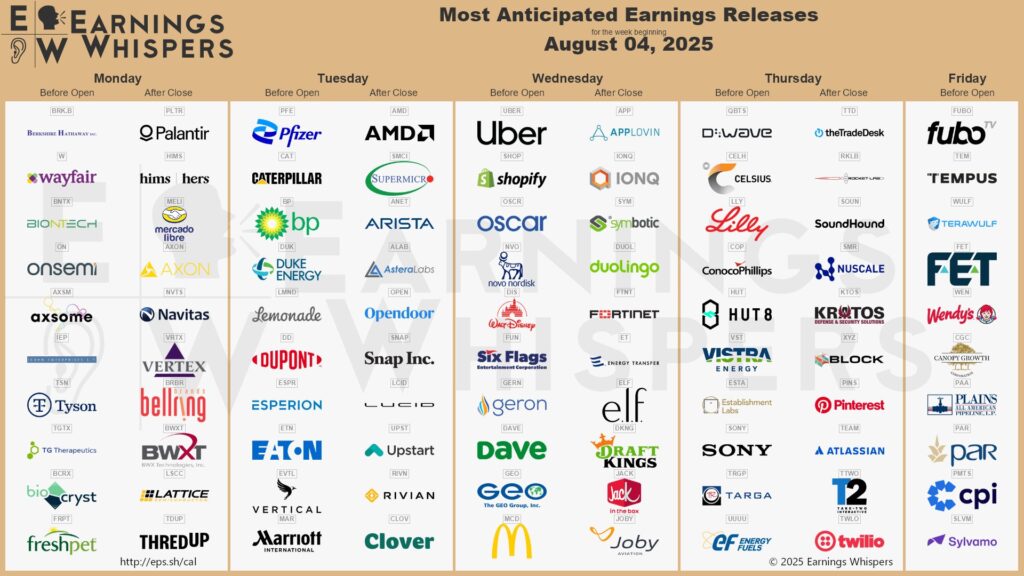
💼 Earnings season is in full swing this week, with markets watching closely across key sectors.
📅 Monday, Aug 4th
- Palantir Technologies (PLTR): Palantir reports Q2 results with consensus revenue of $939.33 million, up 38.5% year-over-year, and adjusted EPS of $0.14, marking a 55% year-over-year increase. Market participants should monitor the commercial versus government revenue split. Analysts forecast $429.3 million in commercial sales (+39.7% YoY) and $510.5 million in government revenue (+37.7% YoY), as well as management’s guidance range of $934–938 million in revenue and $401–405 million in adjusted operating income for Q2. Finally, any upward or downward revisions to full-year guidance and commentary on client retention and pipeline development will be key indicators of Palantir’s ability to sustain its current growth trajectory.
📅 Tuesday, Aug 5th
- Advanced Micro Devices, Inc (AMD): AMD is set to report Q2 earnings, with analysts expecting the chipmaker to deliver strong revenue growth despite facing significant regulatory headwinds. The consensus forecast calls for $7.41 billion in revenue (up 27.1% year-over-year) and $0.48 in earnings per share, representing a substantial decline from the $0.69 reported in Q2 2024.
Market participants should closely monitor three key areas: Data Center segment performance (projected at $3.31 billion, up 16.7% year-over-year), the impact of $700 million in lost revenue from China export restrictions on chip sales, and guidance for the MI350 GPU rollout which has reportedly considered a 70% price increase to $25,000 per unit. The earnings report will be critical in determining whether AMD can sustain its AI momentum amid export license challenges that are expected to reduce full-year 2025 revenue by $1.5 billion. - Marriott International (MAR): Marriott is set to report Q2 results with consensus earnings of $2.61 per share, up 4.4% from $2.50 a year ago, on revenues of approximately $6.67 billion, a 3.5% year-over-year increase. Market participants should watch management’s outlook for global Revenue per Available Room (RevPAR), which is guided to rise 1.5%–2.5% year over year in Q2, and gross fee revenues, expected to climb by 3%–4% year-over-year in the quarter. These metrics are key signals of the strength of group bookings and recurring fee-based income across regions.
📅 Wednesday, Aug 6th
- Walt Disney Company (DIS): Walt Disney is scheduled to report Q3 FY2025 results, with consensus estimates projecting EPS of $1.45 (a 4.3% year-over-year increase) on revenue of $23.70 billion (a 2.3% year-over-year rise). Market participants should look beyond the headline numbers to the Direct-to-Consumer segment. Streaming operating income, supported by Disney+ net subscriber additions, Average Revenue Per User (ARPU) trends, and the initial impact of password-sharing fees, will be key to determining whether profitability momentum can be sustained. Equally important is the Parks, Experiences & Products division. Metrics such as per-capita guest spending, international attendance (especially in China), and management’s comments on capacity expansion and Q4 guidance will signal the overall health of Disney’s experiential business.
📅 Thursday, Aug 7th
- Eli Lilly and Company (LLY): Eli Lilly is set to report Q2 results, with consensus estimates projecting adjusted EPS of $5.60, up approximately 42.8% year-over-year, on estimated revenue of $14.70 billion, representing about 30% growth from the prior year. Market participants should focus on detailed metrics from the tirzepatide franchise, particularly Mounjaro and Zepbound. Guggenheim analysts expect Q2 sales of $4.49 billion for Mounjaro and $3.10 billion for Zepbound, both trending above Wall Street forecasts.
Investors should look at how many doses of Mounjaro and Zepbound Eli Lilly actually sold this past quarter, and then see how that compares to how much more of the drugs the company says it can make later this year. Margin commentary and any adjustments to full-year EPS guidance, currently between $20.78 and $22.28, will be key to assessing the sustainability of profitability amid elevated research and development and marketing expenses.
We hope this helps and happy trading!
– Trade and Travel Team
1 Comment
Related Blogs


Follow Us
Testimonials
Hear from students on why they chose the Trade and Travel Family and how it has changed their lives.


Thanks so much for your support..!😊