
Last week ended on a high note as major indices surged following a dramatic start. Markets initially tumbled on Monday when President Trump escalated criticism of Fed Chair Powell, sparking concerns about central bank independence. The S&P 500 plummeted more than 2% in a volatile session that reflected investors’ unease.
However, sentiment shifted midweek as trade tensions appeared to ease. Treasury Secretary Scott Bessent signaled high U.S.-China tariffs were “unsustainable,” while Trump softened his stance on Powell. This optimism, coupled with strong earnings (73% of companies beating expectations), fueled a market rebound.
For the week, the S&P 500 (SPY) climbed 4.6%, the Nasdaq (QQQ) surged 6.41%, and the Dow (DIA) rose 2.48% – marking their second positive week out of three.
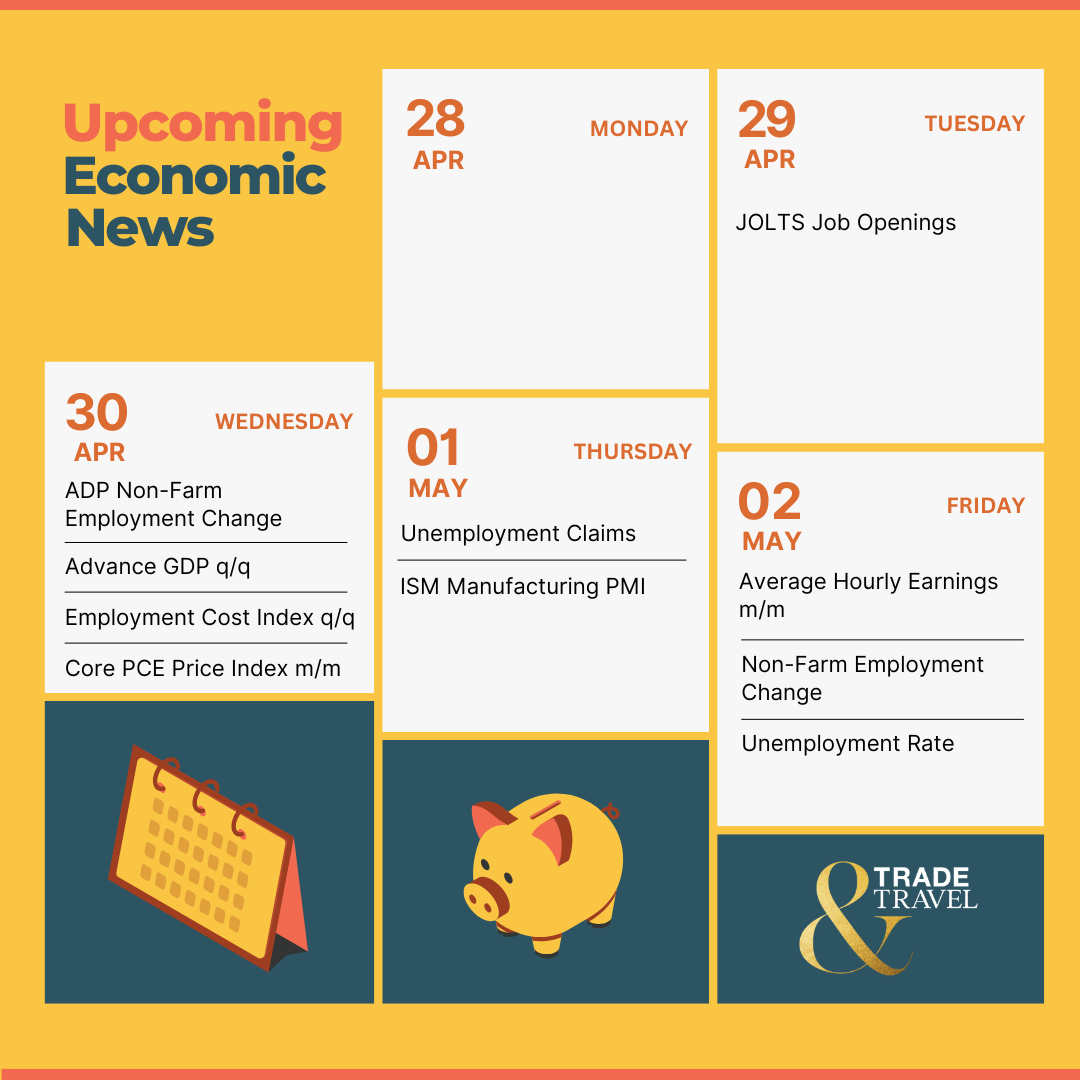
Looking ahead, market participants should monitor a packed calendar: first-quarter U.S. GDP, April’s non-farm payrolls, core PCE inflation data, and manufacturing PMIs revealing tariff impacts. Major tech earnings continue with Apple, Microsoft, and Amazon reporting.
📅 Tuesday, April 29th
- JOLTS Job Openings: The upcoming report for March 2025 is forecast to show 7.48 million openings compared to February’s 7.57 million, suggesting a continued gradual cooling in the US labor market. February’s report revealed notable declines in retail trade (126,000 fewer openings), finance and insurance (80,000 fewer), and leisure and hospitality (61,000 fewer), which market participants should watch for continuation in March as indicators of consumer sector health. Market participants should closely monitor the job openings-to-unemployed ratio (previously at 1.07 jobs per unemployed worker), any acceleration in the downward trend beyond the forecast 7.48 million figure, and sector-specific changes that might signal broader economic shifts influencing Federal Reserve policy decisions in the coming months.
📅 Wednesday, April 30th
- ADP Non-Farm Employment Change: The report is forecast to show 123K private-sector jobs added in April, down from March’s stronger 155K reading. This anticipated deceleration could signal cooling labor market conditions, potentially influencing the Federal Reserve’s interest rate decisions as policymakers assess employment strength against inflation concerns. Market participants should analyze the headline figure versus the 123K forecast, pay attention to sectoral distribution (with manufacturing adding 21K and financial activities adding 38K jobs in the previous report), and scrutinize year-over-year wage growth trends (previously 4.6% for job-stayers and 6.5% for job-changers) for clues about labor market health and monetary policy direction.
- Advance GDP q/q: The U.S. Bureau of Economic Analysis will release its Advance GDP estimate for Q1 2025, showing a projected 0.4% annualized growth rate, significantly lower than the 2.4% expansion recorded in Q4 2024 and representing the weakest quarterly performance in nearly three years. Market participants should closely scrutinize consumer spending patterns, which typically accounts for over two-thirds of GDP, along with the impact of increased tariffs on net exports and potential inventory adjustments as businesses respond to trade policy changes. Market participants would be wise to monitor sector-specific performances within the report for signs of economic resilience or weakness, particularly in services, manufacturing, and housing sectors, while assessing how the significant growth deceleration might influence the Federal Reserve’s interest rate decisions in coming months.
- Employment Cost Index q/q: The U.S. Bureau of Labor Statistics will release the Employment Cost Index (ECI) for the first quarter of 2025, with economists forecasting a 0.9% quarter-over-quarter increase, maintaining the same pace as the previous quarter. Last quarter’s reading showed compensation costs for civilian workers rose 0.9% while annual costs increased by 3.8%, slightly down from the 3.9% annual increase observed in Q3 2024. Market participants should closely monitor the wages and salaries component (which grew 0.9% in Q4) versus the benefits component (which increased 0.8% in Q4) as an acceleration beyond consensus expectations could signal persistent wage inflation pressures.
- Core PCE Price Index m/m: The upcoming report is forecast to cool sharply to 0.1%, down from February’s elevated 0.4% reading, which would mark the slowest monthly core inflation pace since November 2024. Market participants should scrutinize whether the deceleration reflects broad-based disinflation, particularly in sticky core services ex-housing components like healthcare and hospitality, which help drove 0.4% monthly gains in February. Market participants should also assess potential upward revisions to prior months’ data, as Q1 strength in services inflation previously prompted analysts to lift full-year core PCE forecasts to 3.1%.
📅 Thursday, May 1st
- Unemployment Claims: The upcoming report for the week ending April 26, 2025, is forecasted to reach 224,000, representing a slight increase from the previous week’s 222,000 figure, which was already 6,000 claims higher than the week before. Market participants should closely monitor this potential uptick against the four-week moving average of 220,250, as consecutive increases above this level could signal deterioration in the historically tight labor market that has shown resilience despite economic uncertainties. Market participants should also pay particular attention to continuing claims, which previously fell to 1,841,000, as persistent readings above 1.8 million since May 2024 have been identified as a warning sign of potential underlying weakness in hiring conditions.
- ISM Manufacturing PMI: The upcoming report is forecast to decline to 48.0 for April 2025, falling further below the contraction threshold of 50 and deteriorating from March’s reading of 49.0, which would mark the second consecutive month of manufacturing contraction following a brief expansion in January and February. Market participants should closely monitor the Prices Paid component, which surged to 69.4 in March (the highest since June 2022), while also watching the New Orders Index (previously 45.2) and Employment Index (previously 44.7) for signs of deeper economic weakness. Particular attention should be paid to comments from manufacturing executives regarding tariff impacts, supply chain disruptions, and domestic versus export demand, as March data showed significant “demand confusion” with weakening new orders but growing inventories, suggesting manufacturers are struggling to balance production with uncertain market conditions.
📅 Friday, May 2nd
- Average Hourly Earnings m/m: The upcoming report is expected to maintain a steady growth rate of 0.3%, matching the March figure when wages increased by 9 cents to $36.00 per hour. The year-over-year earnings growth slowed to 3.8% in March from 4.0% in February, suggesting a gradual cooling in wage pressures that could influence Federal Reserve policy decisions. Market participants should closely monitor whether the actual figure deviates from the 0.3% forecast, as stronger-than-expected wage growth could signal heightened inflation concerns, while weaker numbers below 0.2% might accelerate expectations for monetary easing and trigger volatility in currency and equity markets.
- Non-Farm Payrolls: The upcoming Non-Farm Payrolls report is expected to show a significant slowdown in job creation with a forecast of 129,000 new positions compared to March’s robust 228,000 gain, potentially signaling a cooling labor market after several months of volatility. Market participants should pay close attention to revisions to previous months’ data, the unemployment rate, which stood at 4.2% in March. Market participants should prepare for heightened market volatility across markets immediately following the release, as any substantial deviation from the 129,000 consensus forecast could significantly impact Federal Reserve interest rate expectations and potentially trigger sharp movements in the US Dollar and risk assets.
- Unemployment Rate: The U.S. Bureau of Labor Statistics will release the unemployment rate data with analysts forecasting the rate unchanged at 4.2%, consistent with the March 2025 figure. Market participants should closely monitor job creation numbers with consensus estimates, which could significantly impact stock market performance if they deviate from expectations. Market participants should also pay attention to other key components within the report, including labor force participation rate (previously at 62.5%), average hourly earnings (forecast to rise 0.3% month-over-month), and any revisions to previous months’ data, as these metrics collectively provide crucial insights into economic health.
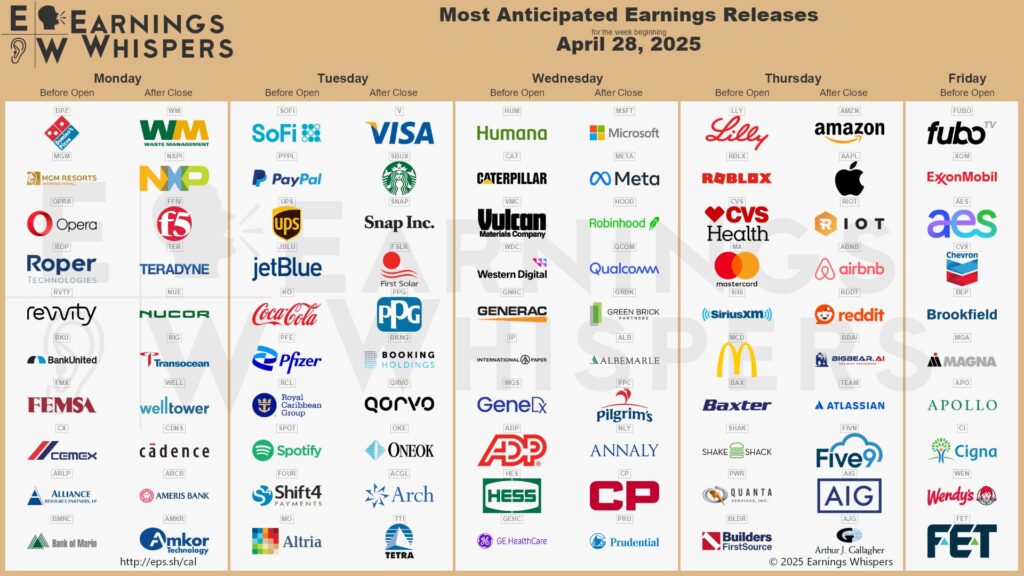
With earnings season in full swing, here are some stocks reporting earnings this week:
📅 Tuesday, April 29th
- Visa Inc (V): Visa is scheduled to report its earnings with analysts expecting EPS of $2.68 (up 6.8% year-over-year) and revenues of approximately $9.55 billion (representing a 9% increase from the same period last year). Market participants should closely monitor key metrics including payment volumes growth, cross-border transactions (which grew 16% in Q1), and Visa Direct transactions (which rose 38% in the prior quarter to 2.8 billion). Recent tariffs could potentially reduce payment volume growth by 1–2%, possibly cutting quarterly revenue by $100–$200 million, as retail and e-commerce-heavy U.S. markets may be affected. This makes Visa’s forward guidance particularly important as consumer spending patterns remain uncertain in the current economic environment.
📅 Wednesday, April 30th
- Meta Platforms, Inc. (META): Meta Platforms will report after market close, with Wall Street analysts expecting revenue of $41.34 billion (13.4% year-over-year growth) and earnings per share of $5.24. Market participants should closely monitor the impact of US-China trade tensions on advertising revenue, as Chinese advertisers account for over 10% of Meta’s ad revenue and companies like Temu and Shein are already reducing their ad spending. Additionally, Meta’s operating margin is expected to drop sharply to 32.5% from 43.1% in Q4 2024, reflecting rising costs from its planned $60-65 billion capital expenditure for 2025 on AI infrastructure and data centers, making management comments on ROI and future growth expectations particularly important.
- Qualcomm (QCOM): Qualcomm is to report earnings with analyst expectations of EPS between $2.70-$2.90 and revenue forecasts of $10.2-$11.0 billion, following their record-breaking Q1 performance where they achieved $11.7 billion in revenue and $3.41 EPS.
Market participants should closely monitor QCT segment performance, particularly handset revenues (expected to grow ~10% year-over-year) and automotive revenues (which saw 61% growth last quarter), along with IoT revenues which increased 36% in Q1. While Qualcomm continues to demonstrate strength in diversification initiatives toward their fiscal 2029 target of $22 billion in non-handset revenues, market participants should be attentive to commentary around China market exposure (which accounts for approximately 46% of total revenue) amid ongoing trade tensions, as well as QTL licensing revenues which have shown more modest growth compared to other segments.
- Microsoft Corp. (MSFT): Microsoft is set to release its earnings report with analysts expecting revenues of approximately $68.43 billion (representing a 10.62% year-over-year increase) and earnings per share of $3.22 (a 9.35% year-over-year growth). Market participants should closely monitor Azure cloud services performance, which is projected to grow 31-32%, as well as the company’s AI initiatives which reached a $13 billion annualized revenue run rate in Q2. Following Microsoft’s Q2 earnings beat with EPS of $3.23, market participants will be particularly attentive to whether the company can overcome the execution challenges and capacity constraints in its cloud business that were highlighted during the previous quarter’s guidance.
📅 Thursday, May 1st
- Amazon.com (AMZN): Amazon is set to report its earnings after market close, with analysts expecting revenue of approximately $155.1 billion (representing 8% year-over-year growth) and earnings per share of $1.37 (up 39% from the previous year). Market participants should closely monitor AWS performance, which generated $28.8 billion in Q4 2024 with 19% year-over-year growth but faces increased competition from Microsoft Azure and Google Cloud. Key focus areas should include the impact of an estimated $2.1 billion foreign exchange headwind, potential tariff effects on Amazon’s retail operations where approximately 60% of cost of goods sold comes from imports (with a third from China), and commentary on AI investments including the company’s Trainium 2.0 chips and Bedrock platform.
- Eli Lilly and Company (LLY): Eli Lilly will report its financial results with analysts expecting EPS between $3.45 and revenue of approximately $12.67 billion, though earnings will be impacted by a previously announced $1.57 billion pre-tax charge for acquired in-process research and development. Market participants should focus on sales performance of GLP-1 drugs Mounjaro and Zepbound, which drove 26% revenue growth in the previous year and remain crucial to Lilly’s growth trajectory despite supply constraints. Additionally, market participants should monitor any adjustments to Lilly’s full-year 2025 guidance, which currently projects revenue between $58-61 billion and adjusted EPS of $22.50-$24.00, as manufacturing capacity expansion and market penetration of weight loss medications could significantly impact future earnings potential.
We hope this helps and happy trading!
– Trade and Travel Team
Related Blogs






Follow Us
Testimonials
Hear from students on why they chose the Trade and Travel Family and how it has changed their lives.

