

The S&P 500, tracked by SPY, surged approximately 3.6% on the week, snapping a six-week losing streak in the index’s best weekly performance since May 2025. The Nasdaq-100 (QQQ) rallied roughly 4.4%, the Dow (DIA) advanced approximately 3%, and Tuesday’s ceasefire announcement between the United States and Iran served as the week’s primary catalyst, with the Dow gaining more than 1,300 points that session alone for its best day in a year. All three averages remain negative year-to-date despite the sharp rebound.
WTI crude plunged as much as 17% on Tuesday, its largest single-day decline since April 2020, and settled near $96 per barrel by Friday for a weekly drop of approximately 13.7%, crude’s worst week since 2020. However, Israeli strikes on Lebanon prompted Iran to briefly re-close the Strait of Hormuz within hours of the ceasefire, sending oil back toward $100 midweek.
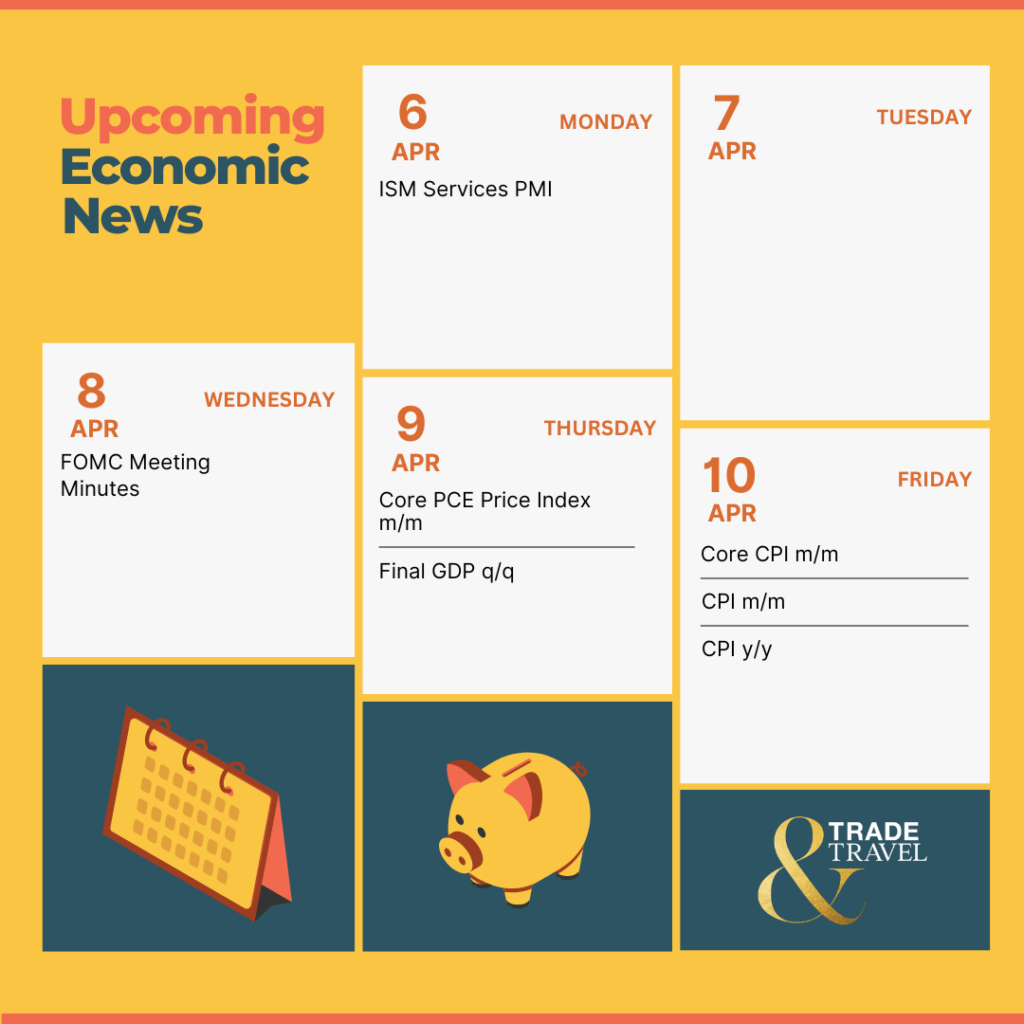
The FOMC March meeting minutes, released Tuesday, revealed that some officials advocated keeping rate increases on the table if inflation remains sticky. Friday’s March CPI print landed at +0.9% month over month and +3.3% year over year, the highest annual reading since May 2024, driven by a 21.2% surge in gasoline prices. Core CPI rose a benign +0.2% month over month, leading markets to interpret the report as energy-driven rather than broad-based.
Looking ahead, March PPI arrives on Tuesday, and the Census Bureau has rescheduled Advance Retail Sales to next week, April 21. Q1 2026 bank earnings season kicks off with Goldman Sachs on Monday, Johnson & Johnson on Tuesday, Bank of America on Wednesday, and Taiwan Semiconductor and Netflix on Thursday; we preview each below, alongside the broader bank cohort and PepsiCo, also reporting this week.
💥How This Impacts You
You can use this week to focus less on jumping into trades with all the activity in the market and more on studying how the price reacts to major news like inflation data and earnings. Sharp moves tied to oil and geopolitical headlines have been fading quickly, and watching that pattern play out can build better intuition over time. Bank earnings may highlight where strength still exists even in uncertainty. The advantage right now comes from staying disciplined while others react too fast, because that’s where better decisions are made.
📅 Tuesday, April 14th
• Producer Price Index (PPI m/m, Core PPI m/m): March 2026
The Bureau of Labor Statistics (BLS) is scheduled to release the March 2026 Producer Price Index (PPI), measuring price changes received by domestic producers across final demand goods, services, and intermediate demand stages.
February 2026 data delivered a third consecutive month of accelerating producer prices: headline PPI rose +0.7% month over month (following +0.5% in January and +0.4% in December 2025), while the year-over-year rate climbed to +3.4%, its highest level since matching the same figure in February 2025; core PPI, excluding food, energy, and trade services, advanced +0.5% month over month, the tenth consecutive increase.
February’s composition shifted meaningfully toward goods: final demand goods jumped +1.1%, with energy prices rising +2.3% and foods surging +2.4% (the latter accounting for roughly 40% of the headline advance), while final demand services rose a more moderate +0.5% for a third straight monthly gain; within services, traveler accommodation surged +5.7%, contributing approximately 20% of the services increase, and within goods, fresh and dry vegetable prices spiked +48.9%, contributing over 20% of the goods advance.
The March reading arrives against the backdrop of a historic energy shock: the Strait of Hormuz crisis pushed WTI crude above $100 per barrel for sustained periods during March, and the March CPI gasoline component surged +21.2%, suggesting PPI energy inputs will carry substantial upside pressure.
Consensus projects a headline PPI reading of +1.2% month over month and core PPI of +0.5% month over month; a headline print at or above +1.0% would represent the hottest monthly PPI reading since early 2022 and would further erode expectations for any 2026 rate cuts, while a core reading at or below +0.3% could suggest the energy shock is not yet filtering into broader pipeline costs, offering modest relief to rate-sensitive equities.

💼 Q1 2026 earnings season officially begins with a bank-heavy lineup, set to reveal how Wall Street navigated the Iran oil shock and tariff uncertainty, while other companies face their own test after a volatile quarter.
📅 Monday, April 13th
• Goldman Sachs (GS): Q1 FY2026 (Before Open)
Goldman Sachs (NYSE: GS) reports its fiscal Q1 FY2026 results, with analyst consensus projecting EPS of $16.34 on revenue of $17.01 billion. If estimates prove accurate, that EPS figure would represent a 15.7% increase from the $14.12 delivered in the year-ago quarter, extending a streak of four consecutive quarterly earnings beats with an average surprise of 14%. The revenue estimate implies a 12.9% year-over-year advance from the $15.06 billion reported a year ago, building on full-year 2025 net revenues of $58.28 billion.
Equity trading is expected to be a standout once again, after the firm posted a record $4.31 billion in equities revenue in the prior quarter; client hedging activity in gold, energy, and silver tied to the Iran conflict has kept trading desks unusually busy through March. Investment banking fees are projected to rise between 33% and 41% year over year, supported by Goldman’s number-one global ranking in M&A advisory and an investment banking backlog at a four-year high. CEO David Solomon has described 2026 as an IPO “mega-cycle,” with over 120 global filings in the first quarter alone marking the most active start to a year since 2021.
The Asset and Wealth Management division, which generated record management fees of $11.54 billion in 2025, now oversees $3.61 trillion in total assets under supervision and $1.9 trillion in wealth management client assets. Goldman raised its quarterly dividend 12.5% to $4.50 per share alongside the Q4 2025 report, and the firm is targeting high-teens returns for the AWM division over the medium term, with roughly 5% annual growth in long-term fee-based net inflows. Tariff uncertainty and the Iran-driven oil shock present the primary macro risks heading into the call, as elevated geopolitical volatility could either sustain the trading tailwind or freeze the M&A pipeline that underpins the investment banking outlook.
📅 Tuesday, April 14th
• Johnson & Johnson (JNJ): Q1 FY2026 (Before Open)
Johnson & Johnson (NYSE: JNJ) reports its fiscal Q1 FY2026 results, with analyst consensus projecting EPS of $2.68 on revenue of $23.44 billion. If estimates prove accurate, that EPS figure would represent a 3.2% decline from the $2.77 delivered in the year-ago quarter, a reversal that reflects the growing drag from Stelara biosimilar competition as multiple entrants from Amgen, Teva, and Samsung Bioepis capture market share. The revenue estimate implies a 7.0% year-over-year advance from the $21.9 billion reported a year ago, an acceleration from the 6.0% full-year 2025 growth rate that lifted annual sales to $94.2 billion.
Darzalex, the multiple myeloma franchise that surpassed $14 billion in annual sales last year, remains the primary growth engine in Innovative Medicine, while Tremfya grew roughly 40% in 2025 to approximately $5.2 billion and is positioned to absorb displaced Stelara demand following its Crohn’s disease approval.
The company has guided 2026 full-year sales in the range of $100 billion to $101 billion, a target underpinned by RYBREVANT’s overall survival data in lung cancer and nipocalimab’s FDA approval for generalized myasthenia gravis. Tariffs present a material headwind, with management estimating a $400 million annual impact concentrated in MedTech’s China-bound device exports; in response, J&J has committed $55 billion in U.S. investment over four years, including four new manufacturing facilities. Talc litigation remains an overhang after a bankruptcy judge rejected the $8 billion Red River Talc settlement plan in late 2025, and a $50 million federal jury verdict in March 2026 underscored the ongoing trial risk across more than 90,000 pending claims.
📅 Wednesday, April 15th
• Bank of America (BAC): Q1 FY2026 (Before Open)
Bank of America (NYSE: BAC) reports its fiscal Q1 FY2026 results, with analyst consensus projecting EPS of $0.99 on revenue of $29.25 billion. If estimates prove accurate, that EPS figure would represent a 10.0% increase from the $0.90 delivered in the year-ago quarter, sustaining the momentum that lifted full-year 2025 earnings per share 19% to $3.81. The revenue estimate implies a 6.8% year-over-year advance from the $27.4 billion reported a year ago, consistent with the 7% growth rate the bank posted for both Q4 2025 and full-year 2025.
Management has guided net interest income to grow at least 7% year over year in 2026, supported by a loan book where card lending is expanding above 6% and corporate lending benefits from infrastructure and AI-related spending. The Global Wealth and Investment Management division, anchored by Merrill Lynch’s $4.1 trillion in client balances, delivered $20.7 billion in revenue during 2025 with asset management fees rising 12%; Merrill is targeting $150 billion per year in new fee-producing assets as it shifts the brokerage-to-fee asset mix toward 55% fee-based. Investment banking fees are expected to increase by approximately 10%, a more measured pace than the 44% surge posted in Q4 2025, as the clearing M&A backlog works through a pipeline complicated by tariff uncertainty and geopolitical risk.
Consumer Banking generated $10.5 billion in revenue in the year-ago quarter, and management is targeting approximately 200 basis points of operating leverage for the full year, a metric that would signal disciplined expense management against a backdrop of rising technology investment.
CEO Brian Moynihan has projected economic resilience in 2026, though the Iran-driven oil shock and persistent inflation near 2.7% on core PCE have complicated the rate outlook and could pressure consumer credit quality. Card net charge-offs are guided at 3.6% to 3.9% for 2026, and analysts will be monitoring whether deposit growth, guided at low-to-mid single digits, can sustain the NII trajectory as the era of aggressive rate-driven margin expansion fades.
📅 Thursday, April 16th
• TSMC (TSM): Q1 2026 (Before Open)
Taiwan Semiconductor Manufacturing Company (NYSE: TSM) reports its Q1 2026 results, with analyst consensus projecting EPS of $3.29 on revenue of $35.40 billion. If those estimates prove accurate, the EPS figure would represent a 55.2% increase from the $2.12 per ADR unit delivered in the same quarter last year, extending a period of extraordinary growth driven by insatiable demand for AI accelerator chips. TSMC already disclosed January-through-March consolidated sales of NT$1.134 trillion on April 10, translating to roughly $35.7 billion and landing at the top of its guidance range.
That figure marks a 35.1% year-over-year increase from the NT$839.25 billion recorded in the year-ago period. Management has guided gross margins of 63% to 65% for the quarter, with operating margins of 54% to 56%, ranges that underscore the pricing leverage TSMC commands across its most advanced process nodes.
CEO C.C. Wei has positioned TSMC’s N2 (2-nanometer) process as the next growth catalyst; the node entered high-volume manufacturing in the fourth quarter of 2025 at both Hsinchu and Kaohsiung facilities with yields exceeding initial expectations. Capacity for N2 is nearly sold out through 2027, with Apple securing over 50% of the initial allocation for its A20 Pro chip and the remainder split among NVIDIA, AMD, and Qualcomm. High-performance computing accounted for 55% of Q4 2025 revenue, and the company has committed a record $56 billion in capital expenditure for 2026 to meet AI-related demand.
TSMC’s Arizona expansion continues at pace as part of a $165 billion commitment, with the first fab already producing 4nm chips for Apple and NVIDIA, and equipment installation for a second 3nm fab targeted for the third quarter of 2026 ahead of volume production in 2027. The company fabricates roughly nine out of every ten advanced AI accelerators globally, a concentration that amplifies both its pricing power and its exposure to geopolitical risk surrounding the Taiwan Strait.
• Netflix (NFLX): Q1 FY2026 (After Close)
Netflix (NASDAQ: NFLX) reports its first quarter 2026 results, with analyst consensus projecting EPS of $0.76 on revenue of $12.17 billion. If those estimates hold, the EPS figure would represent a 15.0% increase from the $0.661 delivered in the same quarter last year, sustaining the margin expansion trajectory that has defined the company’s post-password-sharing era. The revenue estimate implies a 15.5% year-over-year advance from the $10.54 billion reported in the year-ago period, a pace that would keep the company on track for its ambitious full-year targets.
Management has guided Q1 operating margin of 32.1%, up from 31.7% a year ago, as the company continues to translate subscriber scale into widening profitability. Netflix ended 2025 with over 325 million paid memberships worldwide, generating full-year revenue of $45.2 billion and an annual operating margin of 29.5%. The advertising-supported tier continues to scale rapidly, with more than 190 million monthly active viewers on the ad plan, and the company expects ad revenue to roughly double in 2026 after exceeding $1.5 billion in 2025.
Live programming has emerged as a key engagement driver, anchored by a 10-year, $5 billion deal for WWE’s Monday Night Raw and exclusive Christmas Day NFL games through at least 2026, events that broaden the platform’s appeal beyond scripted entertainment into appointment viewing that supports ad monetization.
Co-CEOs Ted Sarandos and Greg Peters raised subscription prices across all U.S. tiers in late March 2026, with the standard plan climbing to $19.99 and the premium tier reaching $26.99. Management has guided full-year 2026 revenue of $50.7 billion to $51.7 billion, with a targeted operating margin of 31.5% and approximately $11 billion in free cash flow.
We hope this helps and happy trading!
– The Trade and Travel Team
Related Blogs




Follow Us
Testimonials
Hear from students on why they chose the Trade and Travel Family and how it has changed their lives.

