
The first week of September delivered a measured start for U.S. equities, as market participants balanced optimism about growth with caution ahead of fresh economic data. After a shortened holiday week, the major indexes posted mixed results. The S&P 500, tracked by SPY, edged higher by roughly 0.34%. The Nasdaq, via QQQ, led the pack with a 0.99% weekly gain, while the Dow Jones, represented by DIA, slipped about 0.24%. The split underscored a market still leaning on technology leadership while more traditional sectors lagged.
Earnings reports were steady. Many companies posted solid revenue growth, yet guidance and margin concerns tempered enthusiasm. Rather than sparking sharp rallies, results were digested with a sense of restraint, reflecting investors’ broader focus on the policy outlook.
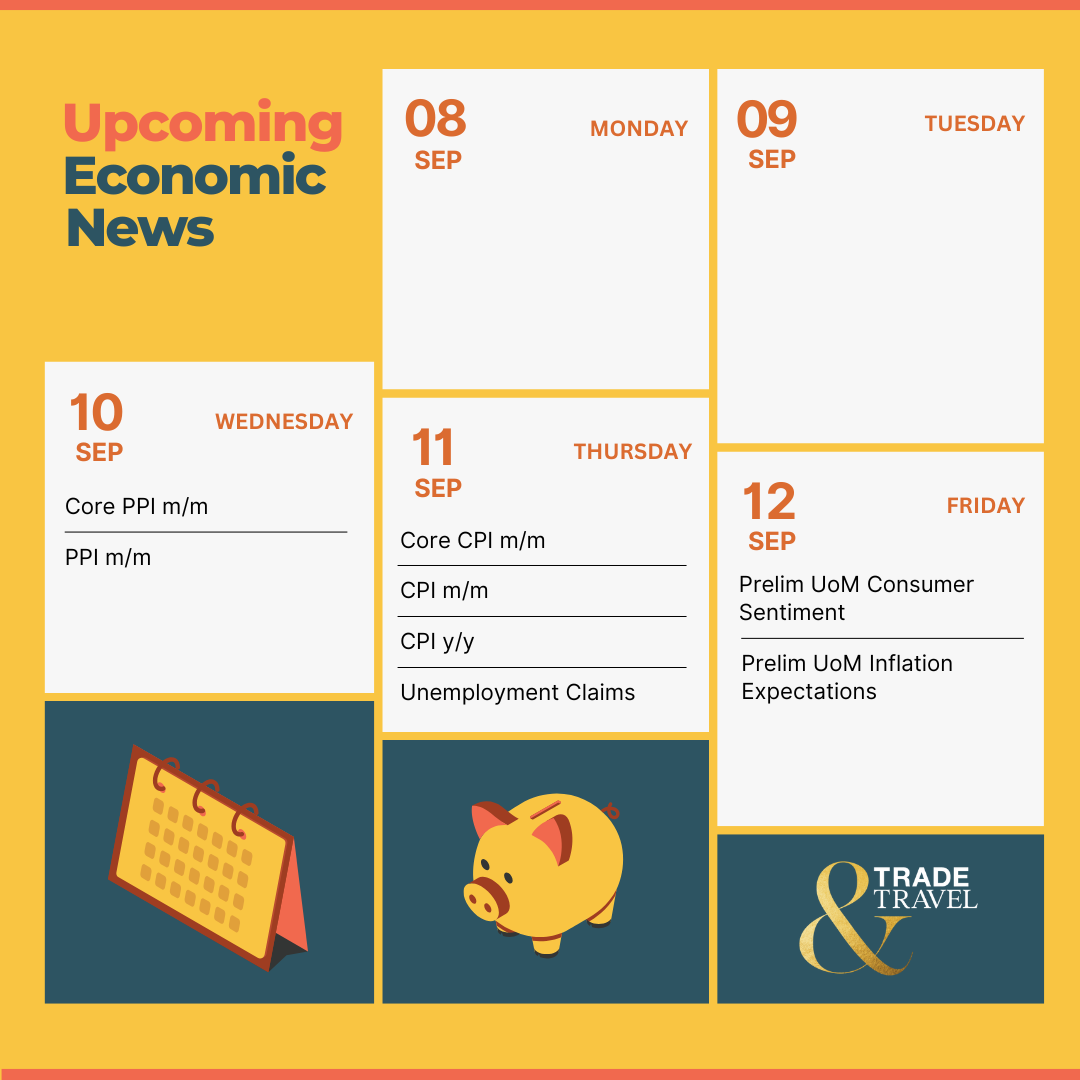
That spotlight now turns to the days ahead. Inflation data is the clear driver this week, with the Consumer Price Index and Producer Price Index due, alongside consumer sentiment from the University of Michigan. Together, these releases will shape expectations for the Federal Reserve’s September meeting, where investors are weighing the chances of eventual rate cuts against the risk of inflation proving sticky. Globally, the European Central Bank’s upcoming rate decision could influence sentiment, while simmering U.S.–China trade tensions remain an ever-present backdrop. Meanwhile, technology stays in focus with Apple’s iPhone 17 launch and the Goldman Sachs Communacopia conference (an annual investor forum where top tech, media, and telecom firms share strategy and growth outlooks) on deck, events that may further sway growth-oriented stocks.
With key economic data and high-profile corporate headlines coming together, the coming days may well set the tone for how markets navigate what is often a volatile month.
📅 Wednesday, Sep 10th
- PPI and Core PPI m/m: The upcoming Producer Price Index report is shaping up as a pivotal test for inflation expectations. Economists forecast a sharp slowdown in both the headline and core PPI, with August expected to rise just 0.3% month-over-month, down from July’s scorching 0.9% gain. That prior jump, the steepest since March 2022, caught markets off guard and pushed core wholesale prices to a three-year high, largely driven by tariff-related cost pressures. A cooler reading now would suggest those forces are easing, offering some relief on the inflation front.
For markets, the stakes are clear. Traders are already pricing in better than a 90% chance of at least a 25-basis-point Fed rate cut in September, but any deviation from the forecast could shift expectations quickly. A hotter print would raise doubts about producer price pressures bleeding into consumer prices and complicating the Fed’s path, while confirmation of a slowdown would strengthen the case for easing.
Focus will fall on core PPI, which strips out food and energy and gives the clearest read on underlying inflation. Whether August shows that spike was a one-off or the start of something more persistent will help determine if the Fed stays on track to cut or holds a firmer line.
📅 Thursday, Sep 11th
- Core CPI m/m: Core CPI is expected to hold at 0.3% month-over-month following July’s increase, the largest since January. On an annual basis, core inflation stands at 3.1%, well above the Fed’s 2% target, underscoring how fragile disinflation progress remains. Market participants will be watching whether the 0.3% monthly pace persists, since sustained readings at that level could delay Federal Reserve rate cuts.
July’s breakdown highlights the persistence of inflation in key categories. Supercore services, which exclude shelter, rose 0.5% on the month and 3.2% on the year, pointing to underlying price pressures in labor-sensitive services. Shelter costs moderated, rising 0.2% month-over-month and 3.7% year-over-year, but remain a significant driver of overall inflation.
- CPI m/m: The upcoming report will be closely watched as markets position for the Fed’s September 16–17 policy meeting. With the previous reading at 0.2% month-over-month and forecasts pointing to 0.3%, the data will show whether price pressures are accelerating amid ongoing tariff impacts and shifting economic conditions. At the same time, tariff-sensitive goods such as furniture, auto parts, and apparel posted price increases, raising the risk that renewed goods inflation could keep core CPI in the 0.3% to 0.4% range in the near term.
- CPI y/y: Year-over-year inflation is expected to rise to 2.9% in August from 2.7% in July, signaling renewed price pressures after several months of moderation. Investors will focus on whether this uptick is driven by shelter and services, which remain sticky, or by tariff-affected goods. A print above 2.9% could dampen expectations for near-term Fed rate cuts, while an inline or softer result would support the case for easing.
- Unemployment Claims: Weekly unemployment claims are forecast at 234,000, slightly below the prior 237,000, signaling a still-resilient labor market. Investors will be watching whether claims trend lower, which would reinforce concerns that tight employment could keep wage pressures and inflation elevated. A surprise increase above expectations could ease pressure on the Federal Reserve by pointing to cooling labor demand ahead of its September policy meeting.
📅 Friday, Sep 12th
- Prelim UoM Inflation Expectations: The preliminary University of Michigan Consumer Sentiment index for September is due to be released, following a prior reading of 58.2 and consensus forecasts pointing to a slight decline to 58.0. Investors should focus on the expectations subindex, which historically correlates with consumer spending trends and may signal shifts in economic growth momentum.
- Prelim UoM Consumer Sentiment: The preliminary University of Michigan one-year inflation expectations for September will be closely watched to see if they ease from August’s 4.8% reading, which was up from 4.5% in July. A print above 4.8% would suggest persistent price pressures and could push Treasury yields higher, while a softer figure would help ease rate-hike concerns. Traders should also compare the one-year figure with the five-year expectation, currently around 3.5%, to gauge whether short-term sentiment is diverging from the longer-term inflation outlook.
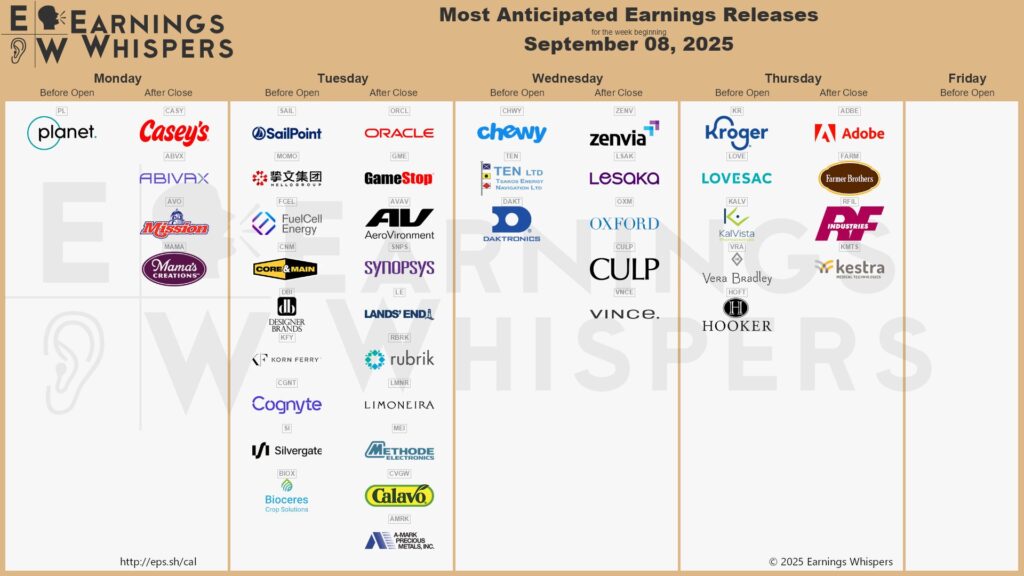
💼 Although the peak of earnings season has passed, several notable companies are still set to report this week:
📅 Monday, Sep 8th
- Caseys General Stores, Inc. (CASY): Casey’s General Stores is set to report quarterly results, with analysts forecasting EPS of $5.05 and revenue of approximately $4.48 billion, a 9.26% year-over-year increase. Investors should watch inside same-store sales, which management expects to grow 2–5% in FY2026, following a 1.7% year-over-year increase in Q4 and a 2.6% gain for FY2025 overall. Equally important will be any forward guidance, as management commentary often drives stock volatility more than the headline results.
📅 Tuesday, Sep 9th
- Oracle Corporation (ORCL): Oracle will report its first quarter fiscal year 2026 earnings, with analysts expecting earnings per share of $1.48 (representing 6.4% year-over-year growth) and revenues of $15.04 billion (up 12.9% from the prior year). Market participants should focus on three critical metrics: Oracle Cloud Infrastructure (OCI) revenue growth, which management projects will exceed 70% in fiscal 2026 compared to 52% growth in the previous quarter, remaining performance obligations (RPO) that are expected to surge over 100% from the current $138 billion baseline, and the company’s ability to meet or exceed its guidance range of $1.46-$1.50 EPS.
Oracle plans to spend over $25 billion on capital expenditures in fiscal 2026, up from about $21.2 billion in FY2025, to expand capacity for AI-driven infrastructure. The company currently operates 23 multi-cloud data centers and has 47 more under construction, and it is a participant in the OpenAI-backed Stargate project. While Oracle has not tied these investments to specific revenue targets, analysts see potential for meaningful upside if the AI and cloud expansion accelerates growth beyond current forecasts.
- Synopsys, Inc. (SNPS): Synopsys, a leading provider of electronic design automation (EDA) software and semiconductor intellectual property used to design and verify advanced chips, will report Q3 fiscal 2025 results. It has an EPS forecast of $3.76, a 9.6% year-over-year increase, and a revenue consensus of $1.77 billion, up 15.9% year-over-year. Market participants will be watching whether Synopsys can extend its streak of estimate beats amid strong AI-driven demand for chip design tools. Management has reaffirmed full-year revenue guidance of $6.745–$6.805 billion, while its 16% exposure to China remains a key risk given regulatory headwinds.
- GameStop Corporation (GME): GameStop is scheduled to report Q2 FY2025 results, with analysts expecting $0.19 in EPS, up dramatically from $0.01 in the prior year, and $900 million in revenue, reflecting +12.7% year-over-year growth. Market participants will be watching for upward revisions to full-year guidance. Key metrics include Q1’s return to profitability ($44.8 million net income, $27.5 million adjusted operating income), strong free cash flow ($189.6 million), significantly lower inventory levels, and continued gross margin tailwinds from the collectibles segment, now representing 28.9% of Q1 revenue.
📅 Thursday, Sep 11th
- Adobe Inc. (ADBE): Adobe will report Q3 2025 earnings, where analysts expect adjusted EPS of $5.18 and revenue of $5.92 billion. Management’s guidance calls for revenue between $5.875-$5.925 billion and EPS of $5.15-$5.20, with Digital Media segment revenue targeted at $4.37-$4.40 billion. Key metrics to watch include Digital Media Annual Recurring Revenue (ARR) growth from the current $18.09 billion, Remaining Performance Obligations (RPO), which stood at $19.69 billion in Q2, and subscription revenue from the Business Professionals segment, which grew 15% year-over-year.
Adobe is on track to surpass $250 million in AI-first annualized recurring revenue (ARR) by year-end, according to its Q2 FY2025 guidance. The company reports that Firefly, its flagship generative AI model, has been used to create more than 24 billion assets, underscoring the scale of adoption. While Adobe has not broken out AI’s specific impact on Creative Cloud or Document Cloud subscriptions, analysts point to Firefly’s integration into Creative Cloud apps and the launch of Acrobat AI Assistant as key drivers of engagement and potential subscription upgrades, factors that will be a central focus in the upcoming earnings report.
We hope this helps and happy trading!
– Trade and Travel Team
Related Blogs
Follow Us
Testimonials
Hear from students on why they chose the Trade and Travel Family and how it has changed their lives.

