

Last week, the U.S. stock market delivered a measured but resilient performance amid swirling headlines on trade policy, earnings season kickoff, and ongoing economic uncertainty. After a series of turbulent sessions driven by U.S.–China tariff concerns, the major indices closed the week modestly higher, calming investors rattled by geopolitical shocks and early earnings volatility.
The S&P 500 (SPY) edged up by 1.74%, the tech-focused Nasdaq 100 (QQQ) outperformed slightly with a 2.45% gain, and the Dow Jones Industrial Average (DIA) led blue-chip stocks higher with a 1.55% increase. This rebound reflected the market’s ability to shake off the previous Friday’s sharp selloff and recover lost territory as reassurances from Washington helped ease fears of a renewed trade war with China.
Earnings season began in earnest, with major Wall Street banks and several industry bellwethers announcing their third-quarter results. Analysts projected healthy profit growth for the S&P 500, with expectations of 8% year-over-year earnings gains, marking the index’s ninth straight quarter of expansion. Underneath the surface, however, the gap between top-performing technology and financial firms and the more challenged consumer-focused sectors was apparent, as value-conscious shoppers and persistent inflation weighed on outlooks in some segments.
Outside of earnings, the absence of critical economic data releases due to the government shutdown injected an element of uncertainty, leaving market participants keenly attuned to this week’s delayed inflation reports.
With the Q3 earnings wave set to intensify and the macro backdrop still clouded by policy and data delays, volatility is likely to remain elevated. Market participants will be closely watching for clarity on inflation, the consumer, and the market’s ability to sustain its upward momentum as corporate America steps deeper into reporting season.
Note: Economic data releases remain on hold because of the government shutdown and any that are postponed are not shown here.
📅 Friday, Oct 24th
- Core CPI m/m & CPI m/m: The upcoming Consumer Price Index report is expected to show that headline CPI rose 0.4% month over month, matching September’s increase, while Core CPI, which excludes food and energy, is forecast to climb 0.3%, also in line with the prior month and consensus expectations. If these estimates hold, Core CPI would remain around 3.1% year over year, unchanged from recent months and still well above the Federal Reserve’s 2% inflation goal, showing that price pressures remain persistent.
Market participants should closely monitor shelter inflation, which contributed 3.6% year over year in August and is the largest component of core CPI. The key question is whether shelter continues to ease from the ~8% pace seen in late-2022/early-2023. Core goods also warrant scrutiny as research from the Federal Reserve shows tariff effects can pass through to consumer prices. BLS data show firmness in household furnishings and some durables, while new vehicles are up modestly and electronics remain mixed.
Services inflation excluding shelter, often called “supercore,” remains critical to watch as it reflects labor-intensive sectors where elevated wage growth continues to fuel price pressures, with August data showing motor vehicle maintenance spiking 2.4% monthly. The breadth of inflation across categories will signal whether price pressures are broadening or concentrating, helping determine if the Fed will proceed with anticipated rate cuts at its October 28-29 meeting despite persistent inflation concerns.
- CPI y/y: The Consumer Price Index for September is set to reveal the annual inflation rate following a 2.9% reading in August. Market participants will scrutinize the core CPI, which strips out volatile food and energy components, to gauge underlying price pressures. A significant acceleration or deceleration from the 2.9% level could shift market expectations for Fed policy, particularly given recent commentary on maintaining a restrictive stance. Attention should also fall on shelter costs, which account for roughly 35% of the CPI basket, as well as gasoline prices that often drive headline volatility.
- Flash Manufacturing PMI: The upcoming Flash Manufacturing PMI report is projected to decline slightly to 51.9 from the previous reading of 52.0, signaling a modest slowdown in manufacturing sector expansion while remaining above the critical 50 threshold that separates growth from contraction. The anticipated 0.1-point decline suggests manufacturing activity continues to expand but at a marginally slower pace, consistent with broader trends showing weakening momentum across major developed economies as tariff-related front-running effects fade.
Market participants should focus on new orders and export orders, which have shown vulnerability to tariff pressures and weak global demand in recent months, as declining order books could signal further manufacturing deceleration ahead despite the headline figure remaining in expansion territory. Additionally, the employment component and input price indices warrant scrutiny, as persistent elevated costs from tariffs combined with slower hiring or continued job losses would indicate manufacturers remain cautious about future growth prospects despite maintaining production above contraction levels.
- Flash Services PMI: The October Flash Services PMI is forecast at 53.5, down from the prior reading of 54.2. This moderation suggests service sector growth may be cooling, so market participants should monitor the new orders subindex for signs of slowing demand. Attention to the employment gauge is critical, as any drop below 50.0 could indicate weakening job growth in service industries. Price pressures remain key, with the flash reading’s input price component revealing whether inflationary momentum is easing.
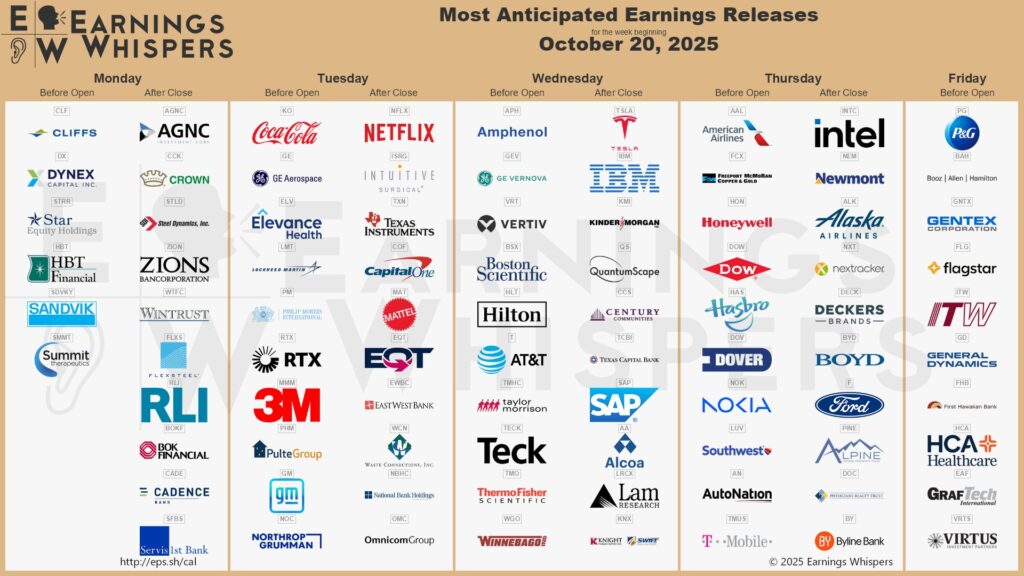
💼 Earnings season moves into full gear this week, led by major U.S. banks that kicked things off earlier and followed by a broad range of companies reporting through the week:
📅 Tuesday, Oct 21st
- Netflix, Inc. (NFLX): Netflix is scheduled to report Q3 2025 earnings and market participants should focus on several critical areas that will determine whether the streaming giant can sustain its momentum. Wall Street expects revenue of $11.51 billion, representing 17% year-over-year growth, and earnings per share of $6.96, up 29% from the prior year period.
The company’s own guidance projects slightly lower EPS at $6.87, with operating income of $3.625 billion and an operating margin of approximately 31%. Beyond the headline numbers, traders should closely monitor the performance of Netflix’s advertising-supported tier, which is expected to see ad revenue nearly double in 2025 with projections, as this represents a fundamental shift in the company’s monetization strategy.
Additionally, focus on revenue per membership (ARM), pricing commentary, and any signals on future price changes; Netflix’s letters emphasize pricing as a key revenue lever while managing to revenue and operating margin as primary metrics. The company raised full-year 2025 revenue guidance to $44.8–$45.2B, citing FX tailwinds and healthy member growth (plus ad sales). Finally, watch management’s engagement discussion (their stated focus) tied to Q3 titles like Wednesday Season 2, ongoing live WWE Raw events, and then Q4 tentpoles such as the Stranger Things finale.
📅 Wednesday, Oct 22nd
- Lockheed Martin Corporation (LMT): Lockheed Martin is set to release its third-quarter 2025 results, with analysts expecting earnings of $6.38 per share, representing a 6.7% year-over-year decline, on revenue of $18.54 billion, up 8.4% from the prior year.
In the second quarter of 2025, Lockheed Martin reported sales of $18.2 billion and a total company backlog of $166.5 billion as of June 29. The company recorded approximately $1.6 billion of program losses in the quarter, including a $950 million loss on a classified Aeronautics program and a $570 million loss on the Canadian Maritime Helicopter Program (CMHP) (plus $95 million on TUHP), which weighed on Aeronautics and drove negative margins at Rotary & Mission Systems.
Looking ahead to the remainder of 2025, management reaffirmed full-year guidance for sales and free cash flow while lowering diluted EPS guidance to $21.70 to $22.00 following the Q2 program charges. Market participants will likely focus on execution, margin stabilization, and updates on key programs during the next earnings call.
- Hilton Worldwide (HLT): Hilton is scheduled to release its Q3 2025 results, with forecast earnings of $2.06 per share, representing a 7.2% year-over-year increase, on revenue of approximately $3.01 billion, up 4.9% year-over-year. The company expects system-wide comparable RevPAR (Revenue Per Available Room) to be flat to modestly down compared with the same period last year.
During the first half of 2025, system-wide comparable RevPAR increased 1.0 percent year over year. Hilton continues to benefit from its asset-light, fee-based business model, in which management and franchise fees are directly influenced by RevPAR performance. The company has highlighted its focus on cost management and operational efficiency amid macroeconomic and cost pressures. In its updated full-year 2025 outlook, Hilton projects adjusted EPS of $7.83 to $8.00 and RevPAR growth ranging from flat to two percent. Market participants are expected to focus on RevPAR trends, margin performance, and guidance updates when the company reports its results.
- Tesla, Inc. (TSLA): Tesla is scheduled to release its Q3 2025 results, with expectations to post an EPS of $0.55, a 23.6% year-over-year decline from $0.72, on revenues of $26.33 billion, up 4.5% from a year ago. Tesla delivered a record 497,099 vehicles globally in the third quarter of 2025, according to its official delivery report. This represented a 7.4% year-over-year increase, partly reflecting a pull-forward in demand ahead of the expiration of U.S. EV tax credits, based on Q3 2024 deliveries of 462,890 vehicles. The company also reported record energy storage deployments of 12.5 GWh during the quarter, highlighting continued expansion of its Energy Generation and Storage business.
As the next earnings report approaches, market participants are expected to monitor automotive margins, average selling price trends, production versus delivery levels, and free cash flow performance, which remain key indicators of Tesla’s operational efficiency and profitability. Updates on the company’s product roadmap, including progress on its next-generation vehicle platform and autonomous-driving initiatives, will also draw close attention from the market.
📅 Thursday, Oct 23rd
- Intel Corporation (INTC): Intel Corporation reports its Q3 2025 results, representing a critical test of the company’s turnaround strategy following a ~80% stock surge this year. Analysts expect revenues of approximately $13.11 billion to $13.15 billion, representing modest 1% year-over-year growth, with earnings per share near breakeven at $0.00 to $0.01.
Market participants should focus on whether gross margin improves from 27.5% GAAP in Q2 2025 and how that tracks toward Intel’s 2030 60%/40% margin framework, progress on Intel 18A (Microsoft and other customers committed), DCAI execution with Xeon 6 and Gaudi 3 in markets contested by Nvidia and AMD, Intel Foundry customer momentum alongside the official $2 billion SoftBank investment, and Q4 2025 guidance that will help assess the impact of its $10 billion 2025 cost-reduction plan.
The earnings call will be particularly significant as management must demonstrate that strategic partnerships with Nvidia on CPU collaboration and government support through CHIPS Act funding are translating into tangible financial progress, not just sentiment-driven stock appreciation.
We hope this helps and happy trading!
– Trade and Travel Team
Related Blogs








Follow Us
Testimonials
Hear from students on why they chose the Trade and Travel Family and how it has changed their lives.

