
The stock market experienced one of its worst weeks since April during the first full week of November, as mounting concerns about artificial intelligence valuations, the prolonged government shutdown, and weakening economic signals rattled investor confidence. The technology-heavy Nasdaq (QQQ) led the decline with a sharp 3.07% drop, while the S&P 500 (SPY) fell 1.63% and the Dow Jones Industrial Average (DIA) declined 1.22% for the week.
This marked a stark reversal from the previous week’s momentum, driven by strong third-quarter earnings from megacap technology companies including Amazon and Alphabet. However, the enthusiasm quickly evaporated as markets grappled with multiple headwinds that exposed cracks beneath the surface of what had been a resilient bull market.
The Federal Reserve’s October rate cut of 25 basis points to a range of 3.75 to 4.00 percent initially buoyed markets, but Chair Jerome Powell’s press conference tempered expectations by signaling that a December rate cut was “far from a foregone conclusion”.
Powell’s cautious stance, coupled with the ongoing government shutdown that has now stretched past 39 days—the longest in U.S. history—has created significant uncertainty about the economic outlook. The data blackout resulting from the shutdown means investors and policymakers alike are navigating in reduced visibility, with critical employment and inflation reports delayed for the second consecutive month.
Corporate earnings season delivered mixed results that highlighted both the promise and peril of massive artificial intelligence investments. While Amazon surged following strong cloud computing growth and announced a $38 billion partnership with OpenAI, companies like Meta Platforms tumbled over 10% on concerns about ballooning expenses and capital expenditures related to AI infrastructure. The divergence underscored growing market anxiety about whether the extraordinary spending on AI development will translate into sustainable profits.
Looking ahead to the week, with government data releases suspended, attention will focus on key earnings reports from companies including Disney, Cisco, Applied Materials, and Instacart. Speeches from several Federal Reserve officials may provide some insight into economic conditions.
The confluence of factors, including signs that consumer sentiment has plunged to its lowest level since mid-2022, concerns about an AI bubble, and narrowing market breadth with many stocks lagging even as indexes remain elevated, has investors exercising increased caution.
How This Impacts You
This kind of market turbulence might seem like a reason to wait, but it’s also a helpful reminder to check in. When major tech companies start slipping, it shows how quickly things can change. This could be a good time to review your portfolio, understand what you already own, and see how those investments are performing. Small steps like these can help you feel more informed.
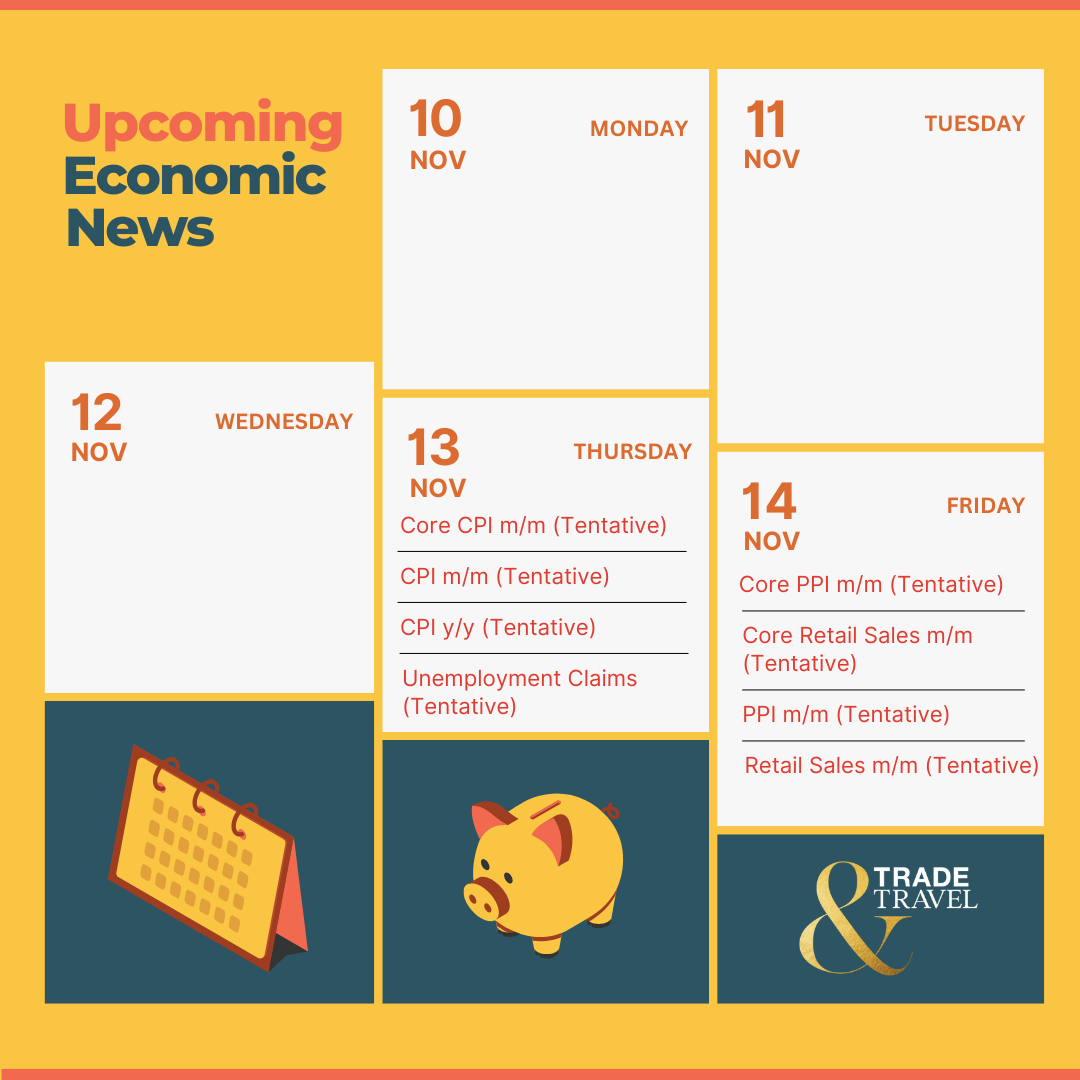
Note: Economic data releases remain on hold due to the government shutdown, and most tentative releases are not shown here.
📅 Thursday, Nov 13th (Tentative)
- Core CPI m/m: The October 2025 Core CPI report is scheduled for release with economists forecasting a 0.3% month-over-month increase compared to the previous reading of 0.2%. This 10-basis-point acceleration would signal a pickup in underlying inflation pressures after months of disinflation, particularly if shelter and services costs reaccelerate.
Market participants should closely monitor the shelter and owners’ equivalent rent components, which have shown recent disinflationary momentum and could be key to explaining any monthly increase. A Core CPI reading at or below the 0.3% forecast would suggest inflation remains on a manageable trajectory and support Federal Reserve rate-cut expectations, while a surprise acceleration above 0.3% might prompt market volatility and recalibration of monetary policy bets.
Key areas to watch include core services inflation trends, wage pressures reflected in service costs, and any unexpected spikes in core goods prices that could signal renewed inflationary momentum.
- CPI m/m and CPI y/y: The Consumer Price Index is set to be released with economists forecasting month-over-month inflation of 0.2% compared to the previous month’s reading of 0.3%. This potential deceleration would represent a meaningful decline in monthly price pressures, suggesting that disinflation efforts may be gaining traction after months of sticky inflation readings.
While headline inflation is expected to cool, core CPI (which excludes volatile food and energy prices) is projected to tick higher. This divergence highlights how persistent cost pressures in shelter and services may continue to drive underlying inflation, even as energy-related components ease.
Market participants should closely monitor whether the actual reading matches the 0.2% forecast, as a surprise higher number could signal persistent inflation and potentially delay Federal Reserve rate cuts, while a print below forecast would bolster expectations for continued monetary policy accommodation. The year-over-year inflation rate will provide additional context on the longer-term inflation trajectory, with current expectations suggesting readings near the 2.9% to 3.0% range.
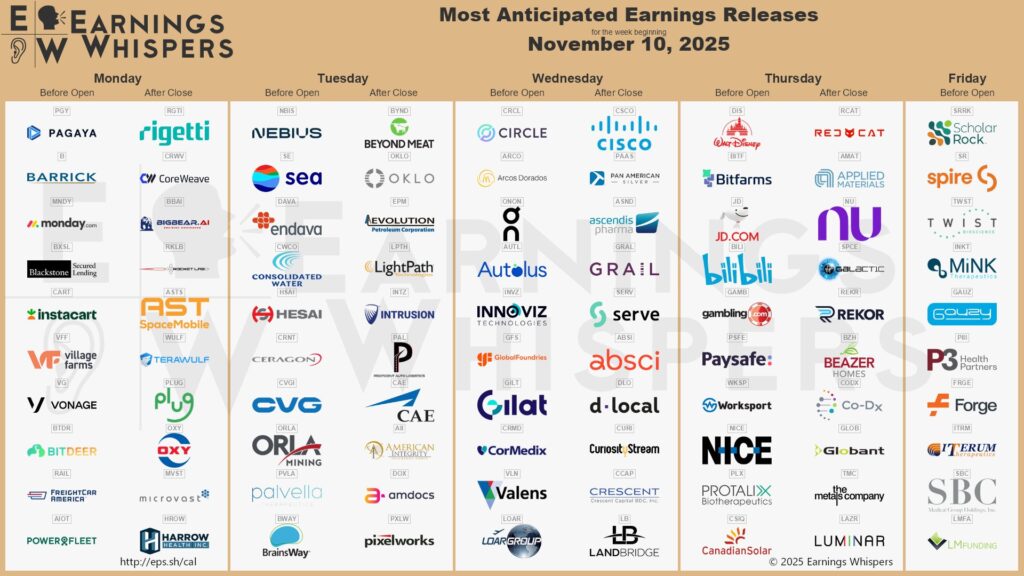
💼 The upcoming week will bring earnings reports from a range of companies in tech, consumer goods, and other sectors, offering a clearer picture of how businesses are performing in today’s economy.
📅 Monday, Nov 10th
- Maplebear Inc. (CART): Maplebear, the parent of Instacart, will release its Q3 2025 earnings with Wall Street expecting earnings per share (EPS) of $0.49, up 16.6% year-over-year, on consensus revenue estimates of $934 million, which marks a 9.6% gain from the prior year.
Market participants should pay close attention to management’s comments on competitive pressure, especially in light of Kroger’s expanded partnership with DoorDash. As Instacart’s third-largest customer, Kroger has accounted for over 10% of the company’s gross transaction value, making this shift a notable threat. Amazon and Walmart also continue to pressure Instacart’s market share with their own delivery and retail ecosystems. The advertising segment will be a key metric to track, as this division demonstrated robust health with revenues hitting $255 million in Q2 2025, a 12% year-over-year increase, potentially offsetting delivery margin compression.
The earnings call’s discussion of enterprise technology initiatives and new partnerships—particularly the Wynshop acquisition and expanded retail integrations—will be crucial for assessing whether CART can maintain profitability expansion while navigating an increasingly crowded competitive landscape.
- monday.com Ltd. (MNDY): Monday.com will announce Q3 2025 results with consensus expecting revenue ~$312.32 million, up roughly 24.4% year-over-year. The consensus estimate for earnings per share is $0.88, also reflecting about 3.5% year-over-year growth.
Market participants should closely monitor the CRM segment performance, which achieved the significant $100 million annual recurring revenue milestone just three years after launch. The AI-driven feature rollout, including Monday Magic, Monday Vibe, and Monday Sidekick, represents a strategic pivot toward work execution, with traders watching whether these tools translate into improved user engagement, higher retention rates, and expanded deal sizes.
Net dollar retention metrics remain a key indicator, particularly the growth in enterprise customers generating over $100,000 in annual recurring revenue, which expanded 46% year-over-year to 1,472 customers in Q2. The company’s full-year 2025 guidance was raised to $1,224 million to $1,229 million in revenue with anticipated adjusted free cash flow of $320 million to $326 million, providing context for Q3 trajectory.
Traders should assess whether the company maintains its earnings surprise streak and guide upward for full-year results, as this would reinforce momentum despite near-term SMB demand pressures and the challenging marketing environment impacting customer acquisition costs.
📅 Wednesday, Nov 12th
- Cisco Systems, Inc. (CSCO): Cisco Systems will report its fiscal Q1 2026 earnings with Wall Street consensus expecting earnings per share of $0.98 (up 7.7% year-over-year) and revenue of $14.78 billion (up 6.8% year-over-year), continuing the company’s recent pattern of beating expectations after reporting $0.99 EPS and $14.67 billion in revenue last quarter.
The critical focus for market participants will be momentum in AI infrastructure orders, which exceeded $2 billion in total for fiscal 2025 and reached $800 million in Q4 alone. Cisco’s security segment, supercharged by the $28 billion Splunk acquisition completed in March 2024, represents a key catalyst as analysts anticipate next-generation security products will grow over 20% in fiscal 2026 with continued cross-selling momentum.
Management’s commentary on enterprise IT spending trends, the anticipated network refresh cycle at large companies, and any reaffirmation or raises to the company’s full-year fiscal 2026 guidance of $59-60 billion in revenue and $4.00-4.06 EPS will heavily influence the market’s immediate reaction. Investors should monitor whether AI orders maintain their triple-digit growth trajectory and assess the timeline for sovereign AI order flows, which management expects will ramp by mid to late fiscal 2026, as this represents a new growth frontier beyond traditional webscale customer demand.
📅 Thursday, Nov 13th
- Walt Disney Company (DIS): Walt Disney will report its Q4 fiscal 2025 financial results, with analysts expecting earnings of $1.05 per share on revenue of $22.76 billion, representing modest year-over-year growth of approximately 0.8%.
Market participants should closely monitor streaming profitability metrics, particularly the company’s combined Disney+ and Hulu performance, as management guided for more than 10 million net new subscriptions in Q4 with the majority expected from Hulu’s expanded Charter Communications deal, though Disney+ subscriber growth is anticipated to remain modest due to recent price increases.
Operating margin trends and the contribution from the newly launched ESPN direct-to-consumer streaming service should be scrutinized, as the sports segment delivered profitability improvements but faces headwinds from higher programming costs driven by increased NBA and college sports media rights.
Traders will key on management’s forward guidance for fiscal 2026, where the company has projected double-digit adjusted EPS growth and double-digit entertainment operating income growth, with particular emphasis on whether Disney maintains confidence in streaming profitability acceleration as it integrates Hulu with Disney+ and continues expanding its sports streaming proposition.
- Applied Materials, Inc. (AMAT): Applied Materials will report its Q4 and fiscal 2025 results. Analysts expect earnings per share of $2.11, representing a 9.1% year-over-year decline, with revenue projected at $6.68 billion, down 5.1% from the year-ago quarter.
The company’s forward guidance of $1.91-$2.31 EPS signals management’s cautious outlook. A critical headwind for Q4 and fiscal 2026 is the anticipated $110 million revenue impact in Q4 alone from newly expanded U.S. export restrictions on advanced chipmaking equipment to China, which represents approximately one-third of AMAT’s typical revenue.
Market participants should monitor whether management addresses the full $600 million estimated impact on fiscal 2026 revenue and how the company plans to offset lost sales in restricted markets. The company’s recent 4% workforce reduction (approximately 1,444 employees) with associated restructuring charges of $160-$180 million signals management is preparing the organization for lower near-term revenues while positioning for operational efficiency.
We hope this helps and happy trading!
– Trade and Travel Team
Related Blogs

Follow Us
Testimonials
Hear from students on why they chose the Trade and Travel Family and how it has changed their lives.

