

Markets navigated a dynamic week of contrasting forces as the fourth-quarter earnings season commenced against a backdrop of record index levels and evolving policy signals.
During the week, the S&P 500, Dow Jones Industrial Average, and Nasdaq traded near record levels early in the week after fresh highs, but all three finished modestly lower for the week. Corresponding ETF performance reflected this: the SPY declined by about 0.35%, the Invesco QQQ Trust (QQQ) fell roughly 0.86%, and the SPDR Dow Jones Industrial Average ETF (DIA) slipped around 0.29% as investors digested the start of the fourth-quarter earnings season alongside mixed sector leadership.
The earnings calendar dominated investor attention as big banks kicked off the fourth-quarter reporting season. JPMorgan Chase, Citigroup, Goldman Sachs, and Morgan Stanley delivered results that offered early read-throughs on loan growth and credit quality across consumer and corporate lending, with investors especially focused on signs of household financial stress and other credit-related headwinds.
AI remained a key market driver after Nvidia CEO Jensen Huang used CES 2026 to detail the company’s upcoming Vera Rubin platform, highlighting claims of roughly 5x improved inference performance and up to a 10x reduction in inference token costs. The comments also rippled across adjacent industries: shares of several data-center cooling and HVAC-linked companies slid after Huang suggested Rubin-era systems could materially reduce cooling needs and eliminate the need for water chillers.
Geopolitical factors remained in the background as U.S.–China technology policy continued to evolve: regulators moved to revise export licensing procedures for advanced AI chips, including Nvidia’s H200, reflecting ongoing debate over how to balance competitiveness and national security.
Looking ahead, earnings season broadens beyond the banks, with Netflix set to report results and Intel scheduled to report after the close on Thursday. Investors will be watching management guidance and commentary for signals on demand trends and 2026 expectations.
At the same time, attention will extend beyond earnings to key macro and policy events, including the next release of the Fed’s preferred inflation measure, Core PCE Price Index and global headlines from the World Economic Forum’s Annual Meeting in Davos (Jan. 19–23), where President Trump is scheduled to deliver remarks on Jan. 21. Investors will be watching how these inputs influence expectations for inflation, growth, and the policy outlook as earnings season broadens.
How This Impacts You
You make smart decisions every day, and you can bring that same mindset to your money. This week, pick one strong company reporting earnings and watch how it performs. Then look at its competitors and how they each respond: Who’s growing? Who’s slipping? Who’s leading the conversation? You’re not investing yet, just observing how strength shows up in real time. It’s a simple way to start building clarity and confidence.
📅 Wednesday, Jan 21st
- WEF Annual Meetings: President Trump is scheduled to address the World Economic Forum’s Annual Meeting in Davos and will lead what organizers describe as the largest-ever U.S. delegation to the event.
Investors will be listening closely for updates on the Trump administration’s tariff agenda, including the rollout of semiconductor tariffs and any follow-on “phase one” announcements flagged by the White House. With reciprocal-tariff policies already in place, markets remain sensitive to trade headlines that can shift supply-chain expectations and the inflation and growth outlook, especially for tariff-exposed industries.
Given ongoing tension between the White House and the Federal Reserve, investors will also watch for any commentary on monetary policy and central bank independence. In the past week, Trump’s public criticism of the Fed for not cutting rates more aggressively has drawn market attention, and comments at Davos could influence sentiment in interest-rate-sensitive sectors.
Traders will be alert for any fresh signals on the administration’s tariff path, particularly after recent semiconductor-tariff actions and amid ongoing legal uncertainty over the broader tariff regime, with the Supreme Court case still pending.
Finally, market participants will be listening for broader geopolitical and trade-policy commentary at Davos, including any updates touching China and Venezuela. Recent headlines on geopolitics and trade have been enough to move oil and broader risk sentiment, and policy surprises have the potential to lift volatility quickly as markets react to unexpected signals from global leaders.
📅 Thursday, Jan 22nd
- Core PCE Price Index m/m: The Fed’s preferred inflation gauge, the Core PCE Price Index, is scheduled for release, and economists have forecast a 0.2% month-over-month increase for November in the delayed report. September’s core PCE rose 0.2%, while October’s reading is expected to be estimated due to shutdown-related data gaps.
With economists noting a widening wedge between CPI and PCE readings, investors will be watching whether the report reinforces a cooling inflation trend or comes in firmer than expected. A stronger-than-forecast core PCE reading could pressure rate-cut expectations, while a softer print would support the case that price pressures are easing.
Markets have been adjusting expectations for Fed rate cuts in 2026, and a stronger-than-expected inflation print could push traders to delay or scale back anticipated easing, while a softer print would reinforce calls for eventual rate cuts.
- Final GDP q/q: The BEA’s updated estimate of Q3 2025 GDP is scheduled, serving as the final update for the quarter after the shutdown disrupted the usual release cadence. The initial estimate showed GDP running at a 4.3% annualized rate, up from 3.8% in Q2, and expectations are broadly for the updated figure to remain near that level.
Investors will watch how underlying components of U.S. growth perform when the updated estimate is released, particularly consumer spending, which has historically been a major driver, even as the Conference Board’s consumer confidence index slid to 89.1 in December, marking its lowest reading in months amid concerns about inflation and economic conditions. Confidence surveys are often treated as a barometer for future consumer spending trends.
Because this is the last update for the quarter, markets will be watching whether the release delivers meaningful changes in the underlying details, including income-side measures such as Gross Domestic Income (GDI). With growth still firm and inflation running above the Fed’s 2% target, investors remain sensitive to whether the data reinforce a “higher-for-longer” policy backdrop. Rate futures have at times been consistent with roughly two 25-basis-point cuts in 2026, and stronger-than-expected momentum could push traders to reassess the timing or extent of easing.
📅 Friday, Jan 23rd
- Flash Manufacturing PMI: The S&P Global U.S. flash manufacturing PMI for December was reported at 51.8, down from 52.2 in November, indicating continued expansion at a slower pace. A reading above 50 signals growth in the manufacturing sector. Markets will look for January’s flash PMI release for early insight into manufacturing momentum as the year begins.
Export demand remains soft. In the separate ISM survey, the Manufacturing New Export Orders index was 46.8 in December, a contractionary reading below 50 that signals weak export activity. ISM respondents have highlighted tariffs and soft demand as persistent headwinds, and traders will watch upcoming survey data for signs that export orders stabilize or improve.
Hiring remains a watch point as the Employment Index in the ISM survey stayed in contraction, and ISM reported that 63% of panelists said “managing headcounts” remains the norm rather than hiring. Input costs also remain in focus, with tariff-related pressures, especially in metals, continuing to be cited as a headwind for manufacturers. Investors will watch upcoming survey releases for signs that hiring intentions and price pressures are easing.
- Flash Services PMI: December’s S&P Global U.S. Services PMI slowed to 52.5, the softest pace of expansion in several months, as new business growth fell to a roughly 20-month low and cost pressures, including tariffs and higher labor costs, remained elevated.
The January flash Services PMI is expected to come in around 52.8, which would signal a modest reacceleration in service-sector growth. Markets will be watching the release closely for early signs of whether soft demand and price pressures are beginning to ease or persist as 2026 gets underway.
The pricing data warrants particular attention after December saw output prices rise at the steepest pace since August 2022, largely driven by tariffs and higher labor costs. A moderation in price growth could support expectations for interest-rate cuts. The January flash services PMI is forecast around 52.8 (vs. 52.5 previously), and a downside miss would suggest tariff uncertainty and softer demand are still weighing on the services sector, which makes up more than two-thirds of the U.S. economy, potentially reinforcing expectations for slower growth and easier Fed policy. A stronger-than-expected reading could push back against near-term easing expectations.
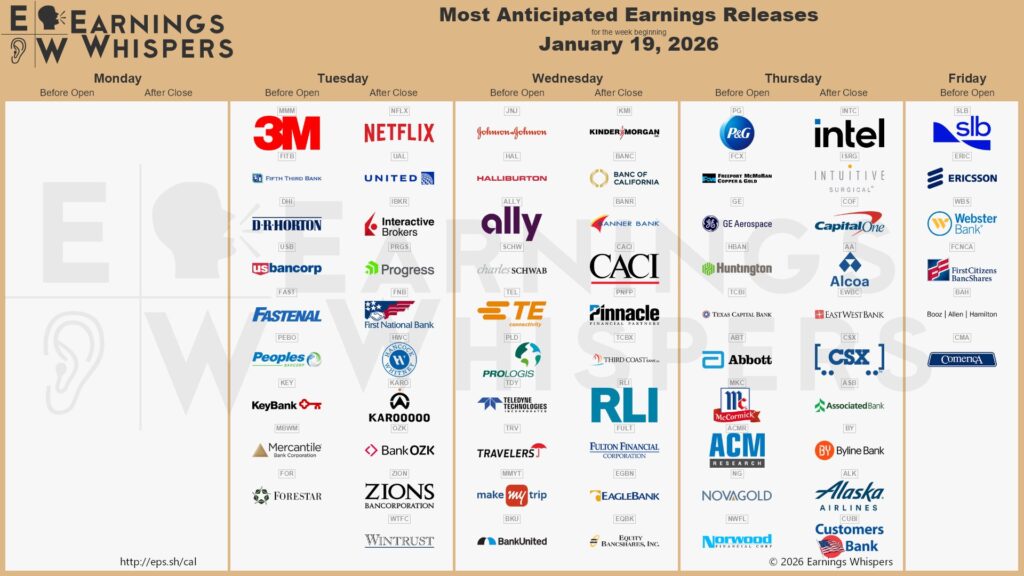
💼 Earnings season picks up in the upcoming week, as a wave of major U.S. companies report and the market gets its first broad read on the new year.
📅 Tuesday, Jan 20th
- Netflix, Inc. (NFLX): Netflix will report Q4 2025 earnings after market close, with Wall Street expecting revenue of $11.97 billion (up 16.7% year-over-year) and earnings per share of $0.55 (up 27.9% from Q4 2024). The company’s own guidance projects Q4 revenue of $11.96 billion with an operating margin of 23.9 %, a two-percentage-point improvement over the prior-year period, as management emphasized strong momentum heading into the quarter.
A critical wildcard is management commentary on the pending $72B equity-value Warner Bros. deal, including the 12–18 month regulatory path and early integration priorities. Netflix has said it expects at least $2–3B of annual cost savings by the third year, and updates on timing, approvals, and execution risk could shape sentiment beyond the Q4 print.
Subscriber growth metrics, while no longer disclosed quarterly, are estimated at roughly 10 million net adds for Q4, with total subscribers over 327 million globally, but market focus has shifted from subscriber volume to monetization (revenue and margins) and engagement signals.
The market will assess whether Netflix can extend its beat-and-raise cadence after a notable Q3 EPS miss (about 16% vs. estimates). Shares have remained under pressure into early 2026 as investors weigh valuation, growth concerns, and uncertainty around the Warner deal. Any sign that pricing or ad momentum is cooling, or that 2026 guidance disappoints, could keep pressure on the stock.
📅 Wednesday, Jan 21st
- Johnson & Johnson (JNJ): Johnson & Johnson will report Q4 2025 results, with analysts expecting earnings of $2.47 per share and revenue of $24.15 billion, representing 21% and 7.2% growth year-over-year, respectively. The company most recently beat Wall Street’s Q3 2025 EPS and revenue expectations, reporting adjusted EPS of $2.80 on about $24.0 billion in sales, and it raised its full-year 2025 sales outlook. Management said growth was driven in part by strength in oncology, with Darzalex among the key contributors.
Stelara, which generated roughly $10–11B annually at its peak, has been pressured by biosimilar competition. Analysts reported Stelara sales declined about 40% in the first nine months of 2025, and Reuters noted Stelara sales are expected to fall to around $7B in 2025, with additional biosimilar pressure anticipated as more entrants launch, including in the U.S., alongside ongoing competition in Europe.
Management said Carvykti has treated more than 8,500 patients globally and described it as the most successful CAR-T launch ever. The company also reiterated $5 billion in peak-year sales potential, highlighting the depth of J&J’s oncology growth drivers beyond Darzalex.
Investors will watch the company’s full-year 2026 guidance and commentary on the Stelara transition. The company completed its $3.05B Halda Therapeutics acquisition in late December, adding a prostate-cancer lead asset (HLD-0915) and a precision oncology platform. J&J said the transaction will be dilutive to adjusted EPS, with total dilution of about $0.20 split between 2025 and 2026 (roughly $0.10 in 2026), and it plans to discuss 2026 guidance on its earnings call.
📅 Thursday, Jan 22nd
- Procter & Gamble Company (PG): Procter & Gamble will report fiscal Q2 2026 results, with Wall Street expecting diluted EPS of $1.87, a slight 0.5% decline year-over-year from the prior quarter’s $1.88, and revenue forecast at approximately $22.3 billion.
Tariff headwinds remain the critical wildcard, with P&G now estimating about $500 million in pre-tax tariff costs for fiscal 2026, down from its earlier $1 billion projection. The company says this equates to roughly $400 million after tax, though management has emphasized that uncertainty persists as trade policy continues to evolve.
The company maintained its full-year FY2026 core EPS guidance of $6.83–$7.09 (midpoint $6.96, about +2% year over year). Management said the outlook reflects modest earnings growth supported by productivity efforts, while also increasing investment in innovation and demand creation. Free cash flow productivity guidance of 85–90% is critical, as P&G plans $15 billion in shareholder returns ($10 billion dividends, $5 billion buybacks), making cash generation essential given capital investments for capacity expansion.
The company’s restructuring initiative includes reducing up to 7,000 non-manufacturing roles globally (about 15% of that workforce) over the next two fiscal years. P&G has said it expects to record restructuring costs/charges related to the program, which can weigh on reported results even as the plan is intended to improve productivity and cost structure over time.
Finally, watch for any revision to full-year guidance, which would signal confidence or concern about the sustainability of P&G’s pricing-driven growth model amid tariff uncertainty and intensifying retail competition.
- Intel Corporation (INTC): Intel will report Q4 2025 financial results after market close, with analysts’ expectations calling for revenue of $13.41 billion (down 5.9% year-over-year) and earnings of $0.08 per share (down 38.5% year-over-year), against management guidance of $12.8–$13.8 billion revenue and 36.5% non-GAAP gross margin.
Investors should focus on Intel’s Data Center & AI segment, which has shown resilient revenue performance. The unit reported about $4.1 billion in Q3 2025 and beat expectations, underscoring demand tied to AI and server workloads. Strong or improving data-center results could help offset ongoing headwinds in the client computing business, which faces competitive pressure and cyclical softness.
Margin recovery remains a key watch: Q3 2025 non-GAAP gross margin came in at 40%, but Q4 guidance stepped down to 36.5% due to the early ramp of Panther Lake (which carries typical high costs for new products) and continued foundry segment pressure.
Management commentary on Intel 18A remains a key credibility check. Recent coverage of KeyBanc analyst notes has sent mixed signals: one report cited John Vinh putting 18A yields at 60%+, while another KeyBanc-related note suggested yields may be ~50–55%, a level that could push the Panther Lake volume ramp toward Q2 2026. Because these are analyst estimates (not Intel-disclosed yield data), investors will look for clearer Intel commentary on yield trajectory, ramp readiness, and the economics of scaling 18A.
On the cost side, Intel must show progress toward its $16B 2026 operating-expense target and articulate capital-expenditure (capex) efficiency. In 2025, management lowered its gross capex target to about $18B from the prior $20B target as it cut spending and refocused investment, making clarity on capex execution critical for investor confidence.
- Abbott Laboratories (ABT): Abbott Laboratories will report its Q4 2025 earnings before market open, with analysts projecting earnings per share of $1.50, representing an 11.9% increase year-over-year from $1.34 in Q4 2024. Consensus revenue expectations stand at $11.8 billion, reflecting approximately 7.5% year-over-year growth from the prior-year quarter, driven primarily by continued momentum in medical devices.
Abbott’s Medical Devices segment has continued to deliver strong organic growth, with recent quarterly results showing double-digit percentage gains driven by Diabetes Care and cardiac device portfolios. In Q3 2025, Diabetes Care (including FreeStyle Libre continuous glucose monitors) accounted for about $2.0 billion in sales and grew high-teens organically year-over-year, underscoring the importance of Libre and related products as key growth drivers within the broader Medical Devices franchise.
Investors will watch management’s outlook and any updated commentary on 2026 expectations, after Ford said Wall Street’s 2026 consensus assumptions in the range of high-single-digit sales growth and double-digit EPS growth “look very reasonable.” At the same time, markets are weighing headwinds Abbott has flagged for 2025, including tariff-related costs totaling just under $200 million and continued pressure in diagnostics tied to China’s volume-based procurement program and related pricing dynamics.
The company unveiled Libre Assist at CES 2026, a new generative-AI feature within the Libre app designed to provide in-the-moment meal guidance by predicting how foods may affect glucose. The company is also developing a dual glucose-ketone sensor. Investors will watch for commentary on early usage/engagement and on CGM competitive and pricing dynamics, where innovation and reimbursement trends can influence growth.
Abbott reported an adjusted operating margin of about 23.0% in Q3 2025, underpinned by productivity and cost management efforts. Investors will be watching management commentary closely for signs of how productivity initiatives and tariff-related cost pressures could influence margins in the coming quarters.
We hope this helps and happy trading!
– Trade and Travel Team
2 Comments
Related Blogs

Follow Us
Testimonials
Hear from students on why they chose the Trade and Travel Family and how it has changed their lives.


Great info. Thanks for your insight
This is so helpful for my weekly analysis/prep! Thank you