
Monday is looking grim as stocks around the world plunge.
The main stock index in Hong Kong fell over 12%, the Taiwan Weighted Index dropped close to 10%, and Japan’s Nikkei 225 finished almost 8% lower. We’ll see how the U.S. market responds.
Last week, U.S. equities faced their second straight week of sharp losses, driven by escalating U.S.-China trade tensions. President Trump’s surprise tariff announcement, framed as “Liberation Day,” triggered swift retaliation from China, igniting fears of a trade war.
For the week, the DIA (DOW) dropped 7.8%, the SPY (S&P 500) fell 9.07%, and the QQQ (Nasdaq) slid 9.87%—marking some of the steepest weekly losses in over a year. Volatility surged, and recession concerns crept back into investor sentiment.
Looking ahead, markets remain highly sensitive to geopolitical developments and key economic data—especially inflation and employment figures—which are likely to steer sentiment. Attention will remain on any softening or escalation in trade policy signals and their potential impact on market direction.
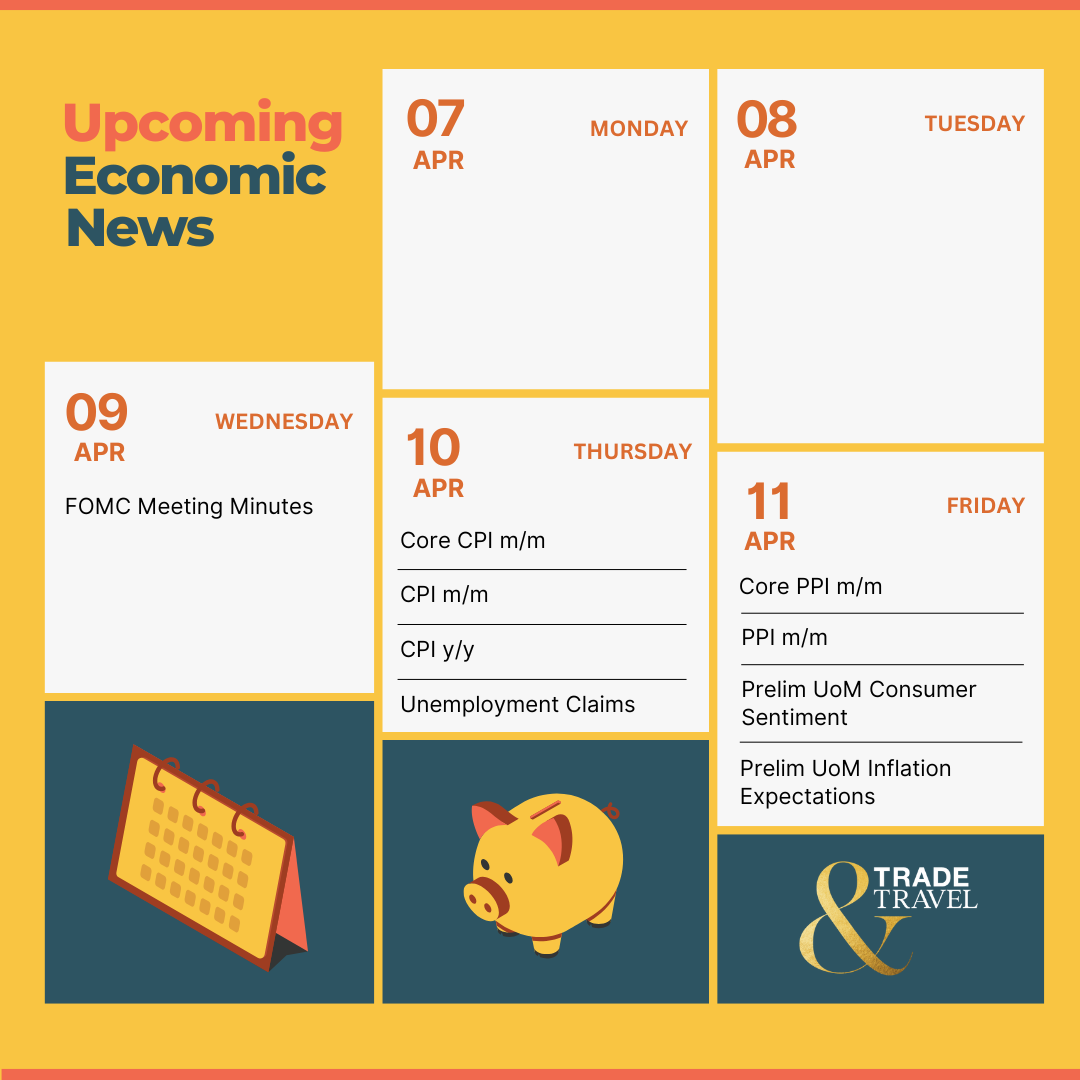
📅 Wednesday, April 9th
- FOMC Meeting Minutes: The Federal Reserve will release the minutes from its March 18-19 meeting, providing detailed insights into the FOMC’s decision to maintain the federal funds rate at 4.25%-4.50% amid heightened economic uncertainty. Investors should analyze the minutes for discussions around the Fed’s downward revision of 2025 GDP growth to 1.7% (from 2.1% previously), the upward adjustment of core PCE inflation projections to 2.8% (from 2.5%), and the committee’s rationale for maintaining its forecast of two rate cuts in 2025 despite these revised economic projections.
📅 Thursday, April 10th
- Core CPI m/m: The upcoming report will be closely monitored as March data showed inflation easing to 0.2% monthly (3.1% annually), below the previous month’s 0.4% and market expectations of 0.3%. Market participants should focus on whether this disinflationary trend continues toward the Fed’s 2% target or if renewed price pressures emerge, particularly in shelter costs which still account for over two-thirds of the annual core increase despite moderating to 4.2% in February.
- CPI m/m: The upcoming report is forecast to show a 0.1% month-over-month increase in headline inflation, down from February’s 0.2% rise and January’s 0.5% surge. Following recent trade policy announcements, market participants should focus on potential tariff-driven price pressures in goods categories. Investors will scrutinize whether the core CPI—projected to ease to 3.0% year-over-year from 3.1% in February—provides the Federal Reserve with sufficient confidence to proceed with potential rate cuts by mid-2025.
- CPI y/y: The upcoming U.S. CPI y/y report is expected to show a 2.6% inflation rate (down from February’s 2.8%), faces upside risks from tariff-driven price pressures reflected in ISM surveys, including a 62.4% February manufacturing prices paid index (up 13.7% monthly) and a March surge to 69.4% (the highest since June 2022).
- Unemployment Claims: The upcoming unemployment claims report will be closely watched after initial claims decreased to 219k for the week ending March 29, 2025, below market expectations of 225k, indicating continued labor market stability despite growing economic uncertainties. Investors should pay particular attention to whether the four-week moving average, which currently stands at approximately 223k, shows any significant change, as sustained increases could signal deterioration in employment conditions ahead of potential volatility from new tariff implementations.
Traders should also monitor continuing claims, which were at 1.9 million in late March, as rising numbers of long-term unemployed combined with the current unemployment rate of 4.2% could influence Federal Reserve policy decisions and market sentiment in the coming months.
📅 Friday, April 11th
- Core PPI m/m: The upcoming report is anticipated to rebound to 0.3% after February’s unexpected -0.1% contraction—the first decline since July. February’s core PPI decline, which followed an upwardly revised 0.5% January increase, pushed the annual rate down to 3.4% from 3.8%, signaling moderating wholesale inflation pressures despite persistent tariff concerns. Market participants should monitor whether the March data confirms a return to growth, as sustained weakness could influence Federal Reserve rate decisions and reflect broader supply-chain disinflation trends.
- PPI m/m: The upcoming report will be closely watched following February’s unexpected flat reading, which came in well below the forecasted 0.3% increase. Market participants should focus on whether the report signals renewed inflationary pressure or continues the disinflationary trend, while also keeping an eye on the headline year-over-year PPI rate, which stood at 3.2% in February—down from 3.7% in January. March’s data will be particularly significant as markets assess the potential inflationary impact of President Trump’s recent tariff announcements.
- Prelim UoM Consumer Sentiment: The preliminary report is expected to decline further to 54.0 from March’s final reading of 57.0, continuing a downward trend that has brought sentiment to its lowest level since November 2022. Market participants should closely monitor year-ahead inflation expectations, which jumped to 5.0% in March from 4.3% in February, as this marks the third consecutive month of unusually large increases and could signal persistent inflation pressures.
With consumer sentiment having already plummeted 28.2% year-over-year and two-thirds of consumers expecting unemployment to rise (the highest since 2009), any reading below the consensus of 55.0 could trigger market reactions, particularly in rate-sensitive sectors and consumer discretionary stocks.
- Prelim UoM Inflation Expectations: The report will be closely watched after three consecutive months of significant increases, with the March reading surging to 4.9% from 4.3% in February and subsequently revised higher to 5.0%. Market particpants should monitor whether this upward trend continues beyond the 30-year high recently recorded, particularly given the simultaneous deterioration in consumer sentiment. Traders will need to pay attention to both the 1-year and 5-year inflation expectations figures (previous readings at 5.0% and 4.1% respectively) as persistent increases could significantly impact Federal Reserve policy decisions regarding interest rates.
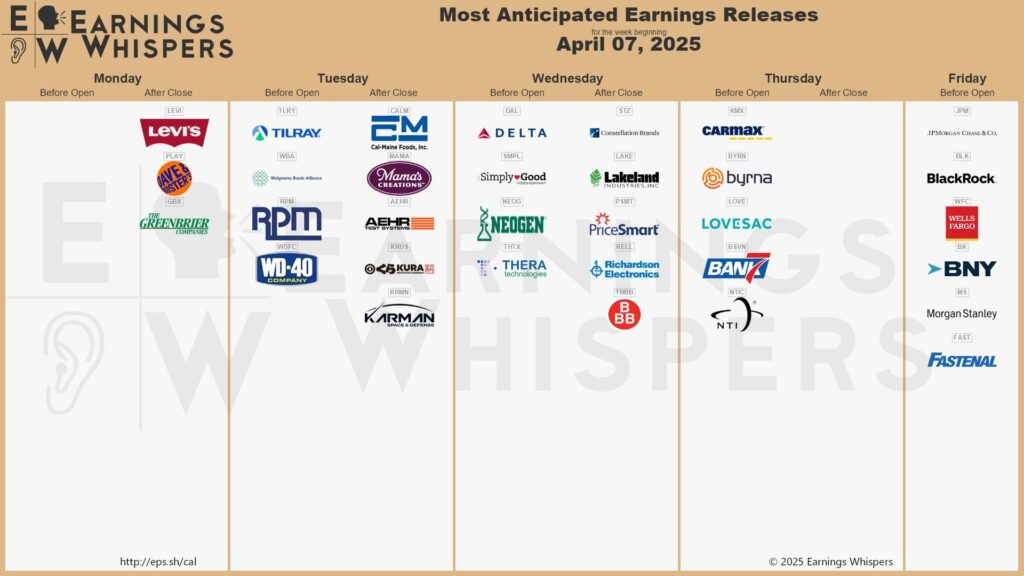
Here are some stocks reporting earnings this week:
📅 Monday, April 7th
- Levi Strauss & Co. (LEVI) is set to report its first-quarter 2025 earnings, with analysts expecting earnings per share of $0.28 (a 7.7% year-over-year increase) despite revenue projected to decline slightly by 1.3% to approximately $1.54 billion. Market participants should closely monitor gross margin performance, which reached 60.0% in Q3 2024, the performance of the core Levi’s brand (which grew 5% globally in Q3 2024), and any strategic updates regarding the company’s Dockers brand review. Particular attention should be paid to management’s forward guidance and commentary on direct-to-consumer business growth, which saw double-digit increases in previous quarters.
📅 Wednesday, April 9th
- Delta Air Lines (DAL) will report its first-quarter fiscal 2025 results with investors closely watching whether the airline can meet its already-lowered guidance of $0.30-$0.50 EPS and 3-4% revenue growth amid weakening domestic travel demand. The airline’s shares have tumbled approximately 46% from their February high as economic uncertainty has impacted both consumer and corporate confidence, though premium and international segments have shown more resilience. Market participants should focus on Delta’s Q2 and full-year outlook, as analysts expect the airline to be conservative in its forward guidance, potentially signaling broader industry challenges that could further pressure airline stocks which have already experienced significant declines.
📅 Friday, April 11th
- BlackRock (BLK) is releasing its Q1 2025 earnings results with analysts expecting earnings per share of $10.52, representing a 7.2% increase from $9.81 in the previous year’s quarter. Market participants should closely monitor key metrics, including assets under management (AUM), which reached a record $11.6 trillion, and quarterly net inflows which totaled $281 billion last quarter. With BlackRock having surpassed Wall Street’s bottom-line estimates in the past four quarters, market participants should pay attention to both organic growth indicators and guidance on the integration of recent acquisitions including GIP, HPS, and Preqin, which management has highlighted as positioning the company for significant future growth potential.
- Morgan Stanley (MS) is releasing its Q1 2025 earnings report with analysts projecting an EPS of $2.30, representing a 13.8% increase from the $2.02 reported in the same quarter last year. The investment banking giant has demonstrated a solid trajectory of consistently outperforming Wall Street’s earnings estimates in each of the past four quarters. Market participants should closely monitor performance across Morgan Stanley’s three main divisions (Institutional Securities, Wealth Management, and Investment Management), particularly the wealth management segment which has been a strong contributor to growth with total client assets recently surpassing $7 trillion, while also watching for updated full-year 2025 guidance against the current consensus estimate of $8.69 per share.
We hope this helps and happy trading!
– Trade and Travel Team
Related Blogs



Follow Us
Testimonials
Hear from students on why they chose the Trade and Travel Family and how it has changed their lives.

