

The S&P 500 advanced approximately 4.5% on the week to close at a record on Friday, the index’s third straight week of gains and its first close above 7,100. The DJIA climbed roughly 3.2%, while the Nasdaq Composite surged about 6.8% and notched its 13th consecutive positive session, the longest winning streak since 1992.
Iran briefly declared the Strait of Hormuz “completely open” on Friday before reversing course over the weekend, and a fragile Israel-Lebanon ceasefire framework took hold mid-week, leaving the geopolitical backdrop calmer than the prior week even as oil whipsawed and WTI crude settled near $81 a barrel. Gold pushed to a fresh record near $4,849 an ounce on the back of broad dollar weakness and a market increasingly pricing in deeper Fed cuts, even as Treasury yields drifted lower with the 10-year settling near 4.24%.
On Tuesday, the SEC approved FINRA’s proposal to scrap the $25,000 pattern day trader minimum, replacing the trade-counting framework with real-time intraday margin standards and lowering the effective floor for active retail traders to roughly $2,000. Implementation begins 45 days after FINRA notice, with up to 18 months for full broker adoption.
Looking ahead, Advance Retail Sales for March arrives Tuesday, and Q1 reporting continues this week with a slate of mega-cap tech, healthcare, and consumer names.
How This Impacts You
Tuesday is the pivot for what your money does next. The morning retail sales report tells us whether the consumer is finally slowing, and that afternoon Kevin Warsh sits before the Senate for his Fed Chair confirmation hearing.
Warsh has been openly hawkish on rate cuts, so a smooth hearing means the cash you have parked in high-yield savings keeps earning where it is for a while longer, while growth names like the mega-cap tech reporting Wednesday stay under pressure. The longer thread to pull on is whether your idle cash is still sitting in a basic checking or savings account when a money-market fund would quietly compound a meaningful difference over the years between now and the freedom to step back.
📅 Tuesday, April 21st
- Advance Retail Sales (Headline + Core m/m): March 2026
The U.S. Census Bureau will release the Advance Monthly Retail Trade and Food Services report for March 2026, rescheduled from its original April 16 date. The report measures total monthly sales at retail and food service establishments across thirteen major categories, serving as the most timely gauge of consumer spending, which accounts for roughly two-thirds of GDP.
Retail sales rose +0.6% MoM to $738.4 billion in February 2026, beating the +0.5% consensus and reversing January’s -0.2% decline, while the control group (excluding autos, gasoline, building materials, and food services) rose +0.5%, its strongest reading in months and a figure that feeds directly into the Bureau of Economic Analysis’s GDP consumption estimate.
The February rebound was led by health and personal care stores, up +2.3% month over month, clothing stores at +2.0%, and sporting goods at +1.3%, while nonstore retailers posted a +7.5% year-over-year gain and food services and drinking places were up +5.2% from the prior year; total sales for the December 2025 through February 2026 period rose +3.1% versus the same window a year ago.
March data will reflect a consumer environment reshaped by the Iran-driven energy shock: AAA’s national average rose roughly one-third during the month from about $2.98 to $3.98 a gallon, which typically inflates nominal gas station sales while squeezing discretionary categories as households redirect spending toward the pump; the National Retail Federation projects 2026 retail sales growth of +4.4% over the prior year, but that forecast predates the sharp escalation in energy costs that began in late February.
Markets will watch whether the gas station category masks underlying consumer weakness, with the control group metric (which excludes gasoline) carrying the most weight for GDP tracking, and a control group print below +0.2% would reinforce the slowdown narrative emerging from the University of Michigan’s record-low consumer confidence reading.
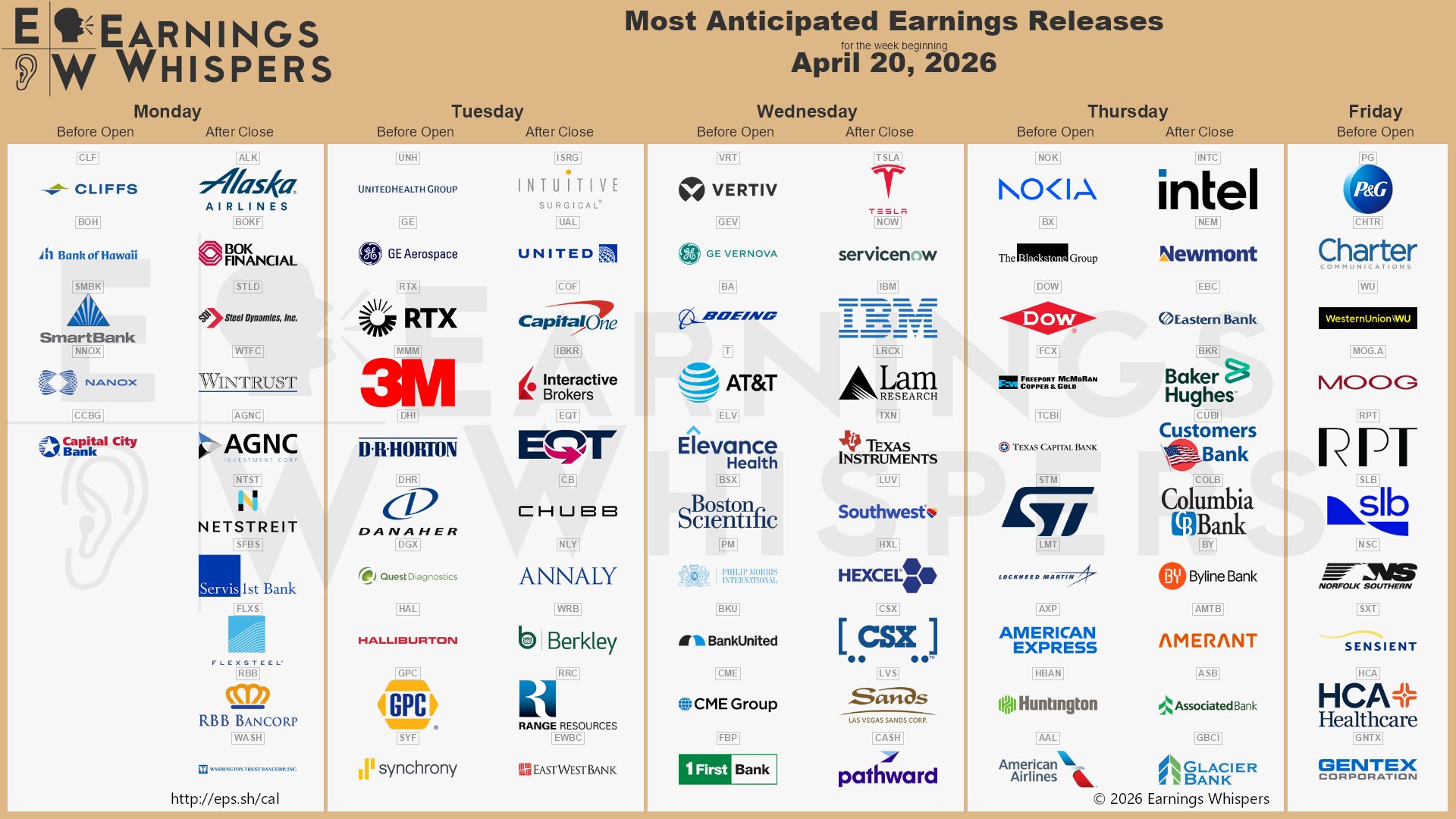
💼 Q1 2026 earnings shifts from financials into mega-cap tech and consumer staples this week. The focus turns to whether AI infrastructure spend and EV demand are holding through the post-Iran energy shock, with managed-care cost trends and consumer pricing power rounding out a slate that will set the tone for the rest of the season.
📅 Tuesday, April 21st
- UnitedHealth Group (UNH): Q1 FY2026 (Before Open)
UnitedHealth Group (NYSE: UNH) reports its fiscal Q1 FY2026 results, with analyst consensus projecting EPS of $6.48 on revenue of $109.45 billion. If estimates prove accurate, that EPS figure would represent a 10.0% decline from the $7.20 delivered in the year-ago quarter, extending a deep profit reset that saw full-year 2025 adjusted earnings fall to $16.35 per share from $27.66 in 2024.
The revenue estimate implies a marginal 0.1% year-over-year decline from the $109.6 billion reported a year earlier, a sharp deceleration from the 12% top-line growth the company posted for full-year 2025 as the insurer right-sizes its enterprise.
UnitedHealthcare expects to lose between 1.3 million and 1.4 million Medicare Advantage members in 2026, with total membership contracting by 2.3 million to 2.8 million as the company prioritizes margin recovery over scale. Optum will be in focus as well, with OptumHealth narrowing networks and value-based care membership expected to shrink roughly 10% in 2026 before resuming growth, even as Optum Rx remains the bright spot inside the services arm.
The dominant macro overhang shifted in the company’s favor on April 6 when CMS finalized a 2.48% net Medicare Advantage rate increase for 2027, well above the 0.09% advance notice and a clear regulatory tailwind for the largest MA carrier in the country; CEO Stephen Hemsley faces his first full earnings cycle since returning to the role last May with the DOJ probes, the Cigna-related litigation, and the still-resonant fallout from the Brian Thompson tragedy as the inherited backdrop.
📅 Wednesday, April 22nd
- Tesla (TSLA): Q1 FY2026 (After Close)
Tesla, Inc. (NASDAQ: TSLA) reports Q1 FY2026 results, with analyst consensus calling for EPS of $0.40 on revenue of $23.06 billion. If the EPS estimate proves accurate, it would mark a 48.1% increase from the $0.27 delivered in the same quarter last year, when Model Y line changeovers across all four factories pulled bottom-line results to a multi-year low. The $23.06 billion revenue projection implies a 19.3% advance from the $19.335 billion reported a year ago, a sharp reacceleration relative to the 3% revenue decline posted in the prior quarter when total revenue was $24.901 billion.
The leading indicator most relevant to the print landed on April 2, when Tesla disclosed Q1 deliveries of 358,023 vehicles, a 6.3% rise over the year-ago quarter’s 336,681 but roughly 7,600 units below the company-published consensus of 365,645. Energy storage, the segment bulls have leaned on hardest, deployed just 8.8 GWh in the quarter, a 15.4% pullback from the 10.4 GWh deployed a year earlier and a 38% step-down from the 14.2 GWh logged last quarter, raising questions about whether the prior year’s storage momentum was structurally durable. Production of 408,386 vehicles outran deliveries by more than 50,000 units, and JPMorgan flagged unsold inventory of roughly 164,000 vehicles entering the print, an overhang that will likely shape questions about pricing actions and gross margin defense.
Investors will also look for fresh detail on automotive gross margin, which improved to 17.9% last quarter, and on whether the Cybercab program, which Elon Musk has guided toward volume production beginning in April 2026, can begin to reshape the long-duration AI and autonomy narrative.
Macro themes likely to dominate the call include the Austin robotaxi rollout, where Tesla now operates without an in-vehicle safety monitor, the path to unsupervised FSD approvals across additional U.S. states, and ongoing tariff exposure on Chinese-sourced components that has pressured the auto P&L. CEO Elon Musk is expected to frame near-term margin pressure against the company’s pivot toward physical AI and energy.
- IBM (IBM): Q1 FY2026 (After Close)
International Business Machines (NYSE: IBM) reports its fiscal Q1 FY2026 results on April 22, with analyst consensus projecting EPS of $1.81 on revenue of $15.65 billion. If estimates prove accurate, that EPS figure would represent a 13.1% increase from the $1.60 delivered in the year-ago quarter, extending a streak in which IBM has surpassed bottom-line expectations in each of the last four quarters.
The revenue estimate implies a 7.6% year-over-year advance from the $14.54 billion reported a year earlier, a deceleration from the 9% constant-currency growth IBM posted in the prior quarter when total revenue reached $19.7 billion.
Software remains the engine of the story after the segment grew 14% as reported and 11% at constant currency last quarter, driven by Hybrid Cloud (Red Hat) up 10% and a generative AI book of business now exceeding $12.5 billion inception-to-date. Consulting is the offset investors will scrutinize closely; the unit grew just 1% to $5.3 billion last quarter and analysts forecast revenue to slip 1% in the first quarter as federal contract delays and AI-driven productivity continue to compress legacy services demand.
The recently launched z17 mainframe, the first system fully engineered for the AI age and powered by the Telum II processor with Spyre accelerators, is expected to extend into the second quarter of the cycle tailwinds for the Infrastructure segment.
The Confluent acquisition, which closed on March 17, should contribute roughly $50 million of inorganic revenue in the period and arrived about a quarter earlier than analysts had modeled, modestly lifting the full-year setup. Management guided 2026 to constant-currency revenue growth above 5%, software growth of 10%, free cash flow rising by about $1 billion from the $14.7 billion delivered in 2025, and operating pretax margin expansion of roughly one percentage point, with CEO Arvind Krishna positioning WatsonX, hybrid cloud, and quantum as the multi-year compounding levers.
📅 Thursday, April 23rd
- Intel (INTC): Q1 FY2026 (After Close)
Intel Corporation (NASDAQ: INTC) reports its first quarter fiscal 2026 results on April 23, with analyst consensus projecting EPS of $0.02 on revenue of $12.30 billion. If those estimates hold, the EPS figure would represent a 84.6% decline from the $0.13 delivered in the same quarter last year, reflecting persistent gross margin compression as the company absorbs the cost of ramping its 18A manufacturing node. The revenue estimate sits comfortably within management’s guidance range of $11.7 billion to $12.7 billion, with gross margin guided at roughly 34.5%, well below the 39.2% the company posted a year ago.
Intel closed 2025 with full-year revenue of $52.9 billion and EPS of $0.42, capping a year in which CEO Lip-Bu Tan, who took the role in March 2025, eliminated roughly 24,000 positions and absorbed $1.9 billion in restructuring charges. The fourth quarter delivered upside on the top line at $13.7 billion, with Data Center and AI revenue rising 9% from a year earlier to $4.7 billion and growing 15% sequentially, the segment’s fastest sequential growth in a decade.
Client Computing Group revenue, however, fell 7% from the year-ago quarter to $8.2 billion as PC demand softened and internal supply constraints capped shipments, dynamics that management expects to persist through the first quarter of 2026.
The 18A node, which now runs Panther Lake in high-volume manufacturing at Fab 52 in Arizona, has cleared the 60% to 65% yield band management previously framed as the commercially viable threshold for Foundry profitability and the upcoming Clearwater Forest Xeon launch. Two macro themes are likely to dominate the call: the U.S. government’s $8.9 billion equity stake taken in 2025 under a CHIPS Act restructuring, which gives Washington roughly 9.9% of the common stock and a five-year warrant tied to retaining the foundry, and renewed competitive pressure from AMD, whose data center revenue reached $5.4 billion in the same quarter even as Nvidia continues to dominate AI training silicon.
📅 Friday, April 24th
- Procter & Gamble (PG): Q3 FY2026 (Before Open)
Procter & Gamble (NYSE: PG) reports fiscal Q3 FY2026 results, with analyst consensus projecting EPS of $1.56 on revenue of $20.57 billion. If those estimates hold, the EPS figure would represent a 1.3% increase from the $1.54 delivered in the same quarter last year, a modest step forward for a company that has weathered seven consecutive quarters of low-single-digit organic growth and is now leaning on price and mix to offset persistent volume softness.
The revenue estimate implies a 3.9% year-over-year advance from the $19.8 billion reported a year earlier, an improvement from the prior quarter when organic sales were flat year-over-year and reported net sales reached $22.2 billion, up 1%.
Segment performance heading into the print favors Beauty and Health Care, which delivered 4% and 3% organic growth respectively last quarter, while Baby, Feminine and Family Care contracted 4% on a 5% volume decline as private-label competition continues to pressure the diaper and feminine care categories. Greater China, long a drag on the international portfolio, posted 3% organic growth in the prior quarter and 5% in the period before that, with double-digit gains in Pampers Prestige and a recovering SK-II skincare line supporting the company’s case that the China rebuild is taking hold.
New CEO Shailesh Jejurikar, who succeeded Jon Moeller on January 1 and now reports to Moeller as Executive Chairman, will face his first quarterly earnings call as chief executive and is expected to reaffirm the $1.0 to $1.6 billion pre-tax restructuring program announced in mid-2025 that will eliminate roughly 7,000 non-manufacturing jobs by 2027.
Tariff exposure remains the dominant macro overhang, with management guiding to roughly $400 million in after-tax tariff costs for fiscal 2026 and signaling mid-single-digit price increases on approximately 25% of affected SKUs to recover the hit from raw and packaging materials sourced from China. Full-year guidance currently calls for organic sales growth of zero to four percent and core EPS of $6.83 to $7.09, a range that gives management room to absorb a soft Q3 print without a formal guide-down so long as Beauty momentum and China recovery continue. Investors will scrutinize US organic sales for any sign of a return to positive territory, the early read on the Tide evo laundry rollout, and whether productivity savings from the restructuring begin offsetting tariff drag in the back half of the fiscal year.
We hope this helps and happy trading! 💼
The Trade and Travel Team
Related Blogs
Follow Us
Testimonials
Hear from students on why they chose the Trade and Travel Family and how it has changed their lives.

