
The stock market stumbled last week as investors reacted to shifting trade headlines, geopolitical uncertainty, and changing expectations around monetary policy. Performance was mixed across the major index ETFs, with SPY (S&P 500) down ~0.35%, DIA (Dow Jones Industrial Average) down ~0.53%, and QQQ (Nasdaq-100) up ~0.24%, signaling a bumpier start after early-January strength.
Weak guidance from Intel weighed on sentiment late in the week. While the company’s quarterly results topped expectations, its first-quarter outlook came in below market estimates, and executives pointed to supply constraints that limited their ability to meet strong AI data-center demand. The stock fell as much as 17% in the immediate reaction, underscoring investors’ focus on whether companies can meet high expectations at current valuations, especially when outlooks miss estimates.
Geopolitical headlines drove market swings throughout the week. Trump’s Greenland-related tariff threats against European countries sparked a spike in volatility and a “Sell America” style move across markets, including noticeable FX moves. After he withdrew the tariff threats, stocks rebounded for two straight sessions, before ending Friday little changed in a quiet close.
On the earnings front, Q4 2025 results are now rolling in, and expectations remain constructive as early reports show the usual pattern of upside surprises. Bank stocks lagged amid renewed focus on a proposed 10% cap on credit card interest rates, raising concerns about lending economics and profitability. Still, early earnings results and recent macro data point to a resilient economy, with consumer spending holding up even as investors debate stretched valuations.
The coming week brings major catalysts. The Federal Reserve meets January 27–28, with markets broadly expecting rates to hold steady. A heavy slate of mega-cap technology earnings will be a key focus. With equities trading at elevated valuations, investors will be watching whether guidance and results support current pricing, which could influence the market’s near-term direction.
How This Impacts You
With markets reacting sharply to guidance misses and policy headlines, this is a smart moment for you to list the 5-10 stocks you’d actually want to own and note their recent highs, so you’re ready if volatility creates better entry points. As mega-cap earnings and the Fed decision hit this week, you can practice reviewing earnings call recaps and Fed summaries to build context without drowning in noise. This is not financial advice. It is about giving you clarity and control so you are positioned to act thoughtfully rather than react emotionally.
📅 Wednesday, Jan 28th
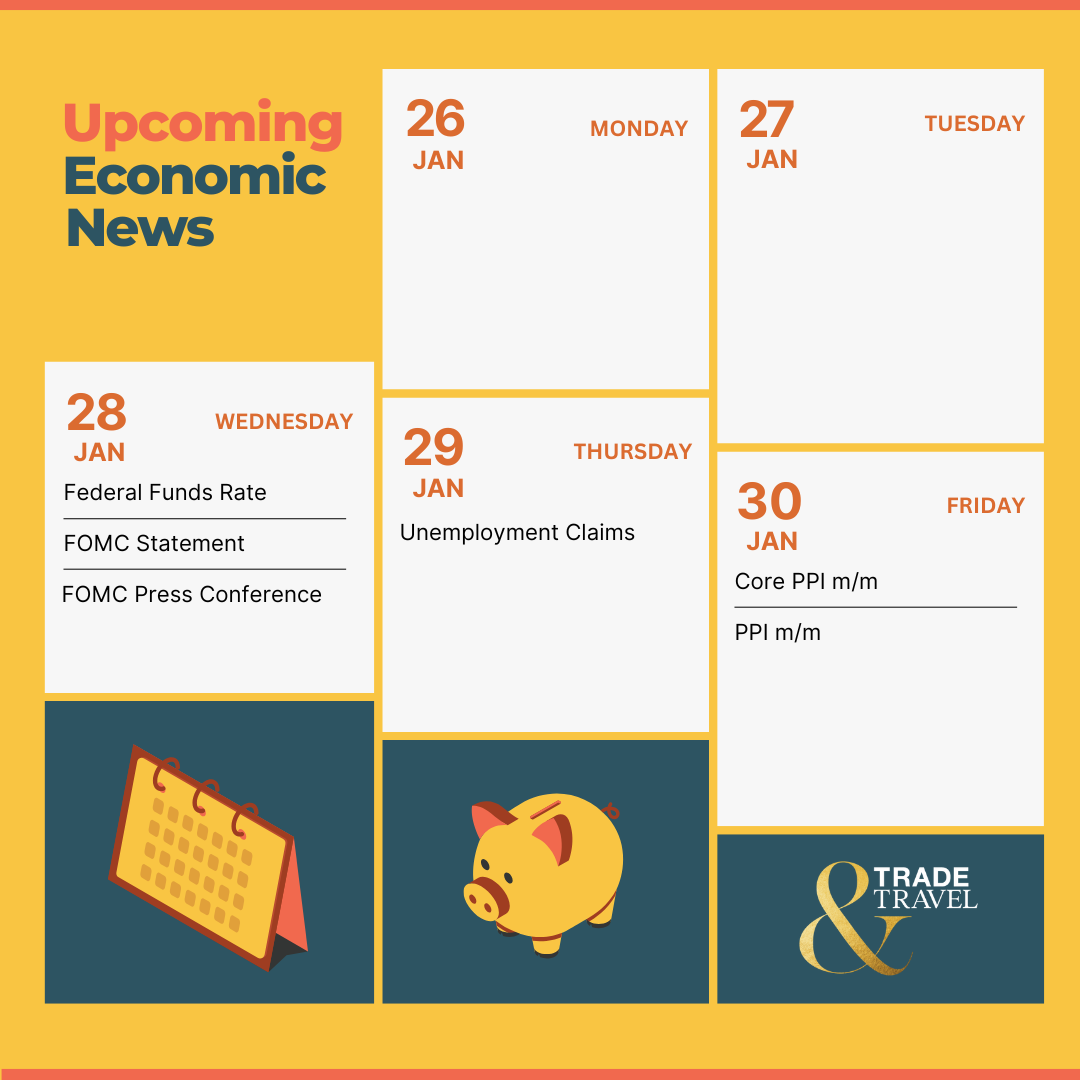
- Federal Funds Rate, FOMC Statement & Press Conference: The Fed’s benchmark rate currently stands at 3.50%–3.75% following the December 2025 meeting. The next decision comes at the January 27–28 FOMC meeting, where economists broadly expect policymakers to hold rates steady. Markets are aligned with that view, with futures pricing implying roughly a 95% probability of no change.
The December dot plot showed a median expectation of just one 25-basis-point cut in 2026, with the projected year-end policy path centered around 3.4%, highlighting meaningful disagreement within the committee, including three dissenting votes at the December decision. The Fed’s latest projections lifted the 2026 growth outlook to 2.3% while forecasting PCE inflation at 2.4%, a combination that helps explain why officials are emphasizing a cautious, data-dependent approach to any further easing.
Because January is not one of the Fed’s projection meetings, there will be no updated dot plot; the next SEP (Summary of Economic Projections) arrives in March. In the meantime, policymakers have stressed that future moves will depend on incoming data, placing January’s employment and inflation reports firmly in focus.
With leadership questions looming ahead of the Fed chair’s term ending in May 2026, and recent market pricing at times implying more than one rate cut this year, investors will be closely attuned to the tone of both the FOMC statement and Chair Powell’s press conference. After expectations for near-term cuts were pushed back by some major forecasters, any shift in how the Fed frames inflation, growth, or risk balance could move Treasury yields, the U.S. dollar, and broader risk appetite.
📅 Thursday, Jan 29th
- Unemployment Claims: Economists are forecasting initial jobless claims to tick up modestly to around 202,000 in the next weekly report, from the most recent reading of 200,000. Even if realized, that would keep claims near historic lows and reinforce the picture of a resilient U.S. labor market, suggesting layoffs remain limited despite mounting economic headwinds.
The four-week moving average of initial jobless claims fell to 201,500, the lowest since Jan 13, 2024, underscoring that layoffs remain limited after the holiday-season noise. Traders should also watch continuing claims, which stand at 1.849 million, since this measure tracks how many people remain on unemployment benefits and can signal whether displaced workers are finding jobs quickly.
A meaningful upside surprise in initial claims, or a sustained rise in continuing claims, would point to softening labor conditions and could shift expectations for the Fed’s policy path, which markets typically price quickly. Weekly claims also offer useful context ahead of the monthly jobs report because they arrive during the payroll survey window and can help investors gauge whether employment momentum is cooling or holding up.
📅 Friday, Jan 30th
- Core PPI m/m:The Core Producer Price Index for December will be released with the consensus forecast expecting a 0.3% month-over-month increase, following a flat 0.0% reading in November.
If the index re-accelerates, it would indicate an uptick in prices received by producers. Because PPI measures price changes from the seller’s perspective, it offers a view into upstream pricing dynamics, though the pass-through to consumer inflation is not one-to-one and varies over time. Markets will be watching whether any increase reflects pressure in trade services or retail-related categories, particularly areas sensitive to tariff and cost pass-through dynamics, as this could shape how the Federal Reserve assesses underlying inflation trends.
- PPI m/m: The final demand PPI m/m is forecast to print at 0.2%, matching November’s 0.2% increase. Goods inflation has been notably volatile, with goods PPI rising 0.9% in November after falling 0.4% in October, underscoring the importance of monitoring goods and services separately.
Over the past year, core PPI, defined by the BLS as final demand less foods, energy, and trade services, has risen 3.5%, while headline PPI stands at 3.0% year over year, both well above the Fed’s 2% inflation goal. A stronger-than-expected move in goods prices would reinforce sticky wholesale price pressures that could push back rate-cut expectations and weigh on equities, while a softer print could offer relief to markets that at times have priced in more than one Fed cut in 2026.
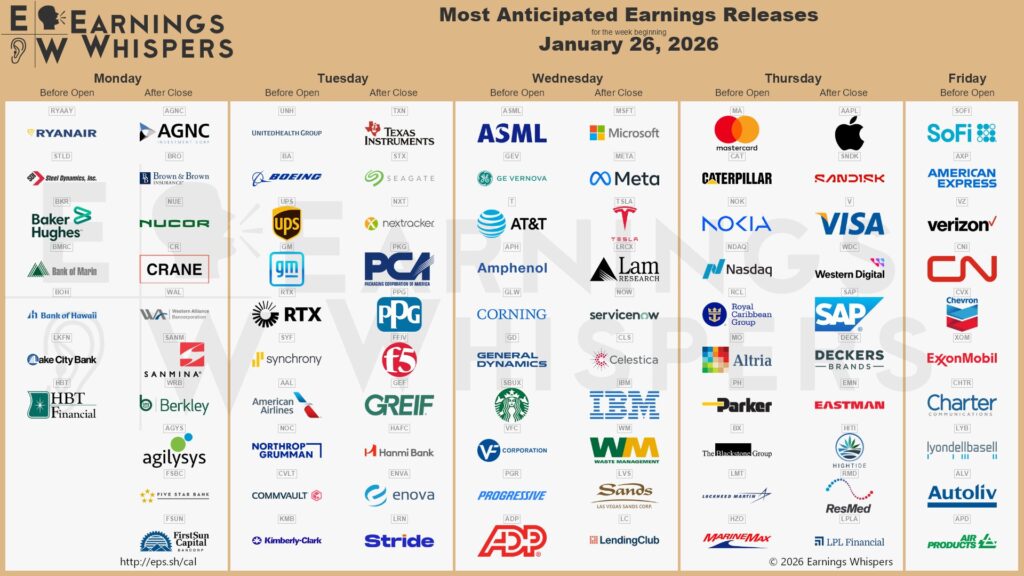
💼 Earnings season accelerates with a broad wave of major U.S. companies reporting and big tech looming just ahead, giving investors their first meaningful read on how corporate America is starting the new year.
📅 Tuesday, Jan 27th
- UnitedHealth Group Incorporated (UNH): UnitedHealth Group is scheduled to report Q4 2025 results, a closely watched moment for the nation’s largest health insurer after a year marked by cost and margin pressure, with investors looking for signs that 2026 could mark a return to more normalized growth.
Wall Street is bracing for a sharp Q4 profit drop, with consensus expecting adjusted EPS of $2.09 (about -69% YoY). Consensus estimates also peg the medical care ratio around 92.2% versus ~85.5% in the year-ago period, keeping the spotlight on medical-cost pressure and utilization as the key swing factors for margins.
Investors should scrutinize management’s 2026 medical cost trend assumption of about 10%, especially given that 2025 medical cost trends were running around 7.5%, above the pricing expectation of just over 5% embedded for 2025. The company’s Medicare Advantage pullback is another key focus. UnitedHealth is exiting plans in 109 U.S. counties, a move that management has said will contribute to an approximately 1 million-member decline in its Medicare Advantage enrollment in 2026.
Management commentary on Medicaid profitability will be closely watched, since the company has faced pressure in its Medicaid business tied to the mismatch between payment rates and utilization. With Stephen Hemsley in the CEO role following the 2025 leadership transition, investors will look for clearer details on progress toward stabilizing margins and what management expects for 2026 performance.
📅 Wednesday, Jan 28th
- Microsoft Corp. (MSFT): Microsoft is scheduled to report fiscal Q2 2026 results, with Wall Street expecting earnings per share of $3.91, representing approximately 21% year-over-year growth from $3.23 in the prior-year quarter. Revenue is projected to reach $80.28 billion, reflecting 15.3% year-over-year growth, with guidance issued at $79.5 billion to $80.6 billion, signaling modest deceleration from the first quarter’s 18% top-line expansion.
The Intelligent Cloud segment remains a key focus, with analysts expecting $32.41B in revenue. Microsoft’s prior guidance for the segment was $32.25B–$32.55B, implying 26%–27% growth year over year. For Azure, Microsoft guided to approximately 37% revenue growth in constant currency, which would be below the prior quarter’s 39% constant-currency pace.
The Commercial Remaining Performance Obligation (RPO) surged 51% year over year to $392 billion in Q1, underscoring strong enterprise demand and long-term revenue visibility. Management noted that the weighted average contract duration remains relatively stable at around two years, so investors will be watching whether future quarters show continued growth in RPO while maintaining this level of durability.
Management commentary on Copilot adoption and commercial AI monetization will be closely watched, alongside any discussion of competitive dynamics in cloud AI as OpenAI expands its compute relationships, including its AWS agreement. Investors are also focused on whether Azure’s growth moderation reflects AI capacity and execution constraints versus demand or share dynamics. Microsoft has highlighted extremely large AI infrastructure spending, including plans to invest about $80 billion in fiscal 2025 in AI-enabled data centers, and Reuters has reported record quarterly capex levels tied to this buildout.
📅 Thursday, Jan 29th
- Visa Inc. (V): Visa will report its fiscal Q1 2026 financial results, providing the first test of the company’s momentum heading into a critical year. Consensus expectations peg earnings at $3.14 per share, representing 14.2% year-over-year growth, while revenue is projected to reach $10.68 billion, up 12.3% year-over-year, marking acceleration from the full-year fiscal 2025 adjusted net revenue growth of 11% that generated $40 billion in total revenues.
Investors will be paying close attention to data processing revenues, a key driver in Visa’s revenue mix. In recent quarters, this line has delivered double-digit year-over-year growth. Visa’s annual report notes that processed transactions are the primary driver of data processing revenue, so trends in this metric help investors track underlying network activity.
Operating expenses require scrutiny, as consensus estimates project 12% year-over-year growth in adjusted total expenses, driven by increased personnel, professional fees, and network processing costs, dynamics that reflect management’s guidance for low double-digit adjusted operating expense growth across fiscal 2026.
Client incentives, a contra-revenue item that reduces reported revenue, are expected to reach $4.4 billion for Q1, reflecting strong client renewals and competitive positioning but also representing a headwind that investors must offset when evaluating organic growth. The company has demonstrated a pattern of earnings upside, having beaten EPS estimates in each of the last four quarters with an average beat of 2.7%, setting a high bar for Q1 2026 results.
Finally, with Visa’s gross margin often calculated by data providers at roughly 97% to 98%, and consensus projecting fiscal 2026 revenue around $44.4B (about 11% growth from FY2025), investors will be focused on whether management reaffirms its outlook for low double-digit FY2026 net revenue growth or strikes a more cautious tone on demand.
- Apple Inc (AAPL): Apple is set to report fiscal Q1 2026 results, with Wall Street consensus estimates calling for revenue of about $138.3 billion, representing roughly 10 to 12 percent year-over-year growth, and earnings per share of around $2.65 to $2.67. Some analysts, including Evercore ISI, are more optimistic, modeling approximately $140.5 billion in revenue and about $2.71 in EPS for the quarter.
Apple’s iPhone segment represents about half of total net sales based on its latest annual filing. In China, Apple retook the top smartphone spot in Q4 2025, with iPhone shipments up 28% year over year and market share reported at around 22%. A key metric to watch is gross margin. Management guided to 47% to 48% for the December quarter, and said this outlook includes about $1.4 billion in tariff-related costs, putting focus on how well Apple can sustain margins while managing tariff pressures.
Services remain a high-margin part of Apple’s mix, often estimated around 75% gross margin versus the mid-30% range for hardware. In fiscal 2025, Services revenue totaled about $109.2B, up 14% year over year. CFO Kevan Parekh said Apple expects Services revenue to grow at a year-over-year rate similar to what it reported in fiscal 2025.
Apple’s AI rollout remains a key focus heading into earnings, and management commentary on Apple Intelligence and Siri will be closely watched. Recent reporting indicates Apple is working on a major Siri revamp that would make it more chatbot-like, which keeps timing and scope front of mind for investors. Apple has also guided operating expenses of $18.1 billion to $18.5 billion for the December quarter, reflecting higher investment levels that markets will evaluate against revenue and margin performance.
Management commentary on geopolitical and macro risks, and on competitive dynamics in China, is likely to be a key focus on the upcoming call because these factors can influence demand trends and regional performance.
📅 Friday, Jan 30th
- Exxon Mobil Corporation (XOM): Exxon Mobil will report Q4 2025 earnings with analysts expecting adjusted EPS of $1.70, marking a marginal decline of 1.7% year-over-year from $1.67 in the same quarter the previous year, though the company has beaten consensus estimates for four consecutive quarters.
The primary headwind comes from sharply lower crude prices. Brent crude fell approximately 20% year-over-year in late 2025, which Exxon flagged in January could reduce upstream earnings by $800 million to $1.2 billion, though improved refining margins may offset $300 million to $700 million of that impact.
Investors will be watching production trends in Exxon’s advantaged assets, especially the Permian and Guyana. Exxon has said it reached its target of having more than 50% of upstream production from advantaged assets (Permian, Guyana, and LNG), and expects more than 60% of production to come from those assets by 2030. In the most recent quarter, Exxon reported record output in Guyana and the Permian, so investors will compare Q4 production against that Q3 baseline.
The Chemical Products segment remains in focus amid an industry margin squeeze. Exxon reported Chemical Products earnings of $515 million in Q3 2025 (up from $293 million in Q2), and investors will watch whether margins stabilize in Q4. Consensus revenue expectations for the upcoming quarter vary by source, but one widely cited estimate puts revenue around $82.85 billion (about 0.7% lower year over year). Separately, Exxon’s updated 2030 plan raised its targets to $25 billion of earnings growth and $35 billion of cash flow growth versus 2024 on a constant basis, with no increase in capital spending versus its prior plan.
We hope this helps and happy trading!
– Trade and Travel Team
Related Blogs

Follow Us
Testimonials
Hear from students on why they chose the Trade and Travel Family and how it has changed their lives.

