

Last week saw a mixed but modestly positive tone for U.S. equities as investors digested a fresh batch of economic data and Federal Reserve minutes. The S&P 500 (SPY) eked out a gain of 0.29%, while the Nasdaq 100 (QQQ) slipped 0.93% amid profit‐taking in big tech stocks. Meanwhile, the Dow Jones Industrial Average (DIA) outperformed, rallying 1.58% on strength in cyclical sectors and financials.
Investors focused on the Fed’s July meeting minutes, which underscored policymakers’ caution around inflation and signaled a patient, data-dependent approach to future rate moves. The most recent durable goods report, covering June, showed headline orders falling sharply but by less than expected, while core capital goods orders remained soft, pointing to sluggish business investment.
Corporate earnings season is winding down, with most major banks and large companies already having reported. Results have been stronger than expected, with the majority of S&P 500 firms beating profit and revenue forecasts, and more than half raising guidance. Still, management teams continue to cite tariffs and supply-chain challenges as headwinds for margins.
Looking ahead to the coming week, traders will watch the advance estimate of second-quarter GDP, due Thursday, which could confirm a slowdown from the first quarter’s robust growth. Finally, a handful of large-cap technology names will report earnings; their results could sway sentiment across the broader market. With markets already pricing in a degree of economic cooling, any surprises on either inflation or growth fronts may spark renewed volatility as August draws to a close.
📅 Thursday, Aug 28th
- Prelim GDP q/q: The second estimate of Q2 2025 GDP is expected to revise the advance reading of 3.0% up slightly to 3.1%. This estimate incorporates more complete data than the advance release and carries significant weight with investors as a more accurate picture of economic activity before the final revision. Analysts will be watching for revisions to consumer spending (the primary driver of Q2 growth), import levels (which fell significantly), and inflation gauges.
- Unemployment Claims: The upcoming weekly unemployment claims report is expected to show initial jobless claims declining to 231,000 from the previous week’s elevated reading of 235,000. This forecast of 231,000 represents a potential 4,000 decrease from last week’s 8-week high and would mark a return toward more normalized levels after recent volatility.
Market participants should closely monitor both the headline initial claims figure and the continuing claims data (currently at 1.972 million, the highest since November 2021), as any deviation from the 231,000 forecast could signal either accelerating labor market deterioration if claims rise above expectations or improved stability if they fall below the forecast. The 4-week moving average of 226,250 and the trend in continuing claims will be particularly crucial indicators for assessing whether the recent softening in hiring conditions represents temporary volatility or a more sustained weakening that could influence Federal Reserve policy decisions.
📅 Friday, Aug 29th
- Core PCE Price Index m/m: Economists are forecasting a month-over-month increase of 0.3%, matching the previous month’s reading. This reading represents the Federal Reserve’s preferred inflation measure, which excludes volatile food and energy prices and is critical for monetary policy decisions as it tracks underlying inflation trends against the Fed’s 2% annual target. Market participants should focus on whether the 0.3% monthly increase continues to keep annual core PCE inflation elevated near 2.8% (as seen in the most recent June data), as this would signal persistent inflationary pressures that could influence the Federal Reserve to maintain its “higher for longer” interest rate stance and potentially strengthen the US dollar while pressuring risk assets.
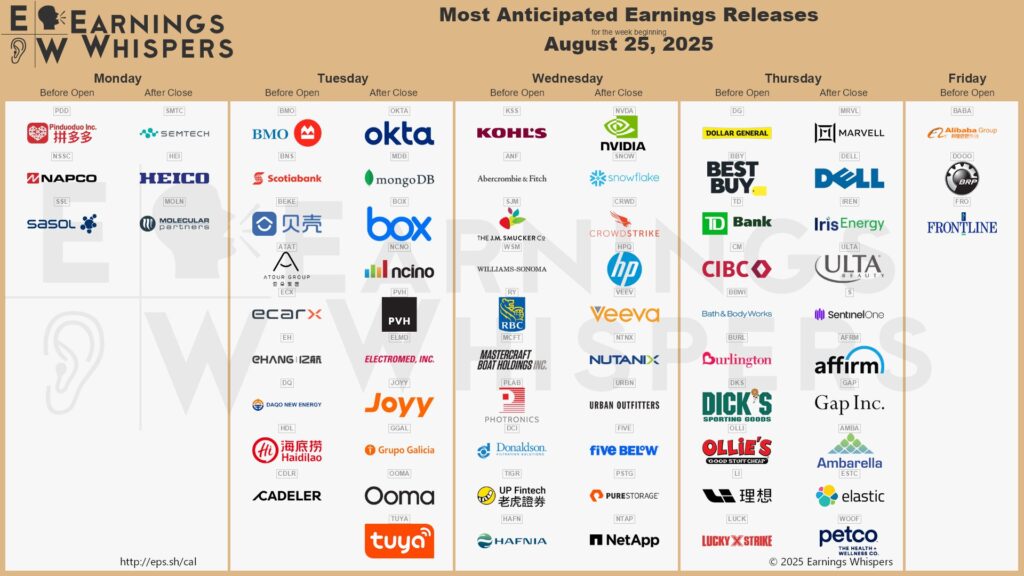
💼 With earnings season winding down, here are some of the companies reporting this week:
📅 Tuesday, Aug 26th
- MongoDB, Inc. (MDB): MongoDB is set to report its second quarter fiscal 2026 earnings, with Wall Street analysts expecting earnings per share of $0.67 (representing a 4.2% year-over-year decline) and revenue of $553.94 million, indicating 15.8% year-over-year growth. Investors should focus on Atlas revenue performance, which has been MongoDB’s primary growth engine, contributing 72% of total revenue in Q1 2026 with 26% year-over-year growth, and watch for management’s guidance on consumption trends after experiencing some volatility with softness at the start of Q2, followed by a healthy rebound.
Key metrics to monitor include Atlas customer count, which reached over 57,100 in Q1 FY2026, up from around 49,200 a year ago, and subscription revenue, which was reported at $531.5 million (up 22% year-over-year). Non-Atlas revenue segments are expected to show modest declines amid weaker momentum outside the core cloud platform.
📅 Wednesday, Aug 27th
- NVIDIA Corporation (NVDA): NVIDIA will report Q2 FY2026 results, with analysts forecasting revenue of approximately $45.94 billion (up 52.9% year-over-year) and earnings per share of $1.01 (up 48.5% year-over-year). Market participants should focus on the Data Center segment, which accounted for approximately 89% of Nvidia’s revenue in Q1 FY2026. Gross margins are expected to recover markedly to about 71.8% in Q2 after a steep 60.5% fall due to H20 export charges. Attention will also be on the continued ramp-up of Blackwell production and any implications from U.S.–China export restrictions. Nvidia’s Q2 fiscal guidance projects $45.0 billion in revenue (±2%, or about $44.1B to $45.9B), signaling robust global demand under challenging geopolitical conditions.
- CrowdStrike Holdings, Inc. (CRWD): CrowdStrike is set to report after the market closes. Consensus estimates call for earnings per share of $0.83 and revenue of approximately $1.15 billion, representing roughly 19.3% year‑over‑year growth. Market participants should closely monitor net new annual recurring revenue, which totaled $194 million in Q1, driving ending ARR to $4.44 billion, a 22% year‑over‑year increase, and compare it to consensus expectations. Additionally, watch subscription gross margins (around 80%), commentary on AI-driven product uptake, and management’s outlook for sequential ARR growth and free cash flow margins to gauge the sustainability of CrowdStrike’s high-growth trajectory.
📅 Thursday, Aug 28th
- Best Buy Co., Inc. (BBY): Best Buy will report its Q2 FY26 results, with analysts forecasting revenue of $9.23 billion, down 0.6% year-over-year, and earnings-per-share of $1.21, a 9.7% decline from the prior-year quarter. Market participants should focus on enterprise comparable sales, expected to be roughly flat to down 0.3%, and gross margin trends, particularly the mix between digital (lower warranty attach) and in-store sales (higher attach), which could impact profitability. Finally, market participants will be watching any updates to full-year adjusted EPS guidance and commentary on tariff pressures or supply-chain cost shifts.
- Dell Technologies Inc. (DELL): Dell Technologies will report its fiscal Q2 2026 results after the market close, with Wall Street expecting adjusted EPS of $2.29 (up 21.1% year-over-year) and revenue of approximately $29.02 billion, representing 15.9% growth. The key metric to watch will be Infrastructure Solutions Group performance, particularly AI server shipments projected at $7 billion for the quarter and management’s guidance on converting the massive $14.4 billion AI server backlog that includes orders worth $12.1 billion booked in Q1 alone.
Investors should focus on gross margin trends, ISG operating margins targeting, and any updates to full-year fiscal 2026 guidance, especially whether Dell raises its AI server revenue target from the current $15+ billion given analyst projections of $20.7 billion for the full year. Additionally, monitor Client Solutions Group trends as the PC business faces headwinds with consumer revenue declining 19-22% in recent quarters, though commercial client revenue has shown resilience. Dell’s ability to maintain delivery momentum while managing supply chain constraints and GPU allocations will be critical given the company’s strategic position as a key beneficiary of enterprise AI infrastructure spending.
We hope this helps and happy trading!
– Trade and Travel Team
Related Blogs








Follow Us
Testimonials
Hear from students on why they chose the Trade and Travel Family and how it has changed their lives.

