
Last week proved exceptionally strong for major indices amid robust earnings results and growing trade deal optimism. The SPY (S&P 500) gained 1.52%, the QQQ (NASDAQ 100) advanced 0.91%, and the DJIA (Dow Jones Industrial Average) climbed 1.30% for the week.
Corporate America maintained its impressive second-quarter performance streak, with the tech sector leading the charge. The week’s marquee earnings came from Alphabet, which delivered strong results on Wednesday with revenue growth of 14% to $96.4 billion, driven by robust performance across Google Search, YouTube ads, and Google Cloud, which surged 32% year-over-year. Tesla, however, disappointed investors with both revenue and earnings misses, posting a 12% revenue decline to $22.5 billion, its steepest drop in over a decade.
Following Trump’s successful agreement with Japan, which reduced tariffs from a threatened 27.5% to 15% in exchange for a $550 billion investment package, the administration has secured additional deals with several Asian partners. Trump also announced framework agreements with Indonesia and the Philippines, each carrying a 19% tariff rate.
Meanwhile, Canada and Mexico have strengthened their trade collaboration, with Canadian Prime Minister Mark Carney and Mexican President Claudia Sheinbaum agreeing to present unified approaches in negotiations with the Trump administration. Both leaders emphasized that the USMCA trade agreement must be respected.
This week promises to be among the most consequential of 2025, featuring the Federal Reserve’s July 30th policy meeting, where rates are widely expected to remain at 4.25%-4.50%. The central bank faces mounting pressure from political quarters while navigating tariff-induced inflation concerns and mixed economic signals.
The technology sector faces its biggest test yet with Microsoft and Meta reporting on Wednesday, followed by Apple and Amazon on Thursday. These earnings will be crucial in determining whether the AI-driven rally can sustain momentum, particularly as analysts scrutinize capital expenditure guidance and returns on massive AI investments exceeding $320 billion across the sector.
The convergence of Federal Reserve policy decisions, mega-cap earnings, the July jobs report, and the approaching trade deadline creates a potentially volatile environment that could either propel markets to new highs or trigger a period of consolidation after the summer’s record-setting run.
📅 Tuesday, Jul 29th
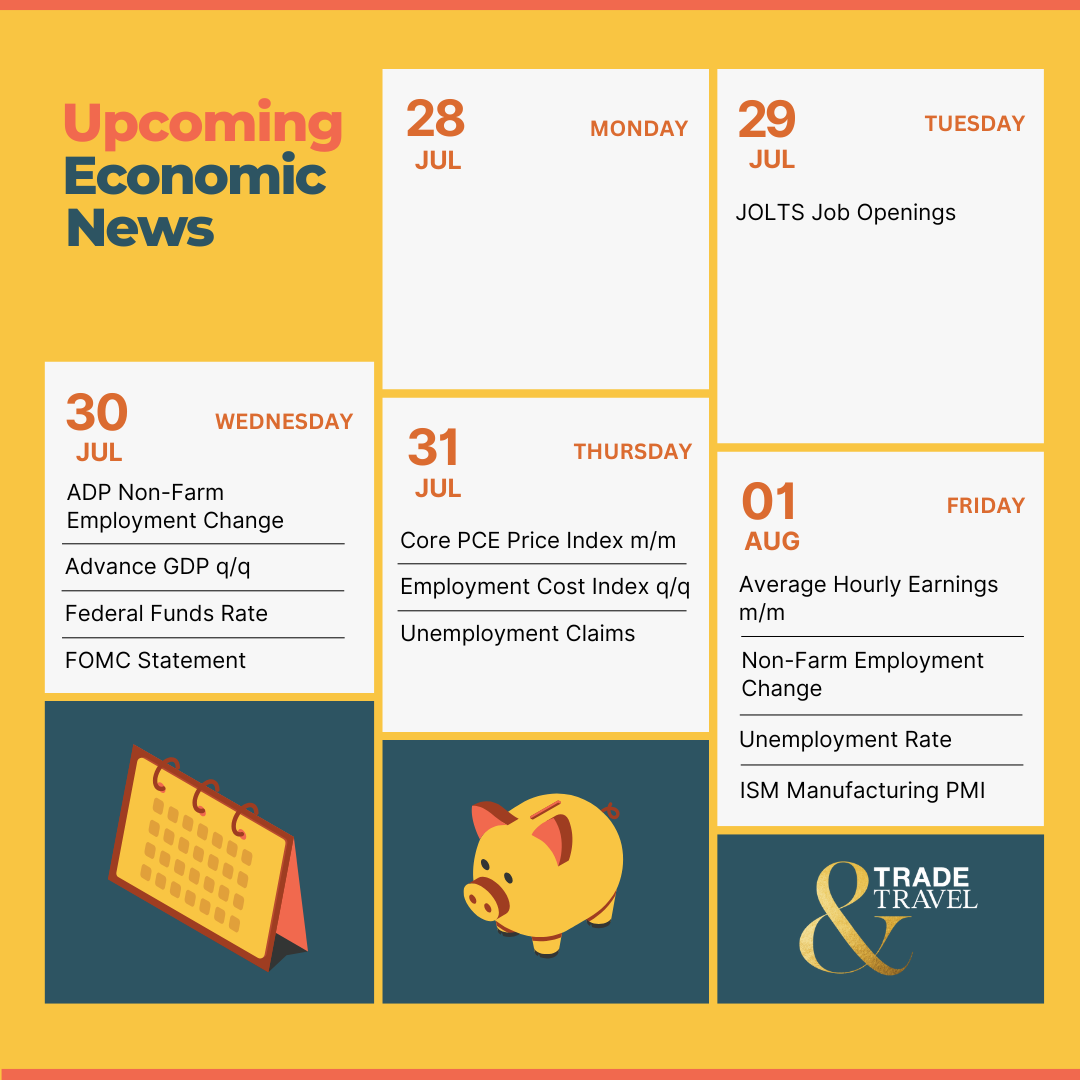
- JOLTS Job Openings: The upcoming JOLTS Job Openings report is expected to show a decline to 7.49 million job openings from the previous month’s 7.77 million, representing a decrease of approximately 280,000 positions. This anticipated 3.6% monthly decline would signal continued moderation in labor demand, potentially easing concerns about persistent wage pressures that have contributed to inflationary pressures throughout 2025.
📅 Wednesday, Jul 30th
- ADP Non-Farm Employment: The upcoming ADP Non-Farm Employment Change report for July 2025 represents a critical economic indicator following June’s surprising 33,000 job loss against expectations of a 95,000 to 99,000 gain. With the forecast now set at 82,000 new private sector jobs, market participants should closely monitor whether this rebound materializes, as the divergence from the previous negative reading could signal either a labor market recovery or continued hiring hesitancy amid economic uncertainty.
Key areas to watch include sector-specific performance (particularly professional/business services and education/health services, which drove June’s decline with losses of 56,000 and 52,000 jobs , respectively), wage growth trends that have remained resilient despite employment weakness.
- Advance GDP q/q: The upcoming Advance GDP quarter-over-quarter report is expected to show a significant turnaround from the previous quarter’s -0.5% contraction to a forecasted 2.4% growth. This dramatic swing reflects the economy’s rebound from Q1 2025’s first quarterly decline in three years, which was primarily driven by a surge in imports as businesses stockpiled goods ahead of tariff implementations.
Market participants should closely monitor three key aspects of the release: first, whether the actual figure meets, exceeds, or falls short of the 2.4% consensus forecast, as GDP surprises typically trigger immediate currency and equity market volatility; second, the underlying components, particularly consumer spending growth (which slowed to just 0.5% in Q1) and business investment patterns, which will signal the sustainability of any recovery; and third, any revisions to the methodology or previous quarters’ data that could alter the economic narrative.
- Federal Funds Rate & FOMC Statement: The Federal Reserve is widely expected to maintain the federal funds rate steady at 4.25% to 4.50% for the fifth consecutive meeting, with all 105 economists surveyed by Reuters anticipating no change. The CME FedWatch tool shows a 95.9% probability of rates remaining unchanged, as markets price in virtually zero chance of a rate cut this month. Despite President Trump’s intensifying calls for immediate rate cuts following his visit to Fed headquarters, policymakers remain cautious. The primary focus will be on tariff-induced inflation pressures, especially as June’s Consumer Price Index rose to 2.7% annually, with core inflation climbing to 2.9%.
Market participants should closely watch Fed Chair Powell’s press conference for signals on September policy direction, where markets currently assign a 60 percent probability to a 25 basis point cut, as well as potential dissenting votes from FOMC members like Governor Christopher Waller, who has advocated for cuts in July, and how the Fed plans to navigate persistent inflation risks ahead of Trump’s August 1 tariff deadline.
📅 Thursday, Jul 31st
- Core PCE Price Index m/m: The upcoming Core PCE Price Index report is forecast to show a 0.3% monthly increase, up from 0.2% in May, which would be the strongest reading since February’s 0.4%. A higher-than-expected result could signal persistent inflation and delay potential Fed rate cuts, while a softer number might calm markets and boost risk assets. Market participants should monitor reactions in Treasury yields, the US Dollar Index, and interest-sensitive equity sectors such as financials, utilities, and consumer discretionary, given the report’s influence on monetary policy expectations.
- Employment Cost Index q/q: The upcoming Q2 2025 Employment Cost Index (ECI) report is forecasted to show a 0.8% quarter-over-quarter increase, slightly below the previous quarter’s 0.9%, signaling ongoing moderation in labor cost growth.
Market participants should watch whether the actual ECI matches or diverges from the 0.8% estimate, as this number guides the Federal Reserve’s assessment of wage inflation and labor market tightness. A result above forecast could renew inflation worries and delay interest rate cuts, while a weaker reading may support the case for policy easing later in 2025.
- Unemployment Claims: The upcoming report is forecast to increase modestly from 217,000 to 222,000, remaining within the healthy 200,000-250,000 range despite ending a six-week decline streak. Market participants will watch key metrics, including the four-week moving average (224,500, down from 229,500) and continuing claims (1.955 million) as indicators of labor market stability. Results significantly above 222,000 could support rate cut arguments, while numbers well below the forecast might reinforce maintaining current rates at 4.25%. This report serves as a critical gauge of job market resilience amid broader economic uncertainties and will influence monetary policy expectations.
📅 Friday, Aug 1st
- Average Hourly Earnings m/m: The upcoming report presents a critical inflection point for markets with the previous reading of 0.2% versus the forecast of 0.3%. This wage inflation indicator is closely monitored by the Federal Reserve as a leading gauge of inflationary pressures, where higher wages typically translate to increased consumer spending power and potential price pressures throughout the economy. Market participants should watch for any deviation from the 0.3% consensus forecast, as readings above expectations could signal persistent wage-driven inflation that may influence the Fed’s monetary policy stance.
- Non-Farm Employment Change: The upcoming Non-Farm Employment Change report is expected to show a continued cooling in the US labor market, with 108,000 jobs added compared to the previous month’s reading of 147,000. This significant deceleration from the forecast of 108K represents a notable slowdown from recent months and would mark one of the weakest job creation figures of 2025, potentially signaling broader economic softening amid uncertainties surrounding trade policies and tariffs.
- Unemployment Rate: The Bureau of Labor Statistics will release the July 2025 Employment with economists forecasting the unemployment rate to rise to 4.2% from June’s 4.1% reading. This potential increase would reverse June’s positive trend when unemployment fell from 4.2% to 4.1%, affecting approximately 7.0 million unemployed Americans.
Market participants should focus on key metrics, including nonfarm payroll additions, labor force participation rate (currently at 62.3%), and average hourly earnings growth, while noting that continuing unemployment claims are near 2021 highs, indicating workers face greater difficulty securing new employment despite initial jobless claims falling. The Federal Reserve’s monetary policy decisions depend heavily on this employment data, making the report critical for determining potential interest rate adjustments amid mixed labor market signals.
- ISM Manufacturing PMI: The upcoming ISM Manufacturing PMI report is expected to show a reading of 49.5, representing a modest improvement from the previous month’s 49.0. This forecast suggests the manufacturing sector will remain in contractionary territory (below 50) for the fifth consecutive month, though at a slower pace of decline.
Investors should closely monitor three critical components: new orders (which declined to 46.4 in June and serve as a forward-looking demand indicator), production levels (which rebounded to 50.3 in June, returning to expansion territory), and employment figures (which contracted to 45.0, indicating continued job market weakness in manufacturing). Market participants should pay particular attention to whether the forecasted 49.5 reading materializes, as any significant deviation from expectations typically creates trading opportunities across equity, bond, and currency markets, while traders should also focus on the supplier deliveries index and prices paid component for insights into supply chain conditions and inflationary pressures that could influence Federal Reserve policy decisions.
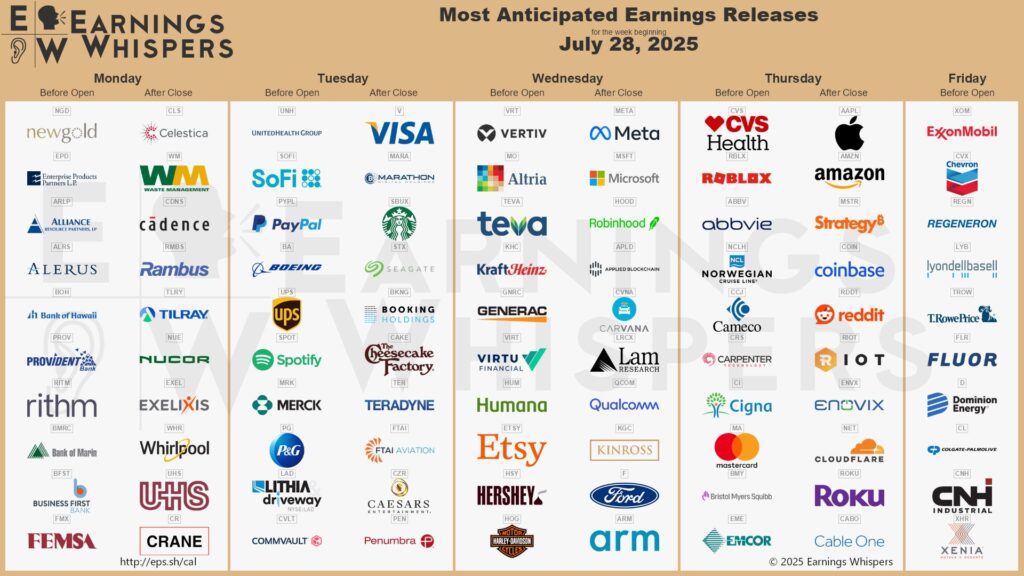
💼 Earnings season heats up, with several high-profile companies set to announce results this week:
📅 Tuesday, Jul 29th
- UnitedHealth Group Incorporated (UNH): UnitedHealth is set to report second quarter 2025 earnings, with analysts anticipating a challenging release as the healthcare giant grapples with elevated medical costs and multiple federal investigations. The U.S. Department of Justice is conducting both criminal and civil probes into the company’s Medicare Advantage billing practices, specifically examining whether patient risk scores were improperly inflated to secure higher government reimbursements. UnitedHealth has stated it is cooperating fully with the investigations. Consensus estimates project earnings per share of $4.48, representing a sharp 34.1% decline from the prior year’s $6.80 per share, while revenues are expected to rise 12.7% year-over-year to $111.5 billion.
Market participants should closely monitor the medical care ratio (also known as the Medical Loss Ratio), which measures the percentage of premium revenue spent on medical care. It is forecast to rise to approximately 88.6%, compared to 85.1% in the same quarter last year, underscoring the pressure from higher costs in Medicare Advantage services throughout 2025.
📅 Wednesday, Jul 30th
- Meta Platforms (META): Meta will report its second quarter 2025 earnings, with analysts expecting revenue of $44.78 billion (up 14.6% year-over-year) and earnings per share of $5.87 (up 13.7% year-over-year). Market participants should closely watch Meta’s Reality Labs division, which is projected to post a $5.35 billion operating loss, while the core Family of Apps business is expected to generate $22.38 billion in operating income, representing 15.7% year-over-year growth. The critical focus will be on whether Meta’s dramatically increased capital expenditure guidance of $64-72 billion for 2025 (up from the original $60-65 billion range) can justify returns on its aggressive AI infrastructure investments, particularly as the company approaches nearly 1 billion monthly active users for Meta AI.
- Microsoft Corp. (MSFT): Microsoft is set to report its fiscal Q4 2025 earnings, with analysts expecting revenue of approximately $73.8 billion (representing ~13% year-over-year growth) and earnings per share of $3.35-$3.38, up from $2.95 the previous year. Market participants should focus on three key metrics: Azure cloud revenue growth, which is projected to maintain its momentum at 34-35% year-over-year in constant currency (with AI services contributing an estimated 15-16 percentage points to this growth), Microsoft’s AI business annual run rate progression beyond the current $13 billion level (up 175% year-over-year), and commercial bookings strength as an indicator of future revenue given the company’s record $315 billion in remaining performance obligations.
The earnings call will be critical for assessing whether Microsoft can sustain its AI-driven growth trajectory while managing the substantial capital expenditures of approximately $80 billion in fiscal 2025 for AI-enabled data centers, with particular attention to management commentary on capacity constraints and the timeline for monetizing these massive infrastructure investments.
- QUALCOMM Incorporated (QCOM): Qualcomm reports fiscal Q3 2025 earnings, with analysts expecting $10.3 billion in revenue and $2.71 in EPS. The QCT chip division is projected to contribute about $9.03 billion, including $964 million from automotive and $1.57 billion from IoT, both showing strong double-digit growth. Management’s prior revenue guidance of $9.9 to $10.7 billion sets the tone for updates on demand and pricing. With 46 percent of sales tied to China, commentary on tariffs and trade risks will be closely watched. Investors will also look for progress toward Qualcomm’s goal of reaching $22 billion in non-handset revenue by fiscal 2029.
📅 Thursday, Jul 31st
- Apple Inc. (AAPL): Apple reports fiscal Q3 2025 earnings, with Wall Street expecting about $89.18 billion in revenue and $1.43 EPS, representing 3.9% and 2.1% year-over-year gains, respectively. Gross margin may compress to roughly 46% as up to $900 million in tariff-related costs hit the June-quarter P&L. A key test will be whether iPhone sales in China can extend their recent 8% rebound amid Huawei’s competing 12% surge, indicating the sustainability of price-driven demand. Services should remain the growth engine, projected to deliver around $27 billion, about 27% of total revenue, at a robust 75% margin, cushioning any hardware softness. Finally, market participants will dissect management’s commentary on the Apple Intelligence rollout to gauge how quickly new AI features can re-accelerate growth and underpin the company’s premium valuation multiple.
- Amazon.com (AMZN): Amazon is scheduled to report its second-quarter 2025 earnings. Analysts expect revenue of $162.11 billion, representing 9.5% year-over-year growth, with earnings per share consensus at $1.32. Market participants should focus on three critical areas: AWS is projected to grow by approximately 17.4% YoY in the upcoming quarter, following a strong ~17% growth to $29.3 billion in Q1, advertising revenue expansion (expected to surpass $14 billion as Amazon’s retail media business heads toward $60 billion annually), and operating margin improvement amid ongoing AI infrastructure investments and potential tariff headwinds that management cited as creating “substantial uncertainty” in previous guidance.
We hope this helps and happy trading!
– Trade and Travel Team
Related Blogs






Follow Us
Testimonials
Hear from students on why they chose the Trade and Travel Family and how it has changed their lives.

