
Market closed last week broadly higher as easing geopolitical tensions, dovish Federal Reserve cues, and solid economic data bolstered risk appetite. Major U.S. benchmarks posted modest gains. The S&P 500 (SPY) climbed 3.47%, the Nasdaq 100 (QQQ) advanced 4.04%, and the Dow Jones Industrial Average (DIA) rose 3.85%.
Markets shook off early-week jitters over Middle East hostilities after reports of a ceasefire between Israel and Iran. Energy prices softened amid renewed optimism, helping cyclical sectors outperform. Federal Reserve Chair Jerome Powell’s testimony, while cautious on rate cuts, signaled patience and reinforced hopes for easing monetary policy later this summer.
With only a few earnings reports released, markets found little disruption from corporate results, which largely met expectations. Instead, attention shifted to upcoming economic data. In the shortened trading week ahead, all eyes will be on the June Non-Farm Payrolls report, set for release on July 3. Alongside updates on unemployment and wages, the jobs data will play a pivotal role in shaping market expectations for the Federal Reserve’s next move.
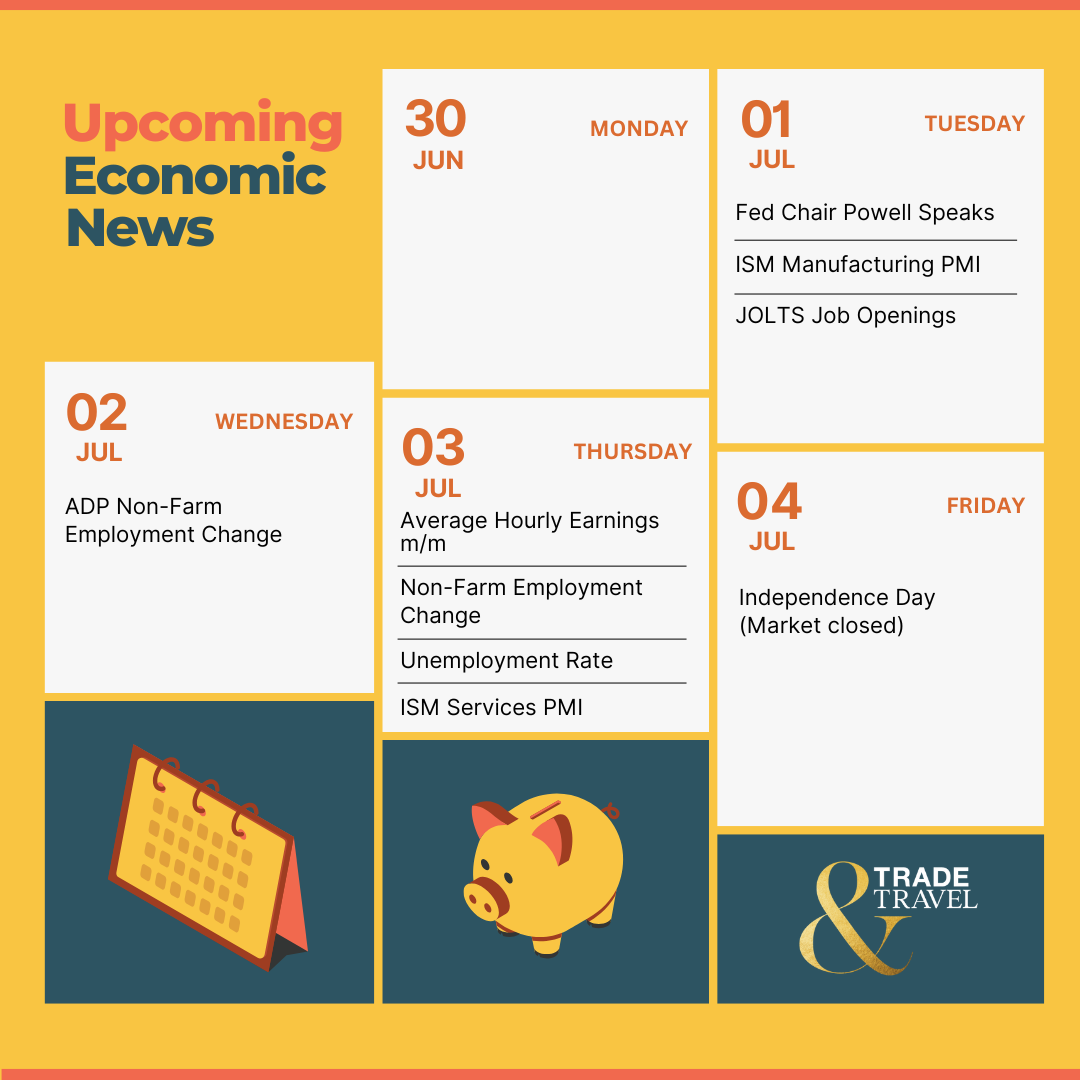
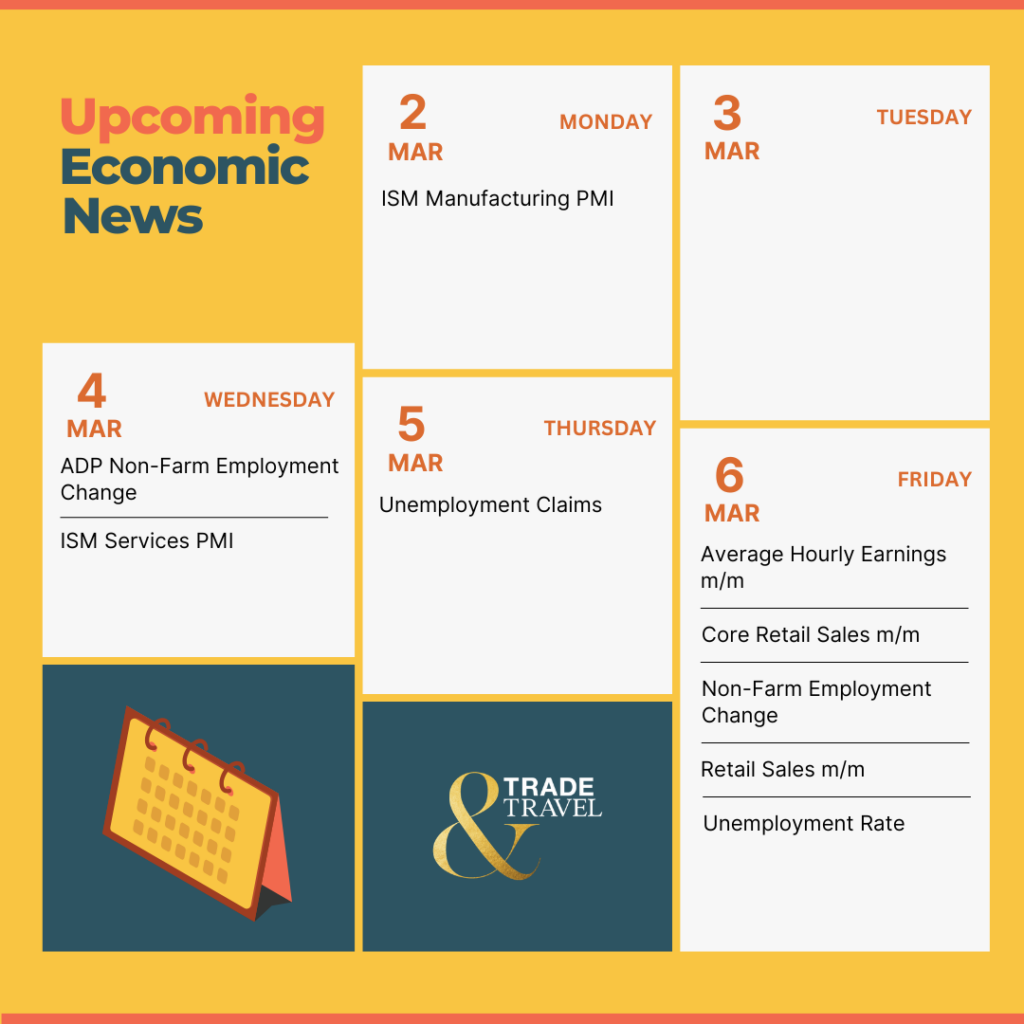
📅 Tuesday, Jul 1st
- Fed Chair Powell Speaks: Fed Chair Jerome Powell will participate in a policy panel at the European Central Bank Forum on Central Banking in Sintra, Portugal, alongside ECB President Christine Lagarde and other global central banking leaders. Market participants will be watching for any shifts in Powell’s stance on interest rate cuts, despite recent dovish signals from Fed Governors Bowman and Waller, who have both suggested that easing in July could be appropriate if inflation pressures remain contained.
Key focus areas include Powell’s commentary on how tariff-induced inflation is materializing compared to Fed expectations, any updates on labor market conditions given the recent uptick in continuing unemployment claims, and whether the central bank’s current 4.25%–4.50% fed funds rate remains appropriate.
- ISM Manufacturing PMI: The upcoming ISM Manufacturing PMI report for July is expected to show modest improvement with a forecast of 48.8, up from the previous reading of 48.5 in May 2025.
Despite this slight uptick, the reading would still indicate contraction in the manufacturing sector, as any PMI below 50 signals declining activity. Market participants should closely monitor key components including the New Orders Index (which measures demand and typically leads the business cycle), the Production Index (reflecting manufacturing output), the Employment Index (indicating hiring trends), and the Prices Index (showing inflationary pressures), as these subindices provide crucial insights into the sector’s health and can significantly impact USD strength and stock market performance.
- JOLTS Job Openings: The JOLTS Job Openings report is scheduled for release with a forecast of 7.45 million openings, representing a modest increase from the previous reading of 7.39 million. This 0.81% anticipated rise reflects continued stabilization in the US labor market, which has remained within the 7-8 million range over the past year, indicating a market that has cooled from its post-pandemic peak but remains fundamentally strong.
Market participants should focus on whether the actual reading significantly deviates from the 7.45 million forecast, as major surprises could influence Federal Reserve policy expectations and dollar strength. A reading well above 7.7 million could signal persistent labor market tightness and support USD strength by reducing expectations of Fed rate cuts, while a print below 7.0 million might trigger concerns about labor market weakening and pressure the dollar as markets price in higher odds of monetary easing.
📅 Wednesday, Jul 2nd
- ADP Non-Farm Employment Change: The upcoming ADP Non-Farm Employment Change report will be closely watched by market participants as it provides an early preview of private sector employment trends following May’s disappointing 37,000 jobs reading that fell significantly below the forecasted 111,000. With economists projecting approximately 105,000 jobs to be added for June, this report will serve as a critical indicator of whether the hiring slowdown that began in May represents a temporary pause or a broader trend of economic deceleration amid ongoing policy uncertainty and elevated tariff concerns.
Market participants should focus on sector-specific employment changes, particularly in professional and business services which shed 17,000 jobs in May, wage growth trends that have held steady at robust levels of 4.5% for job-stayers and 7% for job-changers, and any Federal Reserve policy implications given President Trump’s previous calls for immediate rate cuts following weak employment data.
📅 Thursday, Jul 3rd
- Average Hourly Earnings m/m: The upcoming Average Hourly Earnings (AHE) month-over-month report presents a critical inflection point for market participants, with the forecast showing a deceleration from the previous month’s robust 0.4% growth to an expected 0.3%. This wage growth slowdown represents a potentially significant development for Federal Reserve policy considerations, as the central bank closely monitors wage inflation as a leading indicator of broader price pressures and labor market tightness.
Market participants should focus on three key areas: whether the actual reading aligns with the 0.3% forecast (which would signal cooling wage pressures supportive of the Fed’s inflation fight), any deviation from expectations that could trigger immediate market volatility, and the broader implications for consumer spending power since wages directly impact the 70% of GDP driven by consumer expenditures.
- Non-Farm Employment Change: Market participants are bracing for Friday’s Non-Farm Employment Change report, following a May prior reading of 139,000 jobs and a consensus forecast of 120,000 jobs. Market participants will focus on whether the actual print deviates significantly from the expected 120,000 versus the prior 139,000 to assess US labor market strength and its implications for Federal Reserve policy. A headline figure notably above forecasts could drive broad equity gains, while a shortfall often prompts rotation into defensive sectors.
- Unemployment Rate: June’s unemployment rate is forecast at 4.3%, up from May’s 4.2%. A reading above forecast could pressure stocks, as it may signal growing labor market weakness and increase recession risks, even if it boosts expectations for Fed rate cuts. Conversely, a lower-than-expected print may lift equities by reinforcing hopes for a soft landing. This refers to a scenario where inflation continues to ease without a sharp rise in unemployment or a significant slowdown in economic growth. Traders should also monitor nonfarm payrolls and weekly jobless claims for additional labor-market insights.
- ISM Services PMI: The upcoming ISM Services PMI is forecast to rise to 50.8 from 49.9 in May, which would signal a return to modest growth after a brief contraction. A reading above the 50.0 benchmark denotes expansion, potentially boosting market sentiment among investors and traders. Market participants should watch the new orders subindex at 46.4, the employment gauge at 50.7 and the prices paid index at 68.7 for clues on demand momentum, labor market resilience and inflation pressures.
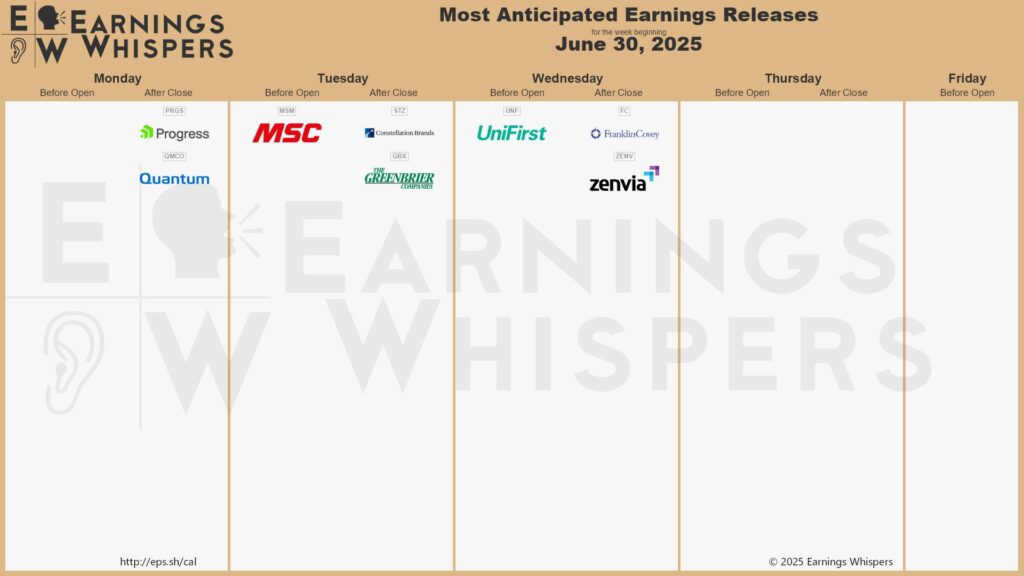
💼 With earnings season yet to kick off in full, here are a few companies reporting this week:
📅 Monday, June 30th
- Progress Software (PRGS): Progress Software will report Q2 results with management guiding revenue of $235–241 million (analysts’ consensus ~$237.5 million, +35.5% YoY) and non-GAAP EPS of $1.28–1.34 (consensus ~$1.30).
Market participants should focus on recurring-revenue momentum. Q1 annualized recurring revenue reached $836 million (+48% YoY) and net retention topped 100%, as well as any swing in non-GAAP operating margin from Q1’s 39% and updates to full-year guidance of $958–970 million in revenue and $5.25–5.37 in EPS. Market participants should watch for commentary and progress on the ShareFile integration, a secure, cloud-based file sharing and collaboration platform with AI-powered workflows and Microsoft 365 integration, which management expects to complete by year-end.
- Quantum (QMCO): Quantum will report its fiscal fourth quarter and full‐year 2025 results, with analysts forecasting a full‐year revenue of $280.18 million (down 10.1% year-over-year) and a GAAP loss of $1.17 per share. Market participants should watch the quarter’s gross margin, which management guided to approximately 44% ±1%, and subscription Annual Recurring Revenue, which grew 29% year-over-year to $21.3 million in Q3. Commentary on free cash flow and debt reduction will also be crucial, as Quantum targets cash flow positivity in the second half of FY 2025 and has taken initial steps toward becoming debt-free.
📅 Tuesday, Jul 1st
- Constellation Brands (STZ): Constellation Brands is reporting its fiscal Q1 results with analysts expecting adjusted EPS of $3.31 on revenue of $2.55 billion, down 7.2% and 4.1% year-over-year, respectively. Market participants should focus on management’s updated full-year comparable EPS guidance, currently in a $12.60–$12.90 range, and any revisions to enterprise net sales growth forecasts amid persistent U.S. beer tariffs. They should also monitor segment performance and margin trends, particularly beer volumes, which account for ~78% of sales with a margin of around 40%, as well as any commentary on cost management, pricing power, or ongoing headwinds in the wine and spirits business.
- MSC Industrial Direct Company, Inc. (MSM): MSC is a leading North American distributor of metalworking and maintenance, repair, and operations (MRO) products serving manufacturing companies with approximately 2.4 million product offerings.
It is set to report Q3 fiscal 2025 results and analysts expect earnings of $1.03 per share on revenue of approximately $970 million, representing a 22.6% year-over-year decline in EPS from $1.33 in the prior year period and a slight revenue decrease from $979 million a year earlier. Key metrics for market participants to monitor include progress on the company’s transition from a “spot buy” to “mission critical” distribution model, where 63.7% of business now comes through e-commerce channels, along with performance in metalworking products which comprise about 45% of total revenue.
We hope this helps. Happy trading and an early Happy 4th of July! 🇺🇸
– Trade and Travel Team
Related Blogs







Follow Us
Testimonials
Hear from students on why they chose the Trade and Travel Family and how it has changed their lives.

